Wednesday, May 6, 2020

Read the Virus Away


Picasso

Meekly accepting our assignment among the highest risk group in a pandemic has meant accepting a social isolation so nearly complete as to leave us struggling to impose structure on our days and to find meaning in activities that might unkindly be called killing time.  The most socially redemptive of these is reading.  There’s always been a lot of that in my life, but this takes it to an altogether new level.  It has also made me think in a slightly new way—this after a long career of being an English professor—about the social role of stories and story-telling.  It is as though my whole library had been picked up and moved into a brightly lit cubbyhole between two of the departure gates at Newark Airport to compete with racks of hard candy and potato chips.

The illusion of large swaths of uncommitted time stretching out before me is one of the more curious aspects of the medical house arrest in which we find ourselves.  One knows, of course, that it is an illusion, that actually the circumstances are an emblem of vulnerability and mortality rather than leisure, but it encourages the adoption of mad projects, such as reading all of Don Quixote in Spanish.  Mind you that is an aspiration rather than a guarantee.  It’s a book of half a million words or so, and my Spanish, though a little better than minimally functional, struggles with the richness of Cervantes’s vocabulary and the frequent obsolescence of his constructions.

As a character Don Quixote is a man who has been made mad by books, or at any rate whose madness has been made all the madder by them.  Art is supposed to imitate life, but Quixote reverses that.  The knights errant of the endless romances in his library take over his life, creating a work of genius frequently described as “the first novel.”  That characterization is not uncontested, and I have simultaneously been reworking my way through another claimant to the title of “first novel,” the Latin prose narrative of Apuleius of Madaurus.  Apuleius was a north African Roman writer of the second century.  The general cultural milieu of his circumstances and training in rhetoric and Platonic philosophy inevitably invites comparison with that of the young pagan Augustine two centuries later.  Only a few of Apuleius’s writings have survived, but one of them is a masterpiece.  It is The Metamorphosis, a picaresque narrative about the adventures of a young man supernaturally transformed into a donkey.  What happens to him in his donkey state is scarcely to be believed, and certainly not to be put down before you read the last word.  The book was known in translation to the English Renaissance  as The Golden Asse, a title of ribald amusement to my fellow undergraduates in the college course in which I first read it.

We professors are prone to make extravagant ethical claims concerning the benefits of reading fiction carefully, and I can hardly abjure  a high seriousness that kept food on my family table for so many years.   But these competing first novels suggest something less grandiose.  The purpose of stories seems first of all to be entertainment and distraction, and the recompense of the story-teller has more to do with bread than with philosophical celebrity.  The narrators of the tales in the Decameron, one of our earliest and best collections of tales, are motivated by the desire to take their minds off the plague and think of something less serious.  Six hundred years ago Boccaccio placed them in the fictional situation that we are today living through in reality.  Though I and others are capable of finding ingenious moral meanings in those tales, they are presented first and foremost as pastime and entertainment.  Scheherazade, the genius narrator of the Arabian Nights, has an aim more urgently practical yet: indefinitely deferring her execution!  The monarch Shahryar’s draconian response to his wife’s infidelity was—after disposing of her--to marry a fresh virgin every night and remove her, permanently, the next morning.   But he got hooked on Scheherazade’s brilliant narratives, and always wanted to hear just one more day’s life-extending installment.

With sea shanties and work-songs of other kinds toilers sought to dull the monotony and physical exhaustion of hard labor.  Travelers, especially, were story tellers.  Travel (with its obvious connections to the two different senses of French and English travail) was arduous work, and often dangerous.  Medieval pilgrims undertaking serious journeys were compelled by canon law to make out their wills before departure.  They well might not be coming back.  The Golden Ass of Apuleius begins with its narrator Lucius on a tiring business trip on horseback.  His destination is Thessaly.  On the road he overtakes two travelers arguing.  Lucius can hear the one accuse the other of having told outrageous tall tales.  It is precisely far-fetched narrative that Lucius seeks as palliatives for the rigors of the journey, and certainly what he delivers in his own right.  As a matter of fact, ancient travelers—and their medieval counterparts, mainly pilgrims—gained the reputation of extravagant fabulators.  The parallels with the framing premise of Chaucer’s Canterbury Tales are quite marked.  The Canterbury pilgrims agree to participate in a tale-telling contest, the prize for which will be a meal at a wayside inn.  Lucius proposes a very similar arrangement.  Story-telling, traveling, and sharing a meal form a fundamental social nexus.  Remember the literal meaning of the word companion—one with whom you share your bread (panis).

“All men by nature desire to know”, as Aristotle’s Metaphysics famously begins.  “An indication of this is the delight we take in our senses; for even apart from their usefulness they are loved for themselves; and above all others the sense of sight. For not only with a view to action, but even when we are not going to do anything, we prefer seeing (one might say) to everything else. The reason is that this, most of all the senses, makes us know and brings to light many differences between things”.  But for the Greek philosophers the desire for true knowledge was quite different from idle and indulgent curiosity.  Curiosity is regarded by most of us today as a plus, but do remember that it killed the cat.  In the Latin moral vocabulary, both classical and Christian, the word curiositas is deeply ambivalent.  If we can believe Saint Paul the Greeks and especially the Athenians had an insatiable appetite for hearing about the new and the strange.  Now the Athenians in general and the foreigners there had no time for anything but talking or hearing about the latest novelty” (Acts 17:21). 

Apuleius’s narrator Lucius would seem to be an honorary Athenian.  When he hears one of his prospective new companions accuse the other of telling “absurd and monstrous lies,” he becomes all ears.  “Such is my thirst for novelty that I said, ‘Please let me share in your conversation, not because I am one of those curious ones, but I am one who wants to know everything or at least most things!”  That curiously qualifying phrase has to be a nod to Aristotle, but its literary-critical import is hard to pin down.

There is an explicit invocation of Aristotle in the first narrative chapter of Cervantes, which deals chiefly with his hero’s literary pathology.  The old don struggled with the vapid purple passages of his beloved romances, “although Aristotle himself would not have been able to understand them, even if he had been resurrected for that sole purpose.”  Don Quixote “had filled his imagination with everything he had read, with enchantments, knightly encounters, battles, challenges, wounds, with tales of love and torments and …had come to believe that all these fictitious happenings were true; they were more real to him than anything else in the world.”  That’s one hell of a fix in “real life,” but, boy, does it ever make for an absorbing story.

Wednesday, April 29, 2020

Masque of the Dread Slime


So people are doing all sorts of novel things to distract themselves, raise their spirits, avoid thinking about unpleasant realities, or simply kill time during the novel virus pandemic.  One of the things they are doing is to begin answering almost any question asked of them with the word so.  “So we’re just sitting here cooped up like everybody else, but…”  To be sure this aberration long antedates the current plague, of which it is, however, one of several linguistic analogues.  It is far from clear what part of speech so is in such constructions, though it clearly cannot be an honest conjunction.  I’d have to side with Miss Ihrig, my elementary school grammar teacher.  Words like hence, thus, then, yet, moreover, still, and so (when so means therefore) are not conjunctions.  They are formal conjunctive adverbs….So so has about as much of a claim to be at the head of that sentence as a razorback hog has to unemployment benefits, but let it pass.  I suppose I should be grateful that it isn’t Like.  “Like, we’re just like sitting here like just cooped up…"

Living in effective isolation as we do, we have been largely unaware of hip ways to kill time.  With us it has been mainly reading, video binging, and continuous, protracted tournaments of games of skill.  Well, some skill.  We completed one cribbage tournament, and are now well into a Boggle tournament.  Modesty forbids me from reporting who won the first or who is ahead in the second.   In my last post I described a vehicular birthday party in which we had participated, little knowing (as I later learned from numerous emails) that the genre was already well established and perhaps even “trending”.  This past weekend we had a somewhat similar experience.


"American Gothic" by Grant Wood and by the Goths themselves


Our daughter, a major executive hunkered down in a Manhattan apartment--from which she conducts a wide variety of business, including large electronic staff meetings, with virtual virtuosity--thought it might be a morale booster for her hard-working team to sponsor a staff competition in another trending amusement that I shall call the photographic tableau vivant.  The idea here is to get yourself photographed in a pose that invokes a famous painting.  I thought that this, too, was an original and promising idea.  Left to my own devices I would have chosen the posture of Goya’s “Maja desnuda”.  It’s a case of type casting.  But I didn’t have a choice.  Katy apparently wanted to win her own competition, and she thought she had in her two parents the raw materials for an unbeatable rendition of Grant Wood’s “American Gothic.”  O wad some Power the giftie gie us/ To see ousels as ithers see us!   The photography was effected on Saturday.  On Sunday I saw in the Times a mention of the new sport, including specifically a posed version of “American Gothic.”

I have now had the opportunity to see the results of the contest, which are very impressive.  While I think we could reasonably be described as remaining competitive, the standard was extraordinarily high, and we would have been lucky to show or even place.  There is a downside to hanging out with very smart people.  But very wisely the Authorities decided to invoke the Dodo-bird verdict from Alice in Wonderland: “Everybody has won, and all must have prizes.”  Out of family pride I will point to one other outstanding entry, the “portrait” of one of my delightful granddaughters (Lulu Fleming-Benite) as orchestrated by her likewise delightful and slightly younger sister (Cora Louise Fleming-Benite).

Alice Neel portrait / Lulu Fleming-Benite (by Cora Louise Fleming-Benite)

A few weeks ago I praised Queen Elizabeth’s pep-talk to her countrymen.  In it she identified three qualities that in her opinion could help see her country through the crisis.  One of them was good-humored resolve.  Of course she actually said “good-humoured”.  That good-humoured resolve might be the contemporary British version of the old stiff upper lip I will regard as one of the more benign evidences of the international impact of American culture, for I have thought that hilarity in the face of difficulty is more an American thing. 

The playful, puckish  quality clearly discernible in mobile birthday parties and photographic  tableaux vivants could serve us well if extended throughout the lively arts.  I think particularly of the arts of the stage.  One of the secrets of success shared by creative artists of all kinds is the ability to see and to exploit usually unnoticed similarities among disparate data.  What is the characteristic icon of our shared situation?  I would say it is the face mask.  Throughout our country skilled volunteers sit at their sewing machines turning out masks by the gross, many of them works of art.  When our dear friend Elizabeth Billington Fox of La Crosse mentioned to us that she was among these Singer Sister heroines we were shameless enough to beg a pair for ourselves, and boy are they beauties!  The William Morris motif is a graceful homage to the year we spent at the William Morris Centre in London.  And what strange accoutrement of costume do we associate with the ancient origins of our theater?  The mask, of course.  Spell that masque, and you will immediately grasp the connection.  The Renaissance masque was a usually short interlude on a mythological, political, or especially moral theme, almost always played by amateurs.   E. A. Poe took a pioneering step toward a pandemic masque in his great short story “The Masque of the Red Death.”  But in that one, unfortunately, the pathogen triumphs.  I want to commission one in which it loses, something along the lines of Milton’s Comus.  This is a dramatic allegory of chastity in which an otherwise unnamed “Lady” triumphs over the charms, blandishments, and even the date-rape drugs of Comus, god of wassail, revelry, and sexual promiscuity—the dramatic antithesis of social isolation indeed.


 haute couture masks by Elizabeth Billington Fox


Surely some talented reader of this blog could come up with a brief Masque of the Dread Slime.  The cathartic potential for the national audience would be boundless.  In the medieval mystery plays the audience was given license to vociferate execration against any of Satan’s brood and other unpopular characters like Judas and Herod.  Who could be more unpopular than Corona Virus?   Not even Cruella de Vil.  There is a contemporary analogue in our elder son’s Brooklyn neighborhood of Red Hook, where each year a street pageant commemorates the community’s hard-won victory over Storm Sandy in 2012, with Sandy represented by a scary float not much different from a medieval hell’s mouth.  It seems that these days the trending epithet for a really, really awful person is scumbag, replacing the once preferred slimeball.   That would probably be different if more people knew that the principal meaning of the Latin noun virus is “slime”.

Wednesday, April 22, 2020

A Moving Celebration


Julie Denny, Birthday Lady

The national slowdown demanded by the medical situation is fraying a few nerves around here like everywhere else, but what I am mainly impressed by is the imagination and good cheer on display among so many imaginative and cheerful friends.  One of these people is a splendid lady named Julie Denny, with whom our friendship dates back about five decades.  It was through church that we first met her and her late husband, Harry Clark, a brilliant macro-Mensch who had done graduate work on Dickens before taking up a creative career in advertising.  They had two delightful boys—Toby and Gregor--real originals who, so far as I could tell, didn’t march to anybody’s drummer.  But how could I predict they would one day launch a birthday party start-up?

There followed a period, which my faulty memory cannot precisely date, during which our friendship was put into a kind of cold storage.  First this family moved away from Princeton to build a dream house somewhere in New York State near the Connecticut line, so that we were only in Christmas card touch for several years.  (Bad news for us.)  But then Harry and Julie returned to Princeton, and we picked up our friendship as though there had been no decade-long hiatus.  (Good news for us.)   But we are born unto trouble as the sparks fly upward, and very sadly Harry died, far too young.  All of us who knew them grieved, but also marveled at the courage and resilience with which Julie absorbed the blow, determinedly carrying on with her skillful professional work as a counselor/mediator while  expanding her volunteer work with worthy social and cultural organizations in our area.  Among many other valuable skills, she has a rare genius for friendship and a flair for cooking, often joined together in delightful dinner parties of which we have been the beneficiaries.

Of course, the years do go by, and it so happens that just last week a highly significant birthday rolled around for Julie Denny.  For the largely youthful readership of this blog such an event and its spiritual freighting can hardly be imagined, though well captured in a New Yorker cartoon I once saw.  Two grumpy geezers are sitting in stuffed chairs at their club, and one says to the other: “You know, eighty is not the new anything.”  Alas, too true, yet its arrival absolutely demanded festivities which, at first glance, seemed absolutely prohibited by social responsibility; and if any single concept defines the Julie Denny Circle, it’s Social Responsibility.  The dilemma must have seemed particularly acute to the aforementioned boys and their families.  High Noon.  Gary Cooper.  Whether to choose twixt love or duty?

Well, it turns out that the boys are no longer around.  While I was busy with the Lesser Ambigua of Maximus the Confessor, they were approaching the Middle Age from a different point of view.  They are highly competent professionals who share the manifestly heritable impishness, wit, dramatic flair, and inventiveness characteristic of the Clark-Denny ménage of my own comparative youth.  Gregor, abetted by his brother Toby, came up with a brilliant idea.  They couldn’t organize a birthday dinner for their mother, so they organized a parade!  This required the email collusion of several of Julie’s friends.  The idea was that at four in the afternoon of her birthday an automobile convoy of such people would drive by her house with posters, banners, flags, noise-makers, and any other appropriate accoutrements we could think of.  I thought of camels and elephants, but it turned out that the Philadelphia Zoo is ruled by the same uptight social distancing requirements as we are.  So cars it must be.


The ideal place for this convoy to bivouac was a nearby elementary school with a broad circular drive designed to make it easier for parents to drop off students or pick them up.   Better yet was its suitability for mustering a parade of automobiles.  Even had the event not fallen on a Sunday, as it did, the place would have been deserted by gubernatorial decree.  By the time we got there to take our places in the formation there were at least a dozen vehicles ahead of us.  According to a report we got later from somebody or another, the caravan when fully formed had more than forty cars.

 
The convoy forms....                                       
             ...and passes in review
 
We snaked through a few quiet blocks of tidy suburban houses, astonishing some masked strollers, who well may not have seen another car in motion all day, to the celebrity’s house.  By I know not what ruse she had been lured to her front lawn just as the first cars arrived.  Fortunately for posterity one of her good friends who is a videographer had also appeared.  Gregor’s concept proved brilliant.  Progress was slow but steady, intermittent rather in the fashion of a traffic stream going through an Easy Pass reader.  Drivers and their passengers shouted their safely distanced greetings through opened car windows.  Now and again a car would stop and someone would quickly deposit a safely distanced gift in its fumigated packaging on the front lawn.  Bells rang, scarves waved; I think I heard some singing.  Julie appeared to be pixilated.  And thus the convoy went around twice without anybody rear-ending anybody else

This event happened last Sunday afternoon.  Sunday afternoon is usually about the time I start trying to dream up a blog topic for Wednesday.  Of course, recognizing plausible topics is not identical to writing essays.  The actual writing is usually a Tuesday night sort of thing.  My role-model here is the great Doctor Johnson who never even began to write his periodical essays until the boy from the printer’s shop was at his door clamoring for copy.  But there conceivably could be some people who might not consider their personal birthday party, however artistically conceived and executed, the proper object of a public retrospective.  So on Monday I ran the idea by the birthday lady herself.  I gained her gracious permission to proceed, so long as I could guarantee that the piece would not go, well, viral.  Among the few promises I can conscientiously make about this blog, fortunately,  is its continuing obscurity.  In the course of our conversation I did drop the hint that I could use some photographs, if she happened to know of any, which led to an embarrassment of riches that I cannot adequately acknowledge.*

As I am dependent entirely upon photographic evidence I can give no full account of the tributes presented to this worthy woman.  Hiram, King Solomon’s admiral, every three years brought to his sovereign from Tarsus a shipload of “gold and silver, ivory, and apes, and peacocks.”  I presume Julie will have received her well-deserved share of such good things, but I am certain that she scored at least one gift more precious yet.  You can consult my recent essay “The Tissue Issue”.


*I am grateful for photographic help from Gregor Clark, Eliot Daley, Elyse Pivnick, Anne Seltzer, Marna Seltzer, and probably others whose names are known only to God.

Wednesday, April 15, 2020

Virtual Easter


Noli me tangere (Albrecht Dürer)


Come ye faithful, raise the strain
Of triumphant gladness,
God hath brought his Israel
Into joy from sadness.

Zoom or Skype this blessed day,
Singing with perfection
Celebrate His mighty deeds
And virtual Resurrection.

Resurrexit, He yet lives!”
On-line voices rang out.
As we  shared the joyful news
In our Google Hangout.

Now He dwells in cyberspace
Yet praised throughout the land,
Or at least those parts thereof
With sufficient broad-band.

            John of Damascus (8th c.)
                  trans. By John Mason Neale (d. 1866)


            You are only as old as you think you are.  Says who?  Actually you are as old as other people think you are, especially if they happen to be your children joined in deep conspiracy based on the shared opinion that you no longer have the good sense to come in out of the rain.  We have three very accomplished adult children who, professionally busy as they are, still spend a good deal of quality concern on the APs.  The solicitousness is heart-warming even if its cost is grudging toleration of the diagnosis on which it is based.   

            Last Wednesday marked the beginning of Passover, and we began our bizarre cybernetic adventures via brief Zoom participation in a seder being held by members of my son-in-law’s family in Jerusalem.  Zvi himself was zooming from New York, but I had no idea of who most of the other guests were, aside from his parents.  Many happy smiles, endlessly welcoming good will, and nearly total incomprehensibility as to substance during our brief visit.  But it definitely put us in a virtual mood, and encouraged us to push the envelope of social isolation.

This we did on Saturday, when we entertained our son Richard’s family to a Distance Lunch in the backyard.  Rich, Katie Dixon, and their daughter Ruby have fled Brooklyn and are magnificently sequestered in their rural paradise on the Delaware near Frenchtown.  Simon Stylites would have to be impressed by their heroic isolation.  You have to drive a quarter of a mile from their digs before you can even see another building.  We had orchestrated a little egg hunt for Ruby, limited in ambition but enthusiastically appreciated.  As they downed their light but elegant lunch of salad and chunks of Jarlsberg, the two generational families sat at separate tables on the lawn, at least twelve feet one from the other but still in good conversational range.


"Please don't pass the mustard"


Later on Saturday our son Luke, an anthropologist at the University of  Montreal, came up with a suggestion for Easter morning.  It has been the custom for his family to join us for Easter.  It is a rather grueling drive with two still young children in the van, but—quite apart from other motives of familial love--the two said kids get such unmitigated joy from searching for artificially panchromatic chicken eggs in our large backyard that the Easter visit has become as the law of the Persians and the Medes.  But this year it is the Law of Coronavirus that has triumphed.  The lockdown in Quebec is ferocious, though perhaps not so ferocious as that in New Jersey, where an aide to our governor told our bishop that anyone joining in a communal Easter religious service would be subject to arrest by the police!  I suppose I should be encouraged that Christianity is still sufficiently threatening to require persecution, but still...  A virtual egg hunt being beyond our technical prowess, Luke, who is quite musical, suggested a symbolic gesture for Easter morn: that we Zoom-sing a hymn together.  I even got to choose the hymn: “The Strife Is O’er,” Luke Fleming on keyboard in Montreal, Joan Fleming on pianoforte in Princeton, all of us singing, sort of, with yours truly marvelously out of tune and out of time.  The Latin original of “The Strife Is O’er” is probably medieval, though first recorded in a seventeenth-century Jesuit collection.  One mainly hears it at funerals, which is of course what Easter started out as, until the defunctus began walking around in a gardener’s outfit.  Our international sing-along was pretty weird, but no more so than other aspects of our New Weird World, and it softened us up for our full-scale official virtual service later in the morning.  That event was actually very moving, with great music, solo performances by individual singers in their own homes.   The preacher made the salient observation, which for some reason had not occurred to me earlier, that the  first words of the risen Christ (spoken to Mary Magdalen) are the famous noli me tangere, or in English “Stay six feet away and wear a mask!”  And that’s on authority higher even than the Governor of New Jersey.

There was now only the one major virtual Easter event to go:  the Family Dinner of the Zoomed, scheduled for 4 pm.  The word virtual was a fairly late arrival in English.  It comes from Latin virtus, “power” or “capacity”.  One hopes for good power, as in the virtues as opposed to the vices; but its indifferent if redundant form still exists in officialese: “by virtue of the power invested in me by blah blah…I blah blah…”  Its computer-talk meaning, for all intents and purposes, is “for all intents and purposes.”  In my old-fashioned view of things a major intent and purpose of a meal is the food, our local portion of which I was still busily preparing when four o’clock rolled around.  But of course the main part of a Zoom event, in my admittedly limited experience, is a cacophony of voices babbling about the technology.  “Oh, look, there’s Aunt Katy….There, in the corner…How do I get into Gallery View?” etc., etc.  I remember in the very early days of cell phones one would overhear in railway carriages loud halves of conversations consisting mainly of “Hello, I am on the train.  I am on my smart phone.  I am talking to you on my smart phone, on the train!”  Et cetera.  You see, the speaker was on the train, and he was talking to somebody on his cell phone.  Loudly.  I suppose that every advance in our methods of communication must be broken in in similar fashion.  And I have to admit that it was a jolly, heart-warming event; and I eventually even did get a few bites of the roast chicken, which, if I say so myself, was delicious.

That is my Easter report.  By the time the dinner festivities were over, the day was done, virtually, and so was I.  It remains only to send my very best and most festive greetings to all my readers.

Wednesday, April 8, 2020

The Queen's Speech


Essays beginning with the author’s profession of faith, either political or religious, are often pretty bad, but what I am undertaking requires one.  I am a sincere democrat (or republican), that is, a believer in that form or government prescribed by the Constitution of the United States and famously described by Lincoln as “of the people, by the people, and for the people.”  I am opposed to monarchy, and I deplore the principle of hereditary power especially as it survives in the modern world and in our country in particular, largely divorced from any sense of hereditary responsibility.  Although I was partly educated in England, and spent a career studying the English language and literature (among other languages and literatures) I am not particularly Anglophilic.  I admire certain characteristics of the vanishing British middle class, but Atlantic culture becomes ever more homogeneous in its cultural decadence, and there’s not all that much difference between York and Youngstown when you get right down to it.  Apart from York Minster, that is.  So when I write in praise of the Queen of England, it is not out of predisposition or favoritism.

On Sunday Queen Elizabeth made a four-and-a-half-minute speech to her countrymen, and to anybody else in the world interested in listening to her, on the subject of the huge challenges presented by the coronavirus pandemic.  The Queen is an old lady.  To be precise, she turns ninety-four in a couple of weeks.  She has been the queen for nearly seventy of those years.  Her reign has been a marathon of dutiful and dignified service to her country during a period of dramatic social change that has left the nature of constitutional monarchy, always ambiguous at best, nearly incomprehensible to many.  Is she supposed to be a relic or a rock star? Unlike other personages of real or self-imagined consequence, and especially our political leaders, the Queen rarely seeks to speak to large audiences.  But she gave one hell of a speech on Sunday.   Nobody has a better right than Elizabeth II to speak the Queen’s English.  This may sound stilted to American ears.  Patrician or “U” accent and usage are on the wane in Britain, and various big-wigs now aim to sound closer to Mick Jagger than to Lord Cholmondeley.   But when you are ninety-three you have every reason to behave as though you belonged to a bygone age, since in fact you do; and you have every right to act like it.
 
The talk was eloquent though not rhetorically elaborate, and it had a clear and effective structure.  She began by acknowledging the disruption the pandemic has brought to people’s lives, the sorrow that has been thrust on many, the financial difficulties on many more, the fear, the uncertainty.  She then offered heartfelt thanks to the medical professionals of the National Health Service, to their official and unofficial helpers, and indeed to all Britons of every stripe who have been cooperating with the policy of isolation and who have through small but concrete acts of charity and aid been helping to protect the needy, especially the elderly.  Right on, Queen E.!  The circumstances reminded her of her first radio broadcast, at the age of fourteen in 1940, when she and her younger sister spoke words of encouragement to all those children who had been evacuated from the dangers of the German bombers.

It was a serious, dignified, and in some ways somber talk.  What else do you want under the circumstances?  But it was not just a list of “steps” taken by her government.  It was an appeal to all Britons so to behave in this crisis that future historians will truthfully report that the nation had lived up to its historical traditions.  This was the only vaguely “literary” moment in the talk.  One could hear Churchill promising to fight upon the beaches, and behind that Henry V rallying his troops on Saint Crispin’s day in 1415.

In one important function the speech was a pep talk, with a pep talk’s exhortation to difficult struggle and its prediction of eventual victory.  But the basis of the speaker’s optimism deserves attention.  There was nothing in it of the narrow or the self-regarding.  She acknowledges the crisis as one shared by all nations, and requiring a world perspective, grounded for her audience, of course, in their own nation and its responsibilities.  She did not count on pulling through because of “Britain First,” “We are the greatest,” or “I am a stable genius.”   Instead she identified three personal qualities as the ones that could see us through: self-discipline; quiet, good-humored resolve and fellow feeling.

My first reaction upon watching the Queen’s modest video was admiration, but it was soon followed by one less worthy: envy.  I shall not even pretend to avoid odious comparisons.  I don’t know whether our current medical crisis will prove in the long run to be so grave as to define an historical epoch.  I am old-fashioned, and for me history is more convincing as retrospection than as prediction.  But anyone with eyes can see that it is a crisis, that it is huge, that it is ubiquitous, that it is frightening, and that its duration and outcome are uncertain.  When, God willing, we look back upon this episode from a vantage point of relative security, how will we remember our own national performance and the lead offered by our own head of state?  How can I regard a four-minute talk as a near model of Ciceronian eloquence simply because it is composed of coherent paragraphs made up of complete English sentences each of which has a subject and a predicate in agreement?   How can I find it newsworthy that a national leader knows what self-discipline, good humor, and fellow feeling are?


Wednesday, April 1, 2020

Literary Pests


In connection with a writing assignment, I have been reading a good deal of “plague literature.”  There is quite a lot of it, and it is attracting a good deal of current attention, some more and some less useful.  There is an excellent essay by Jill Lepore, beautifully written as always, in the latest issue of the New Yorker to arrive here.  This essay may even resuscitate Mary Wolstonecraft Shelley’s The Last Man, which (in my opinion) requires about the same dosage of galvanization as Dr. Frankenstein’s corpse to make it twitch into motion.

            Our great tragic tradition may be said to begin with the plague—that is, with the blindness of Oedipus in plague-ridden Thebes.  Its most brilliant appearance in medieval literature is not (again in my opinion) in Boccaccio’s Decameron but in Chaucer’s “Pardoner’s Tale.”  Revisiting some of the Plague’s famous novelistic appearance, I found myself most impressed by those of Defoe (1722) and Camus (1947).


Camus’s The Plague (La Peste) is a gripping novel.  Its ostensible subject is an outbreak of the Plague in the North African city of Oran—Algeria still being under French colonial administration at the time—but it has invited deep metaphysical speculation.   I tried to read a little of the criticism.  Readers are inclined to find an allegory in the book, though it would seem to be a dark conceit indeed to judge from the lack of interpretive agreement.  Poking about among various confidently expressed explications, I was reminded of what a student had once said to me with great earnestness in a class discussion: “I know it is a Christ-image, but a Christ-image of what?”

But the real rediscovery was Daniel Defoe.  Most young boys of my generation probably read Robinson Crusoe.  I hope they still do, but I rather doubt it.  Only when I was in graduate school did I myself come to appreciate Defoe’s significance in English literary history.  Today he would be classed as a journalist and a middle-brow popularizer, looked down upon by the literary mandarins of the New York Review of Books as he was looked down upon by their equivalents in Queen Anne’s day.  He was something like the Tom Wolfe of the age, and even more prolific.  His literary career got off to a pretty bad start with an anonymous but best-selling pamphlet entitled “The Shortest Way with the Dissenters” (1702).  Defoe was a religious non-conformist (meaning not a member of the Church of England).  His pamphlet, written in the fictional voice of a bigoted Tory, suggested that the answer to the “problem” of Dissent was to deport all the Dissenters except for their preachers, who would be hanged.  The intended irony—later achieved by Swift in his even more extravagant “modest proposal” to eat Irish babies—misfired entirely.  The author’s identity was soon discovered, and Defoe was condemned to three hours in the pillory, a punishment always degrading and occasionally fatal if your tormentors decided to throw brickbats rather than dead cats at your head.  Fortunately, it was a rainy day, with few citizens out and about to hurl anything.


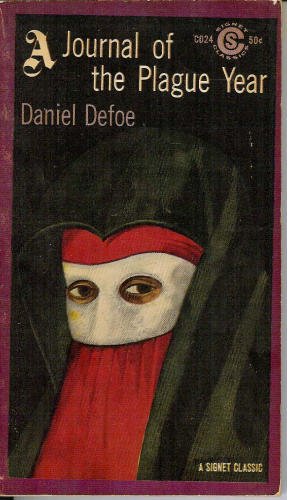
But he rebounded, and was already famous before his huge success with Robinson Crusoe (1719).  His annus mirabilis was 1722 when he published not only Moll Flanders and Colonel Jack but A Journal of the Plague Year.  All three are fiction, but the Journal, deeply researched and written in the first-person, does indeed read like an in-depth work of investigative journalism.  It is a terrifying account of the effects of the epidemic disease that ran its course through the English capital in the years 1665-1666.  While attempting a tone of historical objectivity suggested by its use of statistical charts and tables, it often veers into more or less sensational anecdotes and close-up glimpses of life, and more especially of death, in the beleaguered city.  It is equally compelling in its sober account of the efforts made by the civic authorities to control the disease and in its many and varied “human interest” anecdotes.  Though ignorant of much of the important medical knowledge of our own age, both the learned and the lay grasped the principle of contagion.  The fear of contagion led to draconian ordinances by the authorities and many acts of desperate, selfish inhumanity by individuals.  Any residence known to house a sick person became a prison for all who dwelt there, its door marked with a large red cross and its locked doors guarded by civic wardens.  Most municipal services collapsed including, eventually, the collection and decent burial of the dead.

England had already been through a lot in the seventeenth century, including the judicial murder of its king, a revolution, and a bloody civil war—all related in significant part to questions of religion, including some of fairly far-out radical millenarianism.  The Plague struck in 1665.  In 1666, even before it had fully run its whole course, the Great Fire destroyed the center of the city, rendering thousands homeless.  For those of a mystical or superstitious turn of mind, this could not be coincidental.  The year told it all: the sum of the millennium (1000) and the apocalyptic Number of the Beast (666).  I first became aware of this bizarre aspect of the episode when I was writing about the spiritual healer Valentine Greatrakes in my book The Dark Side of the Enlightenment.  Defoe, though a great believer in Providence—the sort of minimalism eighteenth-century version of God working in the human realm—indulges none of these extravagances directly.  The work as a whole, however, reverberates with apocalyptic suggestion.

In retrospect Camus’s imagined plague had been announced beforehand.  People began finding dead rats all about them, first by the dozens and then by the hundreds.  “People out at night would often feel underfoot the squelchy roundness of a still warm body.  It was as if the earth on which our houses stood were being purged of its secreted humours—thrusting up to the surface the abscesses and pus-clots that had been forming in its entrails.”  In eighteenth-century London, where the rotting remains of small dead animals constituted simply one genre of the offal that clogged the sewers, only a surfeit of human corpses as announced in the parish “death bills” could sound the alarm.  Our own epidemic is said to be still in its early days, but I daresay there are already dozens of novelists drafting the outlines of their next book.  Perhaps that in itself is a sign of difficulties ahead.


Wednesday, March 25, 2020

The Tissue Issue


Medieval philosophers and moralists in the Platonic tradition used a strange Latin phrase to describe what they took to be the disorienting deceptiveness of the empirical world.  They spoke of the regio dissimilitudinis, often translated into English as the “land of unlikeness”.  In the land of unlikeness moral reality is strangely deformed.  Our wounded human nature often seduces us into desiring what is actually bad for us and generally behaving in self-destructive ways.  A passage in Paul’s letter to the Romans—“For the good that I would I do not; but the evil which I would not, that I do”—was frequently cited in this regard.

            This appears to me to be related not merely to Plato’s myth of the cave but to the “mind/body problem” of modern secular philosophy; and quite apart from any theological super-structure, “land of unlikeness” seems a most evocative term to describe the strange world that we have suddenly been thrust into by a frightening pandemic.  I read this in the Times: “An Arizona man and his wife ingested a fish tank cleaning additive made with the same active ingredient as chloroquine phosphate, which President Trump has referred to as a ‘game changer’.”  The result was a definitive change in the man’s game.  He died.

            Less lethal though scarcely more comprehensible has been the run on toilet paper.  One of my first illuminations of the opacity of the regio dissimilitudinis into which the coronavirus was leading us was a journalist’s photograph of the bare shelves, only recently laden with cubic yards of toilet paper and paper towels, of a stripped Walmart.  According to the article it accompanied, two women had engaged in an unseemly battle over the last megapack of Charmin.  Nature red in tooth and claw!  My own unseemly response to the unseemliness was to rush immediately to Amazon.com.  Items temporarily unavailable!  My ancestors got along perfectly well with corncobs and the pages of old Sears catalogues for this sort of thing, but, but….I then recalled an anecdote that suggested there was something particularly American at work here.  It will take a couple of paragraphs of needed context.

And when she went there, the cupboard was bare

When I was a student at Oxford sixty years ago, I enjoyed the benefits provided by an extraordinary service organization called the Dominions Fellowship Trust.  I believe that it no longer exists, and I have not been able to come up with much information about it using the techniques of quickie research.  But it had been active during World War II in a “hands-across-the-water” sort of way to offer comfort to American and Commonwealth airmen—especially volunteer fighter pilots and the bomber crews who flew on thousands of missions beginning with the Battle of Britain and, later, the massive American bombing raids on the German heartland.  These men were offered invitations to spend recuperative leave in various country houses scattered about the British Isles, including several of the Downton Abbey variety.  The war ended, but the Trust continued for a time to operate.  Its administrators, seeking high and low for suitable surrogates for shell-shocked ball turret gunners, came upon Rhodes Scholars.  They were from America and the Commonwealth nations, and by all appearances some of them were pretty shell shocked.

The vacations at Oxford are ample—three eight-week terms are punctuated by two vacations of six weeks and the “long vac” of the summer.  There was more time for foreign travel than money to sustain it, and I personally enjoyed numerous gratis baronial rustications, including one at Glamis Castle, famous in Macbeth.  But there was one place to which I made return visits, at Coldstream, in the extreme south-east of Scotland near Berwick-upon-Tweed.  It was a modest country estate belonging to a collateral branch of the Sitwell family, to which the famous siblings Edith, Sacheverell, and Osbert (none of whom I ever met) belonged.  I became quite friendly with my hostess, Elizabeth (Betty) Sitwell—at least to the degree that a youth from Arkansas and a middle-aged eccentric English grande-dame can be friends.

England at the end of the ‘Fifties had not yet entirely emerged from the rigors of wartime austerity.  I rarely found myself in an adequately heated room or house.  Cramped, chilly bathrooms were the national specialty, and most plumbing features struck an American as archaeological.  The default toilet paper in many domestic as well as all public toilets was something called “Bronco”—packaged in small and apparently impermeable and anti-absorbent waxed sheets.  I never did grasp the engineering design concept.  I suppose it was slightly better for its designated purpose than Saran Wrap, though not by much.  The bathroom of my quarters in the Coldstream mansion, on the other hand, was quite magnificent.  The toilet paper was real, American, on rolls, and abundant.  There were always no fewer than ten unopened rolls in clear sight in a little cabinet.

I eventually became sufficiently comfortable with my hosts to raise these somewhat forbidding topics in conversation.  When I jokingly congratulated my hostess on her American toilet paper she told me the following story.  Her late father, an industrialist, had been great friends with some American counterparts.  When war broke out in 1939—at first without notable hostilities—there was a large Anglophilic movement among the upper crust of New York moneyed society to demonstrate solidarity with France and Britain, especially the latter.  The wife of one of Sitwell’s American industrial buddies was particularly zealous in organizing these efforts.  This lady was sure that there must be many indispensable items—coffee, sugar, chocolates, woolen underwear, Pall Mall cigarettes?—that wartime conditions would soon render difficult of access.  Could she ship some of these items?  The thing was, the Sitwells didn’t really need anything. They lived in a stately home and burned forty tons of coal every winter.  But the New York benefactor was importunate, and the father, to be diplomatic, suggested that the charitable lady herself pick out a few things “of the sort you think most necessary.”

Time passed, and the Sitwells forgot about the whole thing. Soon they really did have other things to think about.  In May of 1940 the “Phony War” ended with the German blitzkrieg through Belgium into France.  By the beginning of June the shocked Brits were desperately evacuating Dunkirk.  One day a few weeks after that a telephone message informed the Coldstream mansion that a freight car of goods was waiting to be claimed on a siding at the Berwick station.  “What is it?” asked the befuddled butler.  “It seems to be mainly—mainly toilet paper” was the astonishing and as it turned out inaccurate reply.  Because it was only most of a box car and entirely toilet paper.  If I could believe my hostess, the household and “half the village” had been slowly working its way through this stockpile for the last twenty years.  “That’s how I learned what Americans consider ‘most necessary’,” she told me.  “We were of course most grateful.  Now we can defecate securely until Doomsday.”