Tuesday, January 28, 2025

Henry Frowde, OUP


I am emerging from a bad week during which some nasty virus drove me to my bedroom.  The actual bedroom is surrounded by books, one of which I grabbed more or less at random.  It turned out to be the “Oxford Dante”—the third edition of this work (1904) first published in 1898.  It was edited by one great Dante scholar, E[dward] Moore, and with an appended index by an even greater one, Paget Toynbee.  This is a no-nonsense book, 490 pages in small type, every word that Dante was known to have written either in Italian or in Latin, but not a word of English anywhere.  The popularity of the great Italian poeta in Edwardian England can perhaps be judged by the publication history; this daunting volume was a best seller.  I still need a crib in reading Dante; but Victorian matrons dived right in.  I didn’t even try to read in it, but flipped through its pages, marked only in a few places in the Latin treatise “On Monarchy,” but there very crudely in ink and a sloppy hand.


The other personal name in the front matter of the Oxford Dante (in addition to those of the two learned editors) is that of Henry Frowde, “whose name will long be remembered as the one who by sterling character, untiring energy, and conspicuous ability, made ‘Oxford University Press’ world famed.” His name may ring a faint bell for anyone who has consulted an old OUP volume, for it is in so many of them.  It offered me the necessary tangent to avoid any serious reading.  Frowde joined the Press in the 1870s, and he was for many years its production manager.  In this volume this name is actually given as Enrico Frowde, but a less “Enrico” sort of a fellow would be hard to imagine—presuming that name leads you to think of a famous opera tenor or an infamous Florida murderer.  Mr. Frowde was a reserved, very old-fashioned and erudite English Pietist who followed the practices of the Plymouth Brethren.  Only incidentally was he a genius at the book trade. 


His particular expertise was the Bible business; and Bibles and prayer books were an important part of the early university press’s bread-and-butter production.  It was this expertise that got him hired by the Oxford University Press. In his first year he supervised the production of a half a million copies, an output he more than doubled over the years.  The OUP retains to this day an important segment of this market, though far better known for both its large “trade book” business and the aura of the highest possible academic prestige.  American academic presses can but wish.  Maybe they ought to consider selling quality Bibles.  As a very young man Frowde was hired at Oxford.  Even at the turn of the twentieth century, the best-seller of best sellers was still the Bible, and Frowde was taxed with this side of the university press’s business.  The tenor of British publishing in those years can be judged by a couple of extraordinary events.


The book world of 1877 was enlivened by the quatercentenary celebrations of Caxton’s introduction of printing to England.  For this bibliophilic festivity Frowde supervised the exhibitionist production of the “Caxton Bible”.  That is, he oversaw the creation of a whole substantial book—printing, collating, sewing, binding , the whole works--in a single day.  Printing began on the Oxford presses at 2 a.m.   (The type of course had been set in advance).  The printed sheets were rushed by train to London, where expert workers stood ready to do the folding, rolling, collating, gilding and binding in Morocco leather.  By 2p.m. gleaming copies were at the headquarters of the Caxton festivities in Kensington!  Mr. Gladstone declared this the most stupendous event in the history of printing!  I have never been able to find an affordable copy.


But this was merely a warm-up for the high-jinx attendant upon the printing of the Revised New Testament in 1881.  Its printing was conducted with military secrecy and security.  The frenzy to get an advance copy was intense, not to say insane, with offers reaching the equivalent in today’s money rumored to approach $300,000 for a copy!  Americans were particularly importunate.  But the sacred security of the publication of the sacred text triumphed.  Long lines awaited the opening of bookshops on the appointed day—a sort of bibliophilic Filene’s Basement on Black Friday.  The exact number of copies sold on the first day is unknown, but it was obviously huge.


The type blocks were sent on locked galleys to America by the fastest ship available.  During the trip typesetters continued working.  But of course that got the text only as far as New York Harbor.  The whole of the Gospels, the Acts of the Apostles, and the Epistle to the Romans (totaling 118,000 words) were telegraphed from New York to Chicago at a vast cost, and appeared in the Chicago Times of 22nd May, 1881.  Similar frenzies attended the later publication of other parts of the Revised Bible.  Mr. Frowde presumably looked on with approval and pleasure, appropriately restrained of course. 


Tuesday, January 21, 2025

Mandator in Chief


I am beginning this essay on Inauguration Day, which by co-incidence happens this year to fall on the day when the nation honors the great civil rights leader Martin Luther King.  King’s  parents named their son after one of the world’s most famous protesters, who is often credited indeed with being the wellspring of the tremendous and consequential movement we call the Protestant Revolt or Reformation.  This history is perhaps particularly relevant for us Americans, whose national origins are intimately connected with the activities of principled Christian protesters.  In any event, one senses contradictory hopes and fears gripping the nation.


In many parts of our nation, including this one, a serious winter chill has descended.  The current outdoor temperature is 18 F (about minus 8 Centigrade, or as the translations of Russian novels I read used to say, “fourteen degrees of frost”.  The temperature will probably fall lower over the next two nights.  The New York Times has given up on even trying to deliver our copy; they kindly sent me an email with the news.  I had an odd experience, possibly relevant to the moment,  in the middle of the night, around 3:00 a.m.  When I went to bed snow was falling.  When I arose briefly about 1 a.m. out of necessity, the snow had ceased, but I could see from my window that there were two or three inches.  About an hour later, having returned to the arms of Morpheus,  I became aware of faint scraping sounds from the patio region behind the house.  My first reaction was that it must be an animal.  If so, it was a very persistent one.  In fact, it was a young Hispanic man, M. S., who does regular yard-work for us.  He was removing snow from parts of the blue-stone patio.  I later discovered that he had already also cleared the driveway, the street fronting, and the path from the street to the front door.  The snow was not deep, and it was easily enough removed I suppose; but even that much shoveling would have tested me to the limit—if I could have done it at all.  I deduce that his absurdly early appearance could be explained because he had several others on his list.  He’s an entrepreneur, a go-getter.


From time to time I have friendly but superficial conversations with this young man, whose work ethic I admire.  I think he may be an American citizen, though I don’t actually know.  If a non-citizen, he is probably a “documented” one, but again I do not know.  I do know that the idea that anyone would not want such a person in this country seems to me mad.  I have been sufficiently unfortunate over the past several years to have several hospital visits, some with short hospitalizations.  On the other hand, I have been fortunate enough to be near an excellent hospital offering excellent care.  My experiences suggest to me that our much-vaunted medical services would probably come to a grinding halt without the often inglorious work done by dozens of people who look more or less like M. S. working in our heath facilities.


I was writing these desultory paragraphs while sort of watching the preliminaries to the presidential inauguration ceremony.  It is now another day, and I move on to the Inauguration ceremony itself.  I was rather moved by the semi-operatic rendition of the “Battle Hymn.”  As a child I heard it frequently, sung by my three aunts and their mother, my paternal grandmother, the daughter of a Union veteran and an old-fashioned kind of American patriotic woman.  It is not called a hymn for no reason. But it certainly is a sombre hymn.  The coincidence that this year brought together the inauguration of a new president and the memorialization of Martin Luther King was striking and worthy of a second thought.  The “beauty of the lilies” hardly describes what we for so many months have seen on our screens.  Furthermore the poetic ideal of the efficacy of sacrificial death is of course paradoxical, puzzling.  But as a call to something higher, nobler, better—it seems to me magnificent.  I had allowed myself to at least entertain hopes for a more irenic presidential speech, but the hope was too tentative to be dashed when it failed realization. That made me a little sad, but what I thought was sadder was Mr. Biden’s plausible belief that he had to shower his kinfolk with preemptive pardons to protect them from a distempered revenge.


In the recent election, in which Donald Trump prevailed over Kamala Harris—an election in which we were repeatedly admonished that “democracy is on the ballot”—only about two thirds of eligible voters actually cast ballots.   This was a higher proportion than in some earlier years, but hardly a demonstration that more voters than usual thought that democracy was on the ballot.  Another way of saying this is that a third of eligible voters did not vote.  The total popular vote, though unambiguously in Mr. Trump’s favor, was not a landslide.  It was pretty close.  In the terms of election criteria established by the Constitution—electors distributed among the individual states—Trump’s victory was more resounding. But the President is the president of all the states, and all the people in them—a fact that he has from time to time acknowledged.  He may need frequent reminders.  He apparently spent the afternoon issuing directives, at least one of which (concerning birthright citizenship) appears to my unlawyerly eye illegal.


Much of the world, including parts of our own land, is under duress.  But amidst all the troubles there are reasonable hopes and real opportunities.  The American president—and I mean whoever holds the office of the presidency—faces truly awesome challenges and responsibilities.  Our democracy operates through professional politicians not philosopher-kings.  Once in a while, almost accidentally, we get something close.  Abraham Lincoln could say and mean “with malice toward none, with charity for all.”  That “all” conspicuously included those who had shattered the republic and made war against it.  You might say they had weaponized the weapons system.


 We cannot hope for another Lincoln just now, but we can hope that what needs to be checked will be checked and what needs to be balanced, balanced.  Presidents have not infrequently been told they cannot do things they want to do.  American presidents have over the years tried to claim and exercise more and more power.  Schlesinger’s The Imperial Presidency dates from 1973, from the time of Nixon.  Well before that, Franklin Roosevelt spent a good deal of time in his first term being told by the Supreme Court that this, that, or the other of his desires was unconstitutional.  That is why he proposed, unsuccessfully as it turned out, expanding (or as others called it packing) the court’s membership in order to achieve an accommodating majority.  The idea was much more recently floated by various Democrats, and is likely to reappear again.  In the meantime, the law on how we make laws is this:  Congress proposes legislation, requiring the agreement of both houses; the proposed legislation is then either agreed to by the president, who must sign it, or rejected (vetoed) by him/her.  A presidential veto can be overcome by a super majority of two thirds in both houses of Congress.  My real fear is that Mr. Trump’s cavalier executive order doing away with birthright citizenship is based less in tyrannical appetite than in ignorance.  I fear he may not have known such citizenship is established by the Constitution, but perhaps he does by now.


Wednesday, January 15, 2025

Los Angeles, Burning


On Saturday our excellent friend Frank drove us into New York to visit the Sienese painting exhibition at the Metropolitan Museum.  The exhibition will be up for only a couple more weeks, so that it was perhaps a little more crowded than I would have liked, but of course the paintings were magnificent.  It is a matter of wonders.  The paintings themselves are individual treasures, and it is wonderful to me that, even in old age, I am still privileged to see such beautiful things entirely new to me.  Ordinarily, a visit like this would inspire me to write a little essay about them.  Even so this week my attention has to be directed elsewhere.  It must be comparatively rare for a couple of octogenarians living in a quiet corner of an east-coast college town to be privy to fairly earth-shattering events playing out some twenty-five hundred miles to the west, but that is the situation we are in.  I am referring to the destructive wildfires, fanned by strong winds, that have been hop-scotching through some of the tonier areas of northwest Los Angeles, and particularly the neighborhood of Pacific Palisades.  They have captured the whole world's attention, but we perhaps have a special interest.  Immediately to the east of some of the incinerated mansions is the Getty Museum, which is distinct from though obviously related to the Getty Villa, a huge waterfront house that back in the day was the tycoon’s private residence.  After additions and modifications the Villa now houses most of the institution’s significant holdings in ancient Greek and Roman artefacts.  Our daughter Katherine is the President and Chief Executive Officer of the J. Paul Getty Trust, and among the most fundamental of her responsibilities, and certainly an awesome one, is the guardianship of these world treasures.  Both the Getty Center and the Getty Villa have been threatened—indeed continue to be threatened—by the fires.  Naturally these circumstances have given us a particular interest in the ongoing national calamity playing out in and around Los Angeles.


Between the classical holdings of the Villa and the much larger and eclectic ones in the Getty Museum on the main campus—an enormous museum surrounded by specialized libraries, conservation ateliers, etc.—a serious fragment of the artistic heritage of our human species has been under threat by wildfire.  One can hardly imagine the urgency and anxiety that Katy and her colleagues have been facing—so far with good success, thank God.  And speaking of the deity, the concept of the act of God—that is, a disturbing event for which no specific individual human responsibility can be plausibly assigned—seems to be waning in the collective litigious consciousness.  The mayor of Los Angeles is facing finger-wagging for having been in Ghana at the time disaster struck, though it is not clear to me that her absence exacerbated an eighty-mile-per hour firestorm, let alone was its cause.  Cnut couldn’t control the tides, and he was a king.  We hope for demonstrable competence in our elected officials, but too many of them are satisfied with the first and indispensable ability: to get elected.  Even so I would hope that the rancor of our recent election season might end, and that we might sympathize with, perhaps even grieve for, our fellow countrymen in such manifest distress.


But this cataclysm has set me on a trip down memory lane, for as a kid I lived briefly in various places in California—including Los Angeles, though not in one of its classier quarters.  We lived in the neighborhood called Westchester, at the time one of the city’s modest but salubrious areas, though very near the airport which even then (circa 1950) seemed to have large, noisy planes coming or going every five minutes.  It was a simpler world.  I remember that my father bought a new Chevrolet—the only brand new car I had ever seen up close—for what seemed to me the astronomical price of a thousand dollars!  At that time I had no first-hand experience of the gold coast neighborhoods that have been in the news on account of their actual or prospective incineration.  The O. J. Simpson trial brought the prophetically named Brentwood to the world’s attention.  And I had a distinguished medievalist colleague and friend who taught at UCLA and whom I visited a couple of times at his fabulous house on toney Outpost Drive where, I learned, several of his near neighbors were movie stars and celebrity “adjacents”.  There was a later episode that for a while had the fancy houses of fancy people in that part of L.A. featured in the national press: that of the “Bling Ring”.  A group of overprivileged young people valiantly battled against their existential ennui by breaking into the houses of rich and famous people, more or less incidentally stealing valuable garments and other gaudy upscale souvenirs.   As I recall, they made a particular victim of Paris Hilton, confusing me, as I at first thought that was a hotel but was actually a person.  Indeed, I believe I saw just yesterday a report that Ms. Hilton’s house has burned to the ground, though it might not have been the same residence as that of the Bling Ring era.


The social, cultural, and economic prestige of a comparatively small number of the fire’s victims has attracted the attention of the popular press; but that should not disguise the fact that this terrible event is a true national human disaster affecting many thousands of our fellow citizens.  Indeed, it may take a good deal of time to absorb the implications for one of the world’s great cities.  And while it may not be a second Lisbon earthquake—the terrible event that challenged the bourgeoning optimism of the heirs of the European Enlightenment—it is necessarily a lugubrious reminder of enduring human limitation and fragility in a world we only pretend to own.


Wednesday, January 8, 2025

Words and Things

Costa Arms 

Many of the most stimulating books I have ever read were written more than a millennium ago, but in thinking about old books, and especially in trying to teach them to undergraduates, I often found they benefit from some introductory explication.  This essay will have a modest topic—words and things and some of the relationships between words and things.  I want to start with a book written by Saint Augustine at the turn of the fourth and fifth centuries.  Augustine’s book has a simple and possibly misleading title, De doctrina christiana, On Christian Doctrine.  A better title might be Teaching in a Christian Manner.  Its subject, to use a very fancy word, is hermeneutics, or the interpretive principles that should inform reading, in this instance the study of the Bible.  You might describe it is as a preparatory handbook for people trying to read, understand, and teach the Bible.  But its general principles are relevant even to my light-hearted subject: rebus puzzles.


This little book of  Augustine’s theories was produced in his role as a Christian theologian—meaning, for him as a student of the Bible—but it has been admired by students of linguistics in general.  The terms “semiotics” is a catch-all term for the various kinds of sign systems with which we are familiar, among which  human language is obviously prominent.  With regard to sign systems in general, Augustine makes a distinction between natural and conventional signs.  His book begins with the assertion that all teaching (doctrina) is necessarily about one of two subjects: things and signs, res and signa in Latin.  By very rough analogy you might think of res/things as the world of science, and of signa/signs as the humanities.  He makes a second binary distinction.  There are two categories of signs, natural signs and conventional signs.  There is no smoke without fire—that is, smoke “signals” fire in all places in the world.  It is a natural sign of fire.  But the word fire which, signals the same reality as smoke does, is a word in the English language, its meaning agreed to by convention among English-speakers but by no means “naturally” obvious to those who do not speak English.   Other words “for” fire include ignis, pyr, fuego, ogieÅ„, brand, and so forth, but they “mean” fire only within the delimited range of conventionally agreed upon shared languages.  Despite what many Americans seem to think, simply raising the decibel level of English to a shout does not make it universally comprehensible.  Nobody "naturally” knows what the word “fire” signifies.


                       “Gift” is a pleasant word in English.  In German the 
lexically identical word means “poison”.  So if somebody gives 
you a gift, hope it is in Birmingham rather than Berlin.  For 
there are many distinct human languages.  The common 
domestic animal we call in English a dog is called a chien 
in French, a perro in Spanish, and a hund in German.  There 
is no universally understood word for dog, not even “bow-
wow”—though there is an actual “bow-wow theory” that
posits the origins of human language in the imitation of
birdsong and animal noises!  Human language is a sign 
system.  


                  But as someone interested in pictorial as well as linguistic signs, my mind just now turns to a genre of signs in which the pictorial and the verbal are intentionally  yoked.  I refer to rebus constructions.  The word rebus is in Latin the dative or ablative plural of res (meaning things).  So a rebus is a verbal construction in, by, or with things  The following is a dictionary definition of a rebus: “a representation of words or syllables by pictures of objects or by symbols whose names resemble the intended words or syllables in sound; also, a riddle made up of such pictures or symbols”


Of course, rebus puzzles are founded not merely in language, but in particular languages.  Many old aristocratic families in Europe, who often had Latin mottoes, also constructed rebuses as well.  Some of these will seem far-fetched to us now.  But in theory a rebus can be constructed in any written tongue.  In English many common words are homophones—that is, words which, whatever variations they may display in their written forms are indistinguishable in their pronunciation: for example, the first person singular pronoun (I) and the ocular organ (eye).  If you wish, you may add the now mainly obsolete expression of assent or agreement, as in “the ayes have it.”


On the south coast of Long Island is the old town of Islip.  Its European settlers arrived early, and it claims its civic foundation in 1683.  In Old England the Islips were a many-branched family, and there is at least one village of that name I have visited (in Oxfordshire) and some others recorded on maps.  The Islip family had several notable branches.  I believe that an Islip was one of the last abbots of Westminster Abbey before the dissolution, for example.  Today the people who live on Long Island are more likely to call the place “Iz-Lip” rather than “I-Slip,” but check out the official town coat of arms.  You do need to know that as a technical botanical term the word slip denotes to a small plant cutting, or leafy twig, especially one made for purposes of grafting. 


There is endless fascination, most of it pretty light-hearted, in rebus constructions, which might fairly be described as visual puns, and this thought can bring me to my slightly digressive conclusion.   The words name, nomen, and noun are first cousins, and many rebus constructions exploit the relationship.  According to the poet Pope puns are the lowest form of humor, but some very witty people have not hesitated to play around with their own names in serious ways.  The heraldic shield at the top of this essay is that of the very extensive clan of Mediterranean families called “Costa,” a word with several meanings in several Romance languages.  But the primary meaning in Latin is rib.  The possibly strange marks on the shield are meant to signify the residual bones of cleanly picked beef or pork ribs!  The name was frequently adopted by or forced upon Spanish and Portuguese conversos—Jewish families converting to Christianity by election or by coercion!  The English “metaphysical” poets of the seventeenth century are so-called because of the sometimes extravagant “wit” of their linguistic formulations.  The greatest of them, John Donne, in what one might call a “rebus-adjacent” poem wrote one of his deepest theological meditations in a deceptively simple three-stanza poem built upon his own surname as past participle, with an implicit pun on the Latin word perfectus. meaning complete, finished, or done.


John Donne: A Hymn to God the Father

Wilt Thou forgive that sin where I begun,
Which was my sin, though it were done before?
Wilt Thou forgive that sin, through which I run,
And do run still, though still I do deplore?
When Thou hast done, Thou hast not done,
For I have more.

Wilt Thou forgive that sin which I have won
Others to sin, and made my sin their door?
Wilt Thou forgive that sin which I did shun
A year or two, but wallowed in a score?
When Thou hast done, Thou hast not done,
For I have more.

I have a sin of fear, that when I have spun
My last thread, I shall perish on the shore;
But swear by Thyself, that at my death Thy Son
Shall shine as he shines now, and heretofore;
And having done that, Thou hast done;
I fear no more.


Wednesday, January 1, 2025

New France & New Year

Christ Church Cathedral, Montreal


            Primo, our heartiest New Year greeting to all.  We have just returned from the journey advertised in my “Christmas” post, a brief visit to the Montreal branch of our family—son Luke, daughter in law Melanie, and grandkids John Henry and Hazel.  Most clichés concerning grandchildren happen to be true.  They are delightful, and they grow very fast.  If they live at a distance from you, you probably don’t see them often enough.  So our reunion was joyous.  The holiday was quite white, deeply chill, and marvelously mellow, its chief achievements being gastronomy, the completion of an impossible jigsaw puzzle from piece one to piece one thousand, and attendance at one or two (I being one of the slacking oners) festival eucharists at Christ Church Cathedral.  There was a nearly Dickensian richness to our festivities, but mainly without the Dickensian schmaltz.  It is hardly more than four hundred miles from our house to theirs, but age and infirmity conspire to make the journey a real trial for me, and therefore something of an accomplishment.  I have pointed out before in these pages the linguistic spoor that links French travail (labor, work) and English travail (taxing difficulty, the pains of a birthing mother).  In earlier epochs almost all journeys required hard traveling.  But in earlier times grandchildren generally lived close by.


French Canada is not far away, but it is always surprising to me.  The kids, who are of course in local schools are now naturally bilingual.  Unsurprisingly, our recent American election has generated some awkward international results, and the presumption of some major international politicians is often enough to shock us. Being a good neighbor is not always easy, and being a neighbor to the United States has its special challenges.  Somewhat more than a century past the revolutionary Mexican President Porfirio Diaz thus lamented his country’s situation: “Poor Mexico!  So far from God, so close to the United States!”  In our day Donald Trump, whose activities as a troll qualify him for a prime residential lot beneath the Brooklyn Bridge, has taken as his target the Canadian prime minister, Justin Trudeau; but his crude hauteur may seem a model of moderation when compared with the behavior of some Renaissance potentates, secular and religious alike.  Naturally certain episodes from history invade my historical mind.  Consider for a moment the Treaty of Tordesillas (1494) brokered by Pope Alexander VI between the kings of Spain and Portugal.  (Tordesillas is a little place in north-central Spain not far from Valladolid.)  The treaty established a longitudinal line running from the top of the globe to its bottom, 370 leagues west of the Cape Verde Islands. This line divided the known world into two areas, with Spain claiming ownership of all non-Christian lands west of the line, and Portugal claiming all non-Christian lands east of the line. 


The principal maritime powers in Europe at the end of the fifteenth century were Spain and Portugal, both of which had been busy claiming insular properties newly discovered or at least newly colonized in the North Atlantic Ocean.  The Western coast of Africa was already somewhat known territory to Iberian sailors when Columbus (a naval agent of the Spanish monarchy) threw a spanner into the works by coming across what he assumed to be India but was in actual fact the huge land mass comprising the continents of North and South America.


The Pope thought that it was important for the peace of Christendom that the rivalry between the Iberians be regulated; so with staggering presumption he proposed that all the “new” territories being found in the “New World” be equably divided between them for the purposes of pacific commerce and of course evangelism.  


This may have been the most stupendous real estate transaction ever effected.   Quite apart from the absurdity of assuming a freehold claim to two vast continents, the arrangement had what seems in retrospect one glaring peculiarity: the peculiarity of Brazil.  Because of the way Brazil’s upper eastern bulge extends far into the South Atlantic, it was counted among the new provinces of Portugal rather than of Spain.  I doubt that the principals realized Brazil was also destined to make up roughly half of the total land mass of South America.  This scheme, though satisfactory to the Iberian potentates, failed to satisfy some other important Europeans who, by chance, did not live in Spain or Portugal.  Needless to say, what the large populations who already lived in the Americas thought was not an issue of discussion. And it is only natural that the Pope’s tidy plan failed to satisfy a number of important players in Europe who had been left out of it.


And in fact the histories of European expansion in the northern sections of the New World would be determined not primarily by a contest between the Iberians but by a later one between France and England.  Competition in land claims among the European powers was brisk but such claims could in the long run be secured only by significant colonization and credible military backing.  France’s plausible land claims in North America were enormous, including Newfoundland and Labrador, the Great Lakes, and the Mississippi River. This land they called New France. 


But the French colonial experience in terms of Francophone settlement in America never approached the level of French territorial claims.  Tentative Francophone settlement was effectively limited to a few places in southern Illinois and, especially, Mississippi River and coastal sites surrounding New Orleans.  Actual French-speakers are few in contemporary Louisiana, and the number is declining rapidly.  The contrast with Spanish speakers is dramatic.  It is significant that the huge American land purchase of 1803 (more than eight hundred thousand square miles of land) is called the Louisiana Purchase despite the fact that the area called “Louisiana” is a small fraction of the land purchased.  Maybe this was history’s second greatest land deal.  And since there was an actual exchange for money—however paltry in retrospect—it plausibly can be described as a land deal rather than a land-grab!


We tend perhaps to think of our early American history from too narrow a view, but our national formation was in part an episode in the large and complex picture of the intense European rivalries working their way out on the North American Continent.  The major work of one of America’s greatest early historians, Francis Parkman, the erudite and eloquent author of France and England in North America (1892), is as exciting a read today as when it was published in the nineteenth century.  And Parkman is in print in the Library of America.


Monday, December 23, 2024

Christmas Greetings

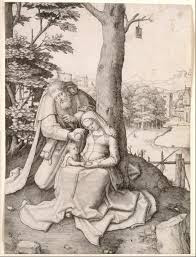
Lukas van Leyden

    A foolish consistency is the hobgoblin of little minds, adored by little statesmen and philosophers and divines.”  You may regard this utterance itself as a bit hobgoblinish, but of course it is not my own but that of one of America’s first great thinkers, Ralph Waldo Emerson.  I invoke it now to salve my own conscience and perhaps attenuate potential embarrassment.  I have for many years now been rather punctilious in mounting a essay on a regular weekly schedule--more or less on the basis of "come hell or high water".  What I have tried to transform into  a moral virtue I now perceive rather along the lines of a foolish consistency, resulting not infrequently in essays of more than usually dubious usefulness.

    So here’s what’s up.  Later this morning Joan and I are flying to Montreal to spend the Christmas holiday with Luke and Melanie and our grandkids John Henry and Hazel.  Travel even so modest as this is a big deal for us old folks, and I want to devote my full attention to getting to Montreal and back and, more importantly, to enjoying our time there.  Although I am in theory as glad as ever to learn and to teach, there will be no post on Wednesday the 25th, Christmas day.  The odds are perhaps better for Wednesday, January 1st, 2025, but even that is provisional.  So let me take the opportunity right now to wish all my readers a Merry Christmas and a Happy New Year.  For what it’s worth I am also throwing to the winds a positively epic unbroken streak on Duolingo.  Why do I have the odd feeling, so portentous in my own minds,  that perhaps these developments are actually ones the world will little note, nor long remember, as somebody or another memorably put it?


Wednesday, December 18, 2024

Urn Burial


Joan is a member of a club in town called the “Old Guard,” a name perhaps suggesting the age but not necessarily the distinction of its membership.  It is in fact a group of men and women of retirement age, many of whom have had distinguished careers in what I shall call the world and have carried into their retirements not merely a great deal of varied life experience but intellectual vigor, imagination, and sociability.  I am not a member, though I now and again scrounge an invitation from my spouse to the weekly lectures that seem to be the group’s chief raison d’être.

            The lecturers come from far and wide, but this is a college town, and Princeton faculty members are not infrequently recruited.  A slightly odd feature of faculty life is that though you are surrounded by eminences in many fields, you do not ordinarily get to hear them lecture. 

The lecturer at the most recent meeting, Anthony Grafton, an internationally famous historian, who is in his last year before retirement, happens also to be my long-time friend and close neighbor.  He is a brilliant scholar and extraordinary teacher.  In this dazzling and highly entertaining lecture, he drew on materials from a recent book co-authored with Maren Elisabeth Schwab and entitled The Art of Discovery in Renaissance Europe: How Scholars and Artists Learned to Dig into their Past (Princeton, 2022).  It was about the birth and early history of antiquarianism and the antiquaries who practiced it.  Tony was dealing mainly with Italian and other continental scholars of the fifteenth and sixteenth century, but he brought to my mind an eminent Englishman of the seventeenth.  I refer to the Norwich physician-philosopher-theologian Sir Thomas Browne, the famous author of the Religio Medici.  Slightly less known, though inescapably brought to my mind by Tony’s wonderful lecture, is Browne’s Hydriotaphia, Urn Burial, or a Brief Discourse on the Sepulchral Urns late found in Norfolk (1658), generally regarded among the greatest monuments of English baroque prose.  One early European mortuary practice was the burial of the remains of cremations in small caskets, boxes and ceramic vase-like jars.  This practice has survived in many cultures, and could be said to be flourishing as cremation has become more commonplace in western countries.  Browne’s title tells it all while telling nothing.  His essay starts out being “about” some ancient burial urns found at Walsingham, Norfolk, in 1658. but soon turns to life, death, and the Meaning of It All.  Browne is widely admired as the greatest writer of baroque English in our literature.  In a passage redolent of the ambiguous anthropology touched upon in last week’s essay, Browne thus summarizes the human condition: “But man is a Noble Animal, splendid in ashes, and pompous in the grave, solemnizing Nativities and Deaths with equal lustre, nor omitting Ceremonies of bravery, in the infamy of his nature. Life is a pure flame, and we live by an invisible Sun within us.”


Sir Thomas Browne (1605-1682)
 

Even for a very great writer, the exhibition of mannered language runs the risk of peer censoriousness.  Ben Jonson was highly critical of the language of the Faerie Queene.  “Spenser,” he wrote, "in affecting the ancients, writ no language: yet I would have him read for his matter.”  Another censorious Johnson (Samuel) made similar remarks about Browne’s prose.  Hydriotaphia cannot be said to be written in no language, but it’s English that no other major writer ever achieved or even very nearly imitated.  The learned neologism of the title itself (a combination of Greek “water jug” and “burial”) is a typical Brownism.


 Iron Age burial urn and contemporary religious ashes urn


Browne was an antiquary but a most philosophic one.  He was genuinely interested in the funeral urns to be sure, but more as a moralist than an archeologist.  There are other notable examples in English literature.  Shelley, to a certain degree, was interested in the actual Egyptian monuments behind the idea of an imaginary statue of the Pharaoh “Ozymandias”.  But the subject of the poem is the vanity of human wishes.

According to Max Weber (and many others) the chief project of the Enlightenment, or at least its collateral inevitability, was “the disenchantment of the world.”  Plausible, but bad news to a medievalist, for there was of course considerable loss among the gain.  “There was a time,” wrote Wordsworth of his childhood, “when meadow, grove and stream, the earth, and every common sight to me did seem appareled in celestial light, the glory and the freshness of a dream”.  But--and what a sad but it is--“The things which I have seen I now can see no more.”  In another place: “Physician art thou? one all eyes, Philosopher! a fingering slave, One that would peep and botanize Upon his mother's grave?”

Prof. Grafton made the point that especially in Renaissance Italy, where ancient ruins were nearly everywhere, there was a strong tendency to associate new discoveries of old tombs and burial sites with specific famous ancient people.  The antiquaries were not big on unknown soldiers.  In my own researches I ran across several medieval tales concerning the grave of the poet Ovid—in reality a site entirely unknown and unknowable—a poetical tomb that was conveniently mobile throughout upper Italy.  (If one had to guess about Ovid’s actual burial site, as one indeed does have to, a better bet  would be coastal Romania.)  The medieval legend of his tomb has several versions, but the core narrative is this: two priests, students, or other literate types are wandering along some Italian via or another and come upon a tomb clearly marked PUBLIUS OVIDIUS NASO and try, with surprisingly easy success, to conjure up the long dead poet’s animated spirit.  They want to ask him a question.  “Please tell us, Sir,” they ask, “Which was the best line you ever wrote and which the worst?”   Old Ovid replies with two pithy lines, both of which are genuine and (this being Ovid after all) are about sex.  I’ll give the lines in abbreviated but accurate paraphrase.  The worst line: the great God decrees that whatever feels good is good.  The best line: It is virtuous to abstain even from lawful joys.  The moral calculus, of course is that of medieval asceticism.  But it is surely a rare example—I at least know of no other—of literary criticism offered not upon but from the grave.

It is not surprising, perhaps, that great historians have taken as their subject matter the written works of such of their predecessors who have written about the past.  The history of written history and of those who wrote it is endlessly fascinating.  Thomas Browne was a medicus, of the tribe “physician” that by Wordsworth’s time could invoke the scathing lines I cited two paragraphs above.  But his world was still sufficiently enchanted to invite his investigations into the mystery of “fiveness” and to speculate about the spiritual meaning of the scriptural water jars in the story of Jesus’s first miracle (John 2), the Greek word being Latinized in the Vulgate as hydrias.  One hardly knows whether to call this mode of thought semi-medieval or semi-modern; but the prose in which is it explicated is delightful.