Wednesday, October 6, 2021

A Lot of Parking


            Now that I get out and about a bit more, I begin to appreciate the extent to which my old employer, Princeton University, has continued to be on the move despite the constraints of the pandemic.  We aren’t waiting on any infrastructure bill.  Bulldozers everywhere pave the way for new voyages of restless minds or, in some instances, simply pave the way.  One of the most profound educational insights ever uttered—usually if uncertainly attributed to Robert Hutchens, Clark Kerr or some other legendary prexy of the last century—involves the disparate priorities of major stakeholder groups within a university.  “All the undergraduates are interested in is sex.  All the alumni are interested in is football.  The faculty are chiefly interested in parking.”  You see, there is a reason those people make the big bucks: educational vision.

            I joined the faculty here in 1965, and in the years since, and particularly during the years since my retirement in 2006, there are many noticeable signs of expansion: more buildings, more gazillion-dollar machines required by Big Science, more faculty, more programs and research centers, and many more administrators.  There is a carefully measured and integrated expansion of the student body underway.  I think I have figured out the algorithm behind it.  For each additional five students you need one new dean.  For each fifty new students you need one new Vice President for Whatever.  And of course all these people, and the necessary additional new ancillary staff bobbing in their wake, do need somewhere to park.  This is a good news/bad news sort of situation, and of course the two are inextricably entwined.  I’ll begin with the good news, because it is just across the street from my house.

            A couple of years ago I wrote  about what I call Butler Park, several acres immediately across the street and until a few years ago the site of an ancient housing project for graduate students dating from the 1940s.  Though all the houses were removed, the grid of streets was left untouched, and can still be found on Google Maps, which have not yet caught up with the university architects.  The housing was originally intended for married veterans, and most of the streets were named for top WW2 brass.  (Look, e.g., for King Street, Princeton NJ—Ernest King, of course, Chief of Naval Operations—but Devereux, Halsey, or Eisenhower will also get you there).  Butler Park is now a great place for a gentle walk, the general vibe being something like walking though a long decayed and romantically overgrown archaeological site or a Claude Lorraine painting.

            Meanwhile, the campus parking crisis had become acute.  The most dramatic of various steps taken to address it was to construct another multi-storey parking garage.  The rub here was that the site chosen for this new building was already a heavily used parking lot.  This meant that until new construction was completed there would be a significant net loss of parking spaces available.  Sometimes you must be cruel to be kind, but  something would have to be done on a temporary basis.  And not too far away the old Butler tract still had its grid of war-hero blacktopped streets, admittedly decaying and sprouting weed patches, along which cars had once been parked and along which even more could be parked with a little ingenuity.  A couple of weeks of quickie road repair, including the conspicuous delineation of hundreds of parking spots in bright white fresh paint, and the job was done!  We couldn’t even mumble, “Not in my back yard,” as it is in our front yards.

           
            Though I used to walk to work each day, it’s a good half hour walk.  There is no denying that this is remote parking.  No status symbol is more potent in the American university than one’s parking spot, and to be relegated to such an obscure assignment is instantly to be rendered low man on the totem pole.  It is an inconvenience with a tinge of insult, and the Vice President for Something or Other has done her best to palliate its impact on staff morale.  Very frequent mini-shuttles speed you to campus from this temporary lot.  In the morning hours you never have to wait more than seven minutes.  Even so, seven whole minutes?  Another vice-presidential brain-wave addresses this problem.  Next to the principal shuttle stop the University has parked for the duration a large, visually conspicuous Food Services truck under the supervision, during morning hours, of an amiable and experienced Food Services professional.  You can sweeten your potential seven-minute wait with a cup of coffee and a pastry (doughnut, cherry Danish, cheese turnover, or bran muffin on some kind of rota).  And it’s free!  Future potential is bright, but I have so far actually used the shuttle only twice.  On most days, however, I have been happy to consume a coffee and Danish, as my habitual long morning walk ends quite near the food truck.  So far as I can tell, no small print prohibits my initiative.  I estimate the goods and services offered by the Tiger Truck at maybe five bucks, max.  And that’s on the inflated scale devised by Starbucks and Gulf pirates.  My most recent trip on the free shuttle was to get a free flu shot offered by my former employers followed by a free chocolate donut.  The ease with which these mini-entitlements could buy my approval perhaps augurs the fate of a pending political package of three trillion in freebies.


            That’s the good news such as it is.  What, then, is the bad?  I fear it is the new parking facility itself.  It will not be the ugliest building of the year.  Sometimes you have to settle for an honorable mention.  But it is huge, brutal, and looming.  Many more people than will ever park in it will have to look at it.  It will be the landmark of the southeast corner of the campus.  This is as it must be.  There is no room here for my romantic aesthetics.  The University is responding to an urgent need.  Form follows function, and the function here is to service our national thralldom to the internal combustion engine.  But the parking garage is in a very prominent place.  I cannot complain with the philosopher Joni Mitchell that they paved paradise to put up it up.  That was done years ago by the folks who built the macadam-surfaced lot from which the new multi-tiered expansion is rising.  It is very much to the institution’s credit that its new construction includes no plans for a supplementary pink hotel, though  it is perhaps too bad that we have lost the old Fitzrandolph Observatory.   But that little edifice was already an eyesore, a decrepit relic of the Little Science of the 1930s.  Per aspera ad astra, indeed.  I think that’s supposed to mean Through hardships to the stars!  Sometimes hardtop has to do.


Wednesday, September 29, 2021

Carleton Beals and Populism


Carleton Beals


There are several ways of meeting people quite apart from shaking hands.  You can develop a sense of knowing a speaker, a musician, an actor whom you have never met and probably never will meet in the flesh.  One of my favorite ways of meeting people is through books.  That is how I just got to know Carleton Beals (1893-1979) better.  Beals was a journalist, popular historian, and radical political activist with a special expertise in Latin America, and we first “met” around 2008 when I was working on some political writers of the later twentieth century.  Our intermediary was Leon Trotsky.  By the end of the 1930s Trotsky, who had been exiled from the Soviet Union in 1929, was unequivocally at the top of Stalin’s hit list.  The master fiction of the Moscow Show Trials of 1936 and 1938 was that Trotsky had been at the center of a vast conspiracy to overthrow Communism in Russia.  The trials, which provided the background for Arthur Koestler’s novel Darkness at Noon, were Stalin’s means of destroying all real or potential rivals.  Though the charges against the Old Bolsheviks were fantastic, Stalin was sure that western radical intellectuals “would swallow the whole thing,” as he put it. 


            In this view he was largely but by no means entirely correct.  I will say parenthetically that while Trotsky had of course been a  mass murderer too, his penny-ante efforts in this field were so far outstripped by Stalin that he could seem a semi-saint to that comparatively small group of internationalist Marxist true believers who broke with the Red Tsar.  Thus “Trotskyism” was much more than a mere annoyance to Stalin.  It was a potential challenge to his hegemonic ambitions.  By now the exiled Trotsky was living in Mexico, where he was in due course assassinated by an NKVD agent, in August of 1940.  But before that happened, while the Spanish Civil War was still raging, a group of anti-Stalinist leftists had put the Moscow Trials themselves on trial in a propaganda coup.  A “People’s Tribunal” went to Mexico to investigate Trotsky’s alleged treason against Socialism.  The tribunal interrogated Trotsky at length and, after a good deal of mock legal deliberation, declared him not guilty.  The head of this blue-ribbon tribunal was the eminent, widely respected American intellectual and educational guru John Dewey.  Other members had been chosen for their expert knowledge of international progressive and revolutionary movements.  One of them was Carleton Beals, a journalist-adventurer who was neither a Stalinist nor a Trotskyite or indeed any kind of Marxist at all.  He was a Populist who had established himself as an expert on the Mexican Revolution and on radical movements in Latin America generally.  But he had felt moved to resign from the tribunal after only a few meetings.  His colleagues had been offended by the “antagonistic” questions he had been putting to Trotsky.  He had asked him, specifically, whether there had been any attempted Bolshevik meddling in Mexican politics in the 1920s.  That seemed a fair question to put to the Apostle of World Revolution, but it was not appreciated  by Trotskyites.


            What an interesting guy, I thought.  But I forgot all about him until, in my hopeless quest to understand what has been going on in our own American politics in the previous and current presidential administrations, I stumbled upon one of Beals’s many books roughly forty years after its author’s death.  It is called The Great Revolt and Its Leaders: The history of popular American uprisings in the 1890’s.*  Few book titles are more precise in their identification of an author’s subject matter.


            The book, though breezily written and journalistic in its temper, is based in extensive research.  Its broad subject is Populism.  The terms Populism and populist are common enough in current journalism, but used today with such imprecision as to render them functionally useless except as vague markers of elitist disapproval.  But around 1900 Populism was a thing, a real political party, the animating force behind important thinkers and writers, the vital spirit of influential newspapers, a vibrant expression of a genuine though now nearly vanished interpretation of the American democratic ideal.  History is replete with sad admonitions, but it also presents us with the clear evidence, if only we will accept it, of the dramatic amelioration of national and world problems which in the past rendered our ancestors virtually helpless.  During the last few months serious authors have claimed that the political divisiveness of Americans is at an all-time high, that the gap between rich and poor has never been greater, that racial injustice and antagonism could hardly be worse, and that juggernaut corporations exercise upon us a uniquely novel and malign tyranny we are incapable of resisting.  If you believe any of these things, as I myself have been wont to do, I suggest you read The Great Revolt.


            Beals was born in Medicine Lodge, Kansas, in 1893.  His father was the editor of a leading Populist newspaper.  His grandmother was the celebrated feminist warrior against alcohol, Carrie Nation.  He summarizes his book thus: “The middle western and southern revolt that came to a head out on the plains in the grim gay 1890’s was the last gasp of the dying frontier.  Two great systems—frontier America with its free lands and egalitarian democracy, and the new industrialization with its private property and the exploitation of the individual—met and clashed.”  It is “the story of that paradoxical grass-roots revolt of a dying agricultural system.”


            Beals is a great story-teller, and his stories center in the remarkable personalities of those he identifies as the “leaders” of the varied attempts to defend or restore the ideals of individual agency and egalitarianism they believed to be the essence of the early republic.  Their efforts ranged from the formation of farmers’ unions, to warfare against the gold standard, to quixotic political action such as that of Coxey’s Army, an early paradigm of the “march on Washington”.  Beals’s subjects include important thinkers like Henry George, author of Progress and Poverty, powerful if now neglected writers like Hamlin Garlin, but also a wide range of politicians, including some whose bombast often exceeded their effectiveness, such as William Jennings Bryan.  Mostly they were themselves men and women inured by years of brutal physical labor.  They were fighting against the mighty power of the trusts and the combinations, the railroads, unscrupulous land speculators, the industrial extractors of oil and mineral wealth, an increasingly rapacious “financial industry,” and the capricious cruelties of natural agricultural disasters.  Giants in the earth, indeed!  It is the special gift of certain writers to be able to honor the comedy that resides within the tragicomedy of history without devaluing the tragedy.  Carleton Beals was of their number.


*Carleton Beals, The Great Revolt and Its Leaders: The history of popular American uprisings in the 1890’s (New York: Abelard-Schuman, 1968), pp. 367.


Wednesday, September 22, 2021

Arc-en-Ciel


            We returned to America last Friday, landing at Newark just before 5:30 and arriving home shortly after darkness had fallen.  To the extent I had thought about it at all, I suppose my intention would have been to pursue a blog topic other than our French idyll.  I did have a few possibilities in hand, but the tenor of our final two days in Salernes, and particularly an allegorical experience on the Thursday following my last posting, has made me change my mind.

             By the very end the wonderful house party had been reduced to Joan, me, and our host Andrew.  The general sense of an impending ending was heightened by the unusual weather on Thursday.  The day was heavy with clouds, and there were occasional faint sprinkles.  The gloom was exacerbated by a  disconcerting experience of the day before—the day, in fact, when I published the previous post.  In order to board an airplane we were required to present evidence of negative results on a very recent Covid test.  Many French pharmacies offer the tests—free for French citizens with a carte vitale (national health insurance card) and twenty-five euros for visitors without one—and we had scheduled ours for Wednesday afternoon.  But there had been a goof-up in the scheduled time (made by me), and when we got to the town square about 4:30 I was told that we had missed our appointment, probably for everything and probably forever.  Nowhere is the bureaucratic spirit more vibrant than in France.  And as a general rule of thumb the less actual power possessed by the bureaucrat, the more rigorously is that power imposed.  But I threw myself upon the mercy of the pharmacological court, who at length allowed that, absolutely exceptionnellement, if we returned in an hour, at a time reserved exclusivement for vaccinations, we could get a Covid test.  This involved another imposition on our host, who had to drive us back and forth again, a short distance but still a drag.  When we showed up, nobody was being vaccinated, though one other woman did get a Covid test, as did we too.  That was the entire commerce of the “clinic hour”.  But since it was so late in the day, it would be impossible for us to get certified results until the next day, the very eve of our departure.   That would be cutting things a bit fine.  We were certain that we were Covid-free, but….

            By the time we got back to the pharmacy on Thursday afternoon, a light rain had begun.  The moment I entered the building the sprinkle transformed to monsoon.   Our host later told us that not in thirty years had he seen such a local cloudburst.  It took me only five minutes to negotiate the printing of our certificates.  I had assumed the findings would be negative, and they were.  But by now I was a prisoner in the Pharmacie du Cour, which was toward the sloping bottom of the town square.  Water at least four inches high was cascading down the street.  In places it was already flooding the sidewalk.  The storm drains, if there were any, were clearly overwhelmed.  I had no hope of exiting without being drenched.  The meteorological enormity was of such a scale as to temper the attitude even of the resident bureaucrat.  He pressed me to stay until the inundation subsided.  His assistant found an envelope that might offer some protection to our precious certificates.  I did eventually make it to my host’s car, the roaring flood halfway up its tires.  I felt a bit like a latter-day Jean Valjean in the Bagne at Toulon.   


         Andrew then gingerly drove to the higher ground of the road back to his house.  Driving even a short distance in that downpour was a significant feat, but he effected a safe return.  Then, as suddenly as it had begun, the deluge ceased entirely.  We had our necessary travel document, but the blackened sky and my soaked shoes, which would present a challenge in packing my suitcase, indeed the general effect of the sudden gloom of the violent storm altogether,  were hardly auspicious omens for our last hours of holiday.  But then a little miracle cheered us up.  A few rays from the sinking sun pierced the cloud cover, and in the dark, distant view looking down from the verandah, the changing beauty of which we had been admiring all week, there appeared the most extraordinary rainbow I can remember seeing in my long lifetime.  For a few moments I was sure that I could discern all seven of its colors.  I had not too long before been instructed in their sequence by my seven-year-old granddaughter Hazel, who has them memorized: red, orange, yellow, green, blue, indigo, violet.

            Now the rainbow, as treated in the myth of Noah’s flood, is among the most prominent of biblical “signs”.  I was a little older than Hazel when I realized with a start that the bow part of rainbow alluded to the curved shape of the ancient archer’s weapon, an archer being a warrior armed with a flexible wooden arcus (arc in French).  I thought it pretty cool that the Flood story featured both a k-ark and a c-arc.  A happy philological accident.  The story of Noah’s flood, and its reflex of the drowning of the Egyptian army in the Red Sea, have a long and rich history in the development of Christian iconography.  In our literature the range runs at least from Dante’s Divine Comedy to James Baldwin’s The Fire Next Time.*

            Friday turned out to be a very long travel day.  It started at 8:30 in the morning, local time, when the car for the airport picked us up.  Only fifteen hours later did we touch down in Newark.  What we had signed up for as a direct flight from Nice to Newark had been altered by the carrier, La Compagnie.  Their pilot first flew to Paris to take on more passengers.  We didn’t have to change planes; but the flight to Orly and the ground time spent there did considerably prolong the trip.  It also added a bit of excitement and mystery.  Before the additional passengers were allowed to board, a squad of very serious policemen, at least five or six, came in and conducted a thorough and aggressive search.  Its object was not clear, but it appeared to be a what rather than a who.  They pretty well ransacked the overhead storage lockers and the interstices of the bed-like Business Class seats.  I cannot really sleep on airplanes, but I can drowse anywhere.  When I do so my mind often fills itself with visual images, as though in a slide show or an art history lecture.  One image in particular kept recurring: a bright rainbow illuminating a French hillside and the dark sky above it.


*While I was drafting this little essay the sad news of the death of an old friend and colleague, Albert Raboteau, reached me.  Al was a distinguished professor of religious studies and the one-time Dean of the Graduate School here.  Among his other important scholarly work is his remarkable book A Fire in the Bones: Reflections on African-American Religious History, which in part deals with the early African-American interpretation of the relevant biblical texts mentioned here.  Requiescat in pacem.


Wednesday, September 15, 2021

Salernes


In premeditating the possibility of posting a blog essay from a rural hideout in southern France, I had anticipated imaginary difficulties of a technical kind.  Nothing of the sort has arrived, but I do face a problem of a different kind—at least if I want to deal with a contemporary personal situation.  For what has made the past week so delightful for us—slow-paced relaxation beneath monotonously sunny skies, featuring a lot of gab with old friends—is not in itself a topic with a lot of intrinsic narrative pull for the general reader.  I suppose I had vaguely imagined the possibility of a sophisticated journalistic piece of comparative pandemicology in which I delineated the prevailing but subtly differentiated ways in which the Covid crisis is affecting two modern, industrialized nations one on either side of the Atlantic.


            That would involve actually knowing something about those things of course.  Since the principal strategy we have adopted, in common with most other sensible people, is to avoid all possible empirical experience of Covid, I actually know very little about the granular scene in America and virtually nothing about it here in Provence, where we have been hiding away from it, and most other things, on principle.  However it is possible to conduct some primitive research even from the hermetically sealed interior of a limousine speeding along the highways.  On our way from Nice to Salernes we saw a good deal of graffiti, especially in and around Draguignan, encouraging us to “de-mask” and to recognize vaccination for the sinister violation of our liberty that it really is.  So it is clear that some of the unhelpful hostilities of our own national experience flourish here as well.  There is no (enforced) masking in interior spaces, though many people at an open market in the town square did in fact wear face-coverings.


            We did not come here to spend time at weekly markets, however.  Our situation is closer to that of those gentlefolk in Boccaccio’s Decameron who flee the Plague ravaging the city to the comparatively safe rustication of a rural village.  Our Fiesole is called Salernes, a modest inland town in the Department of Var.  Our host, at whose commodious country house we are staying, is a very old and dear friend from Oxford undergraduate days more than sixty years ago.  After a long and varied career as father in a remarkable family, captain of industry, entrepreneur, volunteer executive in higher education, and cultural philanthropist, he now spends most of his time in a beautiful historic house in Sussex.  But he has several times welcomed us to Salernes for late summer visits, often with other guests as engaging and interesting as himself.


            This year’s house-party has had its special character, partly because it has been for all of us a long-deferred respite from the pandemic, and undertaken by all only with some difficulty and a little apprehension.  For a time, travel restrictions for the three countries involved—France, Great Britain, and the United States—seemed to be in weekly flux.  Adding to the sense of a movable feast is the fact that people have come and gone at different times.  We have been as many as twelve, but are now down to six, and for our last few days will be but four—Joan and I, our host Andrew and his delightful partner Lee.  So the week we have already spent has had its variable rhythms, crescendos, climaxes, and diminuendos.  


            The classic literary mode for introducing groups of people brought temporarily and fortuitously together long antedates Chaucer’s famous catalogue of his pilgrim-narrators in the Prologue to the Canterbury Tales.  My smaller number perhaps more closely approximates what we memorably find at the beginning of Conrad’s Heart of Darkness, where the narrator and his auditors are old friends brought together in the confines of a cruising yawl—probably only somewhat larger than the paved veranda on which we have spent most of our shared hours, reading, eating, and above all talking.  The males in four of the six couples were classmates at Jesus College, Oxford, around 1960.  The other two men are the host’s younger engineer brother, who has lived for many years as an ex-pat in Cleveland, and the husband of one of the host’s business colleagues back in the day.  The six women are conspicuous for a wide range of professional and artistic experience and achievement.  So there has been a good deal of shared experience and ancient friendship, seasoned, however, by some serious diversity of cultural attitudes and political views.  In academic terms there were some people more oriented toward the sciences, and some to the humanities.  Thus we have had ample raw materials for the most conspicuous pleasure of our stay, its nearly unceasingly rich conversations.


            As you know, the word companion derives from Latin words denoting a person with whom you break bread.  And it is not without significance that a minor genre of our literature—Table Talk—has preserved the meal-time conversations of such worthies as Dr. Johnson, Coleridge, and G. B. Shaw.  Many of our conversations, while less pontifical than these classics and hardly aspiring to publication, fall into this genre.  This means that the pleasure of conversation was often compounded by the pleasure of French food, much of it produced locally in the world’s finest market gardens.  And of course one must not forget the French wines, most of them local and of modest price but ample supply.  As lubricants of significant conversation, they are probably unsurpassed.  As is well known, and immortally expressed by A. E. Housman, “…malt does more than Milton can, to justify God’s ways to man”.


            As a group of vaccinated elders—several of us even boosted--we have been following a regime of shared or communal isolation.  It does not satisfy anybody’s strictest rules.  There are the comings and goings, and of course a minimal amount of masked commercial contact, though less even than at home.  But we have been very cautious.  A medical expert whom I trust has assured me that it is “virtually impossible” for anyone—vaccinated or not—to contract the virus while properly masked in the open air.  The open air of Provence is particularly appealing.  And although the two-hour lunch and three-hour dinner have been prominent features of each day, there have been many other pleasures.  We have had some nice country walks, solitary or shared, and an occasional al fresco beverage in the town square.  Later today we are scheduled for the test that will allow us to fly home.  So that is the report to date.  We look forward to our final two days here.


Monday, September 6, 2021

A Temporizing Announcement


            This is not a blog essay two days early but a temporizing announcement five days late.  We are boarding an airplane tonight to fly to Europe.  Nice!  That is a place name, not an adjective.  We are reserving the adjective for the lovely country property about a hundred kilometers to the west of the airport where we shall join a small group of friends, most of them known to us for more than sixty years, in a subdued house-party, gastronomic festival, and continuous seminar punctuated, possibly, by a few carefully distanced visits to sites noted for their particular natural beauty, archaeological importance, or architectural interest.  You know what they say about old wines, old books, and old friends.  Well, it is all true.  Travel under the current circumstances is not to be undertaken casually or heedlessly.  Had we but world enough and time…timidity would be no crime. Boosted by our booster shots, numerous other careful pre-arrangements, and as much of the cardinal virtue of Prudence as we can claim, we set off with blithe spirits, but just a little edgily.


            For more than a decade I have been fairly fanatical about publishing a weekly essay here.  This has been a self-imposed task.  Neither of my regular readers has pressured me.  But doing so while traveling has sometimes required heroic efforts.  Dame Prudence is an anti-fanatic.  I don’t know what electronic resources I shall actually have during the next ten days, and nothing more may appear here until September 22nd.  Maybe even later.  So, just to be prudent, let me wish you all a most happy ending to the calendrical summer of 2021.

Wednesday, September 1, 2021

Dead Deer


My daily walk, which actually does happen on some days, has a variable route along a wooded lakeside and old tow paths along the Princeton stretch of the Delaware and Raritan Canal.   It generally begins and ends by going through the woods, field, and lakeside path between my back yard and the northern abutments of the bridge that carries County Route 629 (Harrison Street) over Lake Carnegie.  Once across, there are inviting walking paths going in both directions and on both sides of the canal, which at this point runs parallel to the lake.  The very beginning of the walk (or the very end, if on the return)—that is, the four hundred yards or so between my yard and the lake—offers two possibilities.  There is an “official” path used by most strollers and wide enough for the groundsmen to use now and again when  bringing in their large mowers to trim the fields.  Fifty yards or so to the west and more or less parallel to the official path is a long, thin glade where the trees are sparse enough that one can easily make one’s way around and through them on the grass.  These are alternative pleasant routes to the lakeside, and the only motive to choose one over the other is a desire for variety.


            About a week ago, having exited by the glade, I elected to return by the “official” path.  This was after about three miles in hot and humid weather.  That is a little beyond the comfort zone of my enfeebled condition.  I was perspiring copiously and looking forward to a sit-down followed by a shower.  Three hundred yards short of my house I came upon a downed animal flailing in the middle of the path.  It was a pretty large doe, probably near her full growth.  There was no blood, and I could see no evidence of a wound or a broken limb.  It apparently had been on the ground for some time, and in its thrashings it had scraped away patches of hair right down to the raw skin.  Though obviously in bad shape, it was still vigorously kicking its legs, its sharp hooves clattering.  I was not going to mess with this beast.  Years ago back on the farm I had seen large downed animals, domestic as well as wild, recoup their strength, rise, and totter on.  I convinced myself that this was at least a theoretical possibility in this instance; so I simply kept my distance from the flailing flesh and continued the short distance home.  The experience was of course disconcerting, a discordant end to a wholesome walk, undertaken in the pursuit of good health, through rain-fresh woods.  However, I was able to put it mostly out of mind.


            I did not return to that spot until two days later.  It was under the same circumstances of returning from a walk, and by the same route.  This route was downwind from the spot at which I had encountered the stricken deer, and the sickly odor of death reached me well before I could see the remains in the path.   Anyone who has done much hiking in real woods knows the unwelcome smell of decomposing animal flesh.  Even small critters, squirrels, rabbits, raccoons, can cast off quite a stench.  When I got in sight of these large remains, the color of the russet-brown beast seemed to have been transformed into something paler, a kind of light beige.  It appeared as though someone had placed a tight-fitting cloth over the carcass.  The garment was knitted or woven.  You could see the individuated short segments of knitting stiches.  Except that the segments were undulating, many of them rolling down the curvatures of the beast’s back and belly.  What I was actually seeing was a seething mass of fat, moist,  maggots feasting on a rapidly diminishing deer cadaver.   The realization struck me suddenly with equal forces of shock and disgust—and disgust in its fullest old Latin sense, which goes beyond the mere recognition of a repellent yuckiness to suspect a kind of cosmic faux pas.

            There is a large deer population in our part of the state, as there is through much of East Coast suburbia.   It is in fact an over-population, encouraged by an abundance of food and a protection from certain difficulties and dangers of true wilderness.  The animals’ greatest enemy here is not the gun but the motor vehicle.  It is very common to see dead animals on the roads and highways.  The phenomenon is national, and the danger does not reside with the deer alone.  About two hundred people die each year in this country in accidents involving them.  Municipalities have to contract with animal control experts, or at least with some strong guy with a full-bed pickup truck, to remove the roadkill.  An infrequently used footpath through semi-private woods is not the same thing as a state highway.  So I was surprised a few days later, when I next passed, expecting to see a pile of polished bones, to find only tiny trace elements remaining.  There had been a clean-up.  I presume a neighbor living much closer to the scene had called the municipality.  But removing some animal remains could not resolve the disquiet which the episode had left me.


            The problem of reconciling belief in a just God (or even the operations of a godless but benign material universe) with the fortuities of observation and lived experience has a fancy name: theodicy.  Its classical literary expression in our western literature is the Book of Job, which, though a beautiful poem, is for most modern readers even less consoling than the Consolation of Philosophy.  Whether you regard the problem as philosophical or theological, it’s a big one that has disquieted thinking people for eons.  Goethe was only six years old when reports of the Lisbon earthquake upended his infant confidence in a providential universe.  That even now in legal language “natural disasters” are often called “acts of God”—events in which individual human agency plays no role, at least so far as the insurance company is concerned—is possibly disquieting.  From the point of view of the dead deer, was not its grotesque fate as much a natural disaster, and therefore “act of God,” as a great wind or a floodtide?  The subject of Tennyson’s “In Memoriam” is the premature death of promising youth, one of the classic topics in discussions of theodicy.  “Are God and Nature then at strife?”—asks the poet, before anticipating in the poem’s most famous phrase the grim doctrine so many would find in Darwin’s yet unpublished theory of natural selection: Nature red in tooth and claw.


            I recognize that I am saddled with various old-fashioned ideas that strike most of my younger contemporaries as quaint at best or at worst, worse; but I hoped that I had progressed beyond the early Victorian period.  I walk for healthy recreation, and because I enjoy the freshness of nature even in its carefully contrived suburban preserves.  Must I adjudicate the ghastly maggot feast on which I stumbled in terms of a problem in nineteenth-century moral philosophy?  Are my interpretive options limited to “Nature red in tooth and claw” and a striking demonstration of providential order through the food chain and a recycling program vastly superior to anything on offer from the Waste Management Corporation?

Wednesday, August 25, 2021

Medici Monuments


Excitement, of course, is to be judged according to a sliding scale, but by what might be called the geriatric-pandemic index, the Flemings have had an exciting week.  We escaped.  We broke out.  We found ourselves in New York City not once but twice, enjoying ourselves thoroughly on both occasions.  The trips were of quite different kinds, but both were to upper Manhattan. 


            On Tuesday we went up to visit with an old and dear friend, Christine Stansell, and to have lunch with her and her companion at a place called the Café d’Alsace, on 2nd Avenue, a nice and airy space with what seemed like acres of “social distancing” in which to savor our large pots of delicious moules marinières.  When I call Chris an old friend, I am going back to about 1970 when she was among the first class of Princeton women undergraduates.  We knew even then that she was destined for greatness, which she went on to achieve as an historian at Bard College, then at her alma mater and finally at the University of Chicago.  Among her admired books is City of Women: Sex and Class in New York 1789-1860.  She was an Ohio girl, but she came to love the city she wrote about and wanted to live there in her retirement.


            On Saturday we were in New York again, pretty much the same latitude but a tiny bit west in the longitude, at the Metropolitan Museum of Art.  We went there to see the big Medici show—an extraordinary gathering of Renaissance portraits of, or relating to, members of the famous first family of Florence.  This trip, too, came about because of a dear friend, another long-ago student and one-time colleague, Frank Ordiway.  Frank lives in Princeton, where he operates a highly respected private educational consultancy.  He is a classicist as well as a great expert on Italian culture of the Middle Ages and the Renaissance, and he has made a special study of the Florentine scene.  So we could not have had a more competent guide or, to use a possibly yet more appropriate term, cicerone.  And when you are driven from your back door to the Metropolitan’s parking garage in a spiffy blue Honda, you maximize gain while minimizing pain.


            I am by no means an expert on Florence.  But like anyone who has ever been there I love it.  I feel a little disloyal to Dante in saying this, but there is a statute of limitations on vicarious grudges.  The Medici have a rather lurid reputation among the general population.  It may have something to do with all the torture chambers, false imprisonments, assassinations, papal copulations, and that sort of thing.  I am reminded of Edward Arlington Robinson’s nifty stanza in “Miniver Cheevey”:


    Miniver loved the Medici,

                Albeit he had never seen one;

    He would have sinned incessantly

                Could he have been one.


    But to get to the exhibition within the Met, we had to go through some of the Sackler galleries.  Joan made an excellent point and a masterful analogy.  Just as it is necessary to distinguish between the Good Sacklers and the Oxycontin Sacklers, one must distinguish between the peccant and the pious Medici.


                                                         Mrs. Oliphant
             

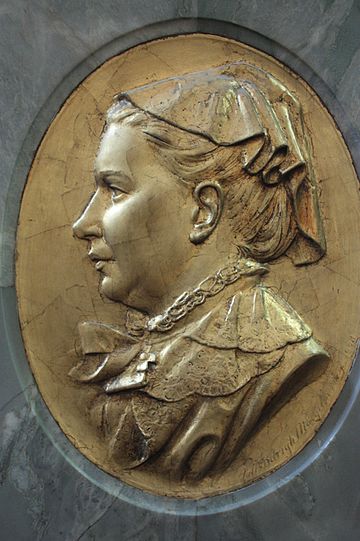
             Pandemics have some slender silver linings.  I can’t remember another major Met exhibition so sparsely attended that you could actually see and contemplate the exhibits.  I learned a lot.  Until very recently my knowledge of early Florence derived mainly from commentaries on Dante supplemented by a magnificent but eccentric book called The Makers of Florence (1876) by the prolific Victorian novelist and amateur historian Mrs. Oliphant (Margaret Oliphant Wilson Oliphant, yes, married her cousin).  Mrs. Oliphant ends with the late fifteenth century and Savonarola, while most of the “popular” Medici (popes, queens, etc.) came later.  The materials in the Met show are sixteenth century.  Yet Oliphant’s qualified view of Medici magnificence in general is perhaps sufficiently indicated by her judgement of Lorenzo (1449-1492): A man of superb health and physical power, who can give himself up to debauch all night without interfering with his power of working all day, and whose mind is so versatile that he can sack a town one morning and discourse upon the beauties of Plato the next, and weave joyous ballads through both occupations—gives flatterers reasons when they applaud him.  Ah, if only I could have been one!  The Medici were a large clan, and liked to name their males Cosimo, but the chief of these for art historians was called Cosimo I de’ Medici, Grand Duke of Tuscany (1519-1574).  He is much on display in the Met.


            A young friend of ours, Billy Magnuson, a brilliant law professor in Texas and a reader and speaker of Italian, is in the process of publishing a book about the development of the business corporation through history.  One of his chapters is on the emergence of the Medici bank.  He asked me to read through that chapter in manuscript and make any “medieval” comments that might be helpful.  I was able for form’s sake to make one or two very minor suggestions, but mainly I was learning, appreciating in a new and revelatory way the extraordinary importance of the emergence of a money economy for modern cultural developments. 


            Historical “elites” are increasingly objects of discomfort and even scorn among historians, and especially of course elite historians.  It may be disconcerting that rich people are disproportionately prominent in our social, cultural, and political histories, but the explanations are so easy and so obvious that it seems to be obtuse to fret about it.  Holding a grudge against rich people of the Italian Renaissance is not particularly productive.  It would be easy to walk through those museum galleries full of portraits of the high and mighty and see little more than the heedless hauteur, self-regard, and naked power of early robber-barons.  That is, to be sure, one thing to be seen.  I saw it and was rattled.   But it is far from the only thing.  In the current cultural climate, anachronistic virtue-signaling across the centuries is becoming a recognizable historical genre.  The impulse to cancel, suppress, erase, abolish from mind and memory those things that we don’t like is a strange exhibition of the thirst for justice.  A verse of the revolutionary anthem called the Internationale pleads thus: Let us make a blank slate of the past.  That way of thinking has not had happy practical results.  The impulse of the museum is quite the opposite, an impulse to conserve, rescue and display for study.


            One of the stranger series of Medici portraits depicts aristocratic Italian youths in the personae of sacral figures—Saint Sebastian, protector against plague, John the Baptist, patron saint of Florence and harbinger of Christ.  One that is particularly captivating imagines Cosimo as Orpheus.  A lot is going on in what seems a rather spare painting.  The mythological Orpheus, who harrowed hell to bring back from death his beloved Eurydice, had been a “Christ figure” in Christian art since late Antiquity. But no simple moral allegory fits the treatment here.  Cosimo-Orpheus sprawls in an awkward position, holding the neck of his elaborate stringed instrument in his left hand while fingering its bow in auto-erotic suggestion with the right.  The head of a large mastiff hound, emblematic I suppose of the whole animal kingdom charmed by Orpheus’s music, forces its way insistently into the scene.  It is hard to know what all this may mean.  The portrait is the work of the Duke’s court painter, Bronzino, creator of one of the most disputed, and certainly one of the most libidinous paintings of the Renaissance.*  We may be mystified by the meanings and motives behind works of art that have come down to us from the remote past, but we must first marvel at the miracle of their survival.  Visiting museums has been among our favorite pastimes.  This was our first post-lockdown museum after well over a year of enforced recusal.  I regard that as a little allegory of resurrection all on its own.


*See https://gladlylernegladlyteche.blogspot.com/2020/10/appalachian-baroque.html