Wednesday, July 5, 2023

The Pimlico Mystery


Old men forget, as we know from Shakespeare; but they also remember.  Indeed, I discover that one of the significant pleasures of aging—there are a few--is the license, indeed the invitation, to unapologetic mental retrospection.  I have spent my life as a teacher, so I suppose it is unsurprising that I now find myself thinking a good deal about the many teachers of my own whose talents have become legendary in my imagination.  This is particularly true of the faculty with whom I worked in my one year of residence in the Princeton doctoral program in1961.  Among them was the elegant scholar of Victorian literature, E. D. H. Johnson.  Dudley, who was later chair of the department, had been a Rhodes Scholar in the 1930s, and his pre-War Anglophilia had its distinct texture.  It was at times as though Matthew Arnold were lecturing to us, except that Dudley’s seminars included occasional asides about Victorian kinkiness, especially sex crimes.  This subject has remained for me a minor amateur specialty.


The case with which Dudley got me started was that of Charles Bravo, a prosperous lawyer and classic male chauvinist pig who died of antimony poisoning in 1876. Bravo’s wife Florence, a woman of independent mind and means, fell under suspicion, especially when it became rumored (accurately) that before marrying Bravo she had  had an affair with the fashionable physician, Dr. James Gully, nearly forty years her senior and a practitioner of “hydro-therapy,” who had also aborted the fetus of their love-child.  There never was an official criminal finding of guilt, but Florence had broken so many taboos that no official finding was necessary to satisfy the schadenfreude of the respectable classes.  In fact, it is more probable that Bravo, who was trying to poison Florence to get her stubbornly held independent money, had killed himself by accident.  As you may recall from Danny Kaye’s The Court Jester, you really do have to know the difference between the chalice from the palace and the flagon with the dragon.*  Charles Bravo got confused.   This case, celebrated among true crime afficionados, has been the subject of several books and at least one TV mini-series, and is reflected in several writers of twentieth-century crime fiction

This case also introduced me to Yseult Bridges (1888-1970), a British writer and author of several books about Victorian crimes, including one on the Bravo affair.  After reading her posthumous autobiography (Child of the Tropics: Victorian Memoirs)** I very much wished I could have known her.  It’s not just that any woman named Yseult has to be very cool.  You can tell from her writing that she’s cool, a straddler of two centuries who gets the Victorian vibe and can write about it with both affection and distanced amusement.  And since she is a modern as opposed to a post-modern, she writes elegant and intelligible English prose.

So many Victorian social conventions frustrated the aspirations of the human heart that the wonder is not that so many English wives bumped off their husbands but that comparatively few did.  Money was at the heart of the Bravo case, but kinky sex (or kinky sexual abstinence) makes the famous Pimlico Mystery (1886) even more interesting to me than that of Charles Bravo.  This (in my opinion) is another instance of the wife who didn’t do it.  Well, not exactly do it.


Adelaide

In Pimlico (a neighborhood in central London) lived a prosperous grocer, Thomas Edwin Bartlett, and his wife Adelaide.  Adelaide Blanche de la Tremoille was a high-born French woman—so high that her birth was out of wedlock.  Her unknown father was rumored to be Somebody Big in Victoria’s court.  But Adelaide’s illegitimacy cancelled her class privilege, and she was probably lucky to snag a rich tradesman.  The Bartletts’ marriage was somewhat bizarre.  It was founded on the agreement that sexual intercourse was not on the table—or anywhere else, for that matter.  This agreement had once, but apparently only once been violated, with unhappy results, a stillborn infant.  Adelaide may not have been entirely disappointed with the arrangement.  Edwin (the grocer’s preferred name) was a man with dramatic and smelly dental problems and worms in his stool.  The Bartletts became friendly with a young Methodist preacher, the Rev. George Dyson.  Indeed, the three became very close friends.  Presumably Edwin explained the ascetic character of his marital arrangements to his clerical friend.  In any event, he encouraged George to make love to his wife, and one must presume that he did so.  The clerical connection made things doubly kinky.  So when things came out in court, as they eventually had to, Adelaide Bartlett was the object of even greater social shock and awe than Florence Bravo had been—if that were possible.

            The reason that things had to come out in court was because someone administered a fatal poison to Edwin Bartlett.  It seemed very likely that this was murder.  The suspicions of the police were hardly surprising.  The poison ingested was chloroform.  The chloroform had been purchased in a suspicious manner by the preacher at the behest of the wife.  When the prosecution got serious, the ignobly innocent Dyson barely avoided prosecution himself by throwing his girlfriend to the wolves.  Adelaide’s preposterous explanation for the chloroform was that she thought a nostril whiff from the bottle would have a chilling effect on her husband’s strangely reappearing end-of-life  sexual appetite.  In passing, one marvels at the casual attitudes of the nineteenth-century pharmacy in the matter of deadly poisons.  You could buy stuff like arsenic and laudanum right off the shelf.  You’ve probably read Madame Bovary, or seen the classic film Arsenic and Old Lace.  For all I know, you could buy strychnine as though it were Alka Seltzer.  I had not known that chloroform could be ingested, but it apparently could be if you were really, really thirsty.  On the way down, before it killed you, according to the medical experts, it would necessarily inflict damage to your tongue, mouth, throat, and esophagus.  The considerable forensic science that thrilled the first readers of the Sherlock Holmes stories is of the same date as the real-life “Pimlico Mystery.”  But it only stumped the jurors charged with resolving the murder case brought against Adelaide Bartlett.  The corpse of Thomas Edwin Bartlett had been subjected to a thorough and efficient forensic autopsy.  The grocer’s stomach was full of chloroform, but there was no evidence of any insult to the mouth or channels to the stomach.  Everybody “knew” that Adelaide had done it, but nobody knew how she had done it.  That’s more or less just what the jury said in acquitting her of a charge of capital murder in a fashion that imposed a life sentence of opprobrium and suspicion.  I think the more obvious conclusion is that she had not done it, only devoutly wished for and engineered it.  All three of the principals in this particular ménage were oddballs, but the really kinky one was the husband.  It was barely conceivably a case of suicide with ingestion through a feeding tube to the stomach, possibly with the collusion of a domestic servant.  Edwin liked rubber devices.  More likely the befuddled hypochondriac took it under the belief, encouraged by his wife, that it was a wholesome tonic.  But how did it arrive in the stomach without causing inflammation en route?  That is the real Pimlico mystery, and the prosecution’s inability to explain it is what saved Adelaide’s own neck.  Concentrating on this issue was the strategy of Adelaide’s brilliant celebrity lawyer, Sir Edward Clarke.  He also presented the eccentricities of Edwin Bartlett as being so numerous and so extreme that even the most implausible scenarios were the daily stuff of life in his household.  It is possible that Clarke was being covertly retained by Adelaide’s mysterious and anonymous patrician father, the rumored Lord Bigwig.  Among Clarke’s other celebrated clients was Oscar Wilde in his contest with the Marquis of  Queensbury.  As Dudley Johnson used to tell us, the idea that Victorian society was boring is a popular fallacy.

E.D.H. (Dudley) Johnson
 

*https://www.youtube.com/watch?v=WzmnSyqv37A


**Child of the Tropics (London : Collins : Harvill Press, 1980). The other two of her books to which I allude are How Charles Bravo Died: A Chronicle of a Cause Célèbre (London: Jarrolds, 1956) and Poison and Adelaide Bartlett: the Pimlico Poisoning Case (London: Hutchinson, 1962)


Wednesday, June 28, 2023

Martyrology


I thought I had quit worrying about our national political scene, but of course the worry is inescapable.  I have been wrong concerning almost everything to do with Donald Trump—and not just a little bit wrong, but sensationally so.  I was convinced that it was impossible for him to be elected in 2016.  I am convinced that he cannot be elected in 2024.  But then the sardonic aphorism of H. L. Mencken steals upon the mind: Nobody ever went broke underestimating the intelligence of the American people.”  Does it not  seem that a detailed and circumstantial criminal indictment, thus far answered only by petulance, might be a serious impediment?  As a result of a  trip to the library last week, I am worried.  For after a long hiatus occasioned mainly by the Covid situation, I have been able to return to spending a few hours now and then in the Firestone Library pursuing what I indulgently call research. 


I face two problems.  The first, not new but newly much more acute, is that most of the books I want to look at have been removed to a “remote storage” facility.  The paging service is fairly quick, but the system itself is still a grievous downgrade from the glory days when Firestone was truly “open stack.”  To fetch something from remote storage, you need already at least to suspect that the book is worth fetching.  No footnote, printed bibliography, or even book review can replace walking slowly down a range of books already carefully arranged for you by expert librarians by subject relevance.  It usually takes about ninety seconds of flipping through a book’s pages to know whether you want to spend time with it or not.  It takes a good deal more time than that to order unseen something that may well turn out to be useless to you.  This wastes your own time as well as that of circulation librarians and unseen book-fetchers.  The second difficulty might be described as the candy store problem.  It is that wandering up and down random stacks, one comes upon alluring random titles of a distracting character.  Thus, straying far from fifteenth-century France, I found myself in seventeenth-century England, where I chanced upon a seductive book by an erudite if somewhat eccentric historian glorying in the name of Esmé Wingfield-Stratford: King Charles the Martyr, 1643-1649. Its subject, obviously, was the period of the final years of King Charles I, decapitated under a parliamentary warrant of treason on January 30, 1649.  It’s a terrific book.


A once-popular comic history of England, 1066 and All That, summarizes the English Civil War of the seventeenth century as a central historical event “consisting in the utterly memorable Struggle between the Cavaliers (Wrong but Wromantic) and the Roundheads (Right but Repulsive).”  That is an amusing way of putting it at only the minor expense of trivializing a major episode in political and ecclesiastical history.  Wingfield-Stratford, while capable of the amusing aside, takes things more seriously.  The convincing paradox he advances is this: the vengeful Presbyterian parliamentarians in believing they were putting an end to the British monarchy were in fact guaranteeing its restoration.  Oliver Cromwell, aware of this danger, did all he could to prevent the execution; but he was outmanoeuvred and thus overpowered by the fanaticism of the radicals in Parliament.  That is the “take away” from Wingfield-Stratford’s book.

Historical parallels do exist, but some are more compelling than others.  The parallel martyrdoms of Charles Stuart and Donald Trump are far from exact.  Indeed, they are tenuous, but there are still enough similarities to disturb me.  King Charles was a pretty lousy monarch.  He was a poor administrator easily influenced by dubious lieutenants.  But he was an excellent martyr.  If he had put a high priority on self-preservation, he could certainly have avoided death.  The issue for which he went to the scaffold was the ecclesiastical governance of the national church.  The victorious Parliament demanded presbyterian governance in which the individual parish ministers had much power.  The King, by statute “head of the church”, insisted on the continuity of episcopacy, a church overseen by diocesan bishops.  It is true that these views were not without political implications.  Charles’s father, King James I, had succinctly opined, “No bishop, no king.” According to Malcolm’s famous line about the Thane of Cawdor in Macbeth, “Nothing in his life so became him as his manner of leaving it.”  This truly could be said of Charles.  His deportment in his imprisonment and on the scaffold was a testament to dignified courage.  It might erase in the popular mind the hauteur of several episodes of his reign.  In the wake of the king’s execution there appeared a book, the Eikon Basilike: the portraicture of His Sacred Majestie in his solitudes and sufferings.  It is presented as though the monarch’s own memoir of his imprisonment, and I see little reason to doubt that it is.  The title of the book is Greek for “the picture of the King.”  And the picture is that of an ethically noble, long-suffering, and very attractive man.  The book became an enduring best-seller, and reinforced at the popular level the idea that the man had been a saint.  It won for Charles in death a true popularity that had eluded him in life.  One might even say that martyrdom was his only possible route to reputational salvation.

It took only about a decade for monarchy to be restored in England.  When it was, terrible punishments were inflicted on some still-living signers of the King’s death warrant and unpleasant desecrations visited upon the interred remnants of the dead ones.  Severed heads decorated the palings of the Thames bridges.


I now come to the political parallel which, while hardly dramatic, does have me worried.  Mr. Trump, with lots of encouragement, is presenting himself as a martyr, victim of  a “witch-hunt” and selective prosecution.  Never mind that no martyr on the books has ever led so sybaritic, pampered, and self-indulgent a life.  Never mind that through the long months of Document Gate he was treated not with kid but gossamer gloves by government officials not generally conspicuous for their patient tolerance of illegality.  Unfortunately, there is enough of a revanchist tone to some of the left-wing gloating to allow those so inclined to doubt that the majesty of the rule of law is the actual animating passion of his adversaries.  And our politics du jour is that of the “so inclined”.  Dogmatic, abrasive, and (very often) ignorant certainty has replaced any pretense of civilly debating debatable matters.  Trump is not a martyr; he is a hoarder of impressive memorabilia who thinks that military secrets are "cool".  Those are two things more different than chalk and cheese.  Nor is he in any conceivable sense the paladin of any Christian cause, as he has claimed in a recent pronouncement that should be deeply offensive to all Christians—though alas probably won’t be.  But even the most tenuous parallels between 1649 and 2023 are worrisome to me.  The law of unforeseen and unintended consequences still operates, and usually malignly.


                 He nothing common did, or mean, Upon that memorable scene


*Esme Wingfield-Stratford, King Charles the Martyr, 1643-1649 (London : Hollis & Carter, 1950)

Wednesday, June 21, 2023

Monastic Studies


The courtyard of the Bodleian Library, Oxford
 

Now and again I run across something in the press that catches my attention both because of its information and ideas and because of its congruence with issues concerning which I actually do or at least should know quite a lot.  Recently Molly Worthen, an historian of American religion  at Chapel Hill, published a Times op ed essay entitled “Why Universities Should Be More Like Monasteries.”*  It is a very interesting essay in and of itself, and it stimulated interesting letters from Times readers.  Concerning Professor Worthen I know nothing more than what I find on her Wikipedia page, but that was pretty arresting.  The final sentence of her brief biography is “She recently converted to Christianity.”  I’m guessing that is a pretty unusual event in the history department at UNC, but who knows?  I have never converted to anything.  I’m just got put a rut in stayed there.  According to a piece of paper to which I have access I became a Christian at a baptismal font in 1936, but I have to take that—how does the phrase go?--on faith.  I was about six weeks old.  These days I have difficulty remembering what happened when I was sixty years old, let alone six weeks.


Prof. Worthen is dealing with a variety of topics, and she brings them together in an elegant fashion.  One topic, a pretty familiar one these days, is slavery to electronic screens.  Though this is particularly a crisis of youth, most of us are more or less indentured to “streaming” communication and (mis)information, a good deal of it vapid, to some degree or another.  A second strand of the essay has to do with the initiative of a religion professor at Penn, Justin McDaniel, who teaches an unusual but highly subscribed class commonly called the “Monk Course.” In it the students study various forms of the monastic life as practiced among the world’s contemporary religions.  They actually commit to imitate their different monastic practices for a period of time.  I presume in all instances this requires ditching electronic devices entirely, but that is only for starters;  students apparently go considerably farther, adopting protracted periods of monastic silence, for instance.  Though I have some difficulty crediting the reports of the fidelity with which this is done, the concept of the course strikes me as brilliant.  The way these two strands come together, their “intersection” as we now say, is in the idea of education as a contemplative pursuit of truth.  Many institutions have some such phrase in a mission statement, but that is about as far as it goes.


All this interests me personally, since I have spent most of my career studying the cultural products of Christian asceticism, among which is the unique institution of the Western university.  One needs to stress the uniqueness.  All of the world’s major religions are important for the development of what can loosely be called educational institutions, but the modern university descends explicitly and uniquely from Christian spiritual practice.  It is not going too far, indeed, to say that the university’s origins begin in a single biblical book—the Psalter.  I shall attempt to explain this cryptic remark in a moment.


One must first acknowledge that the monastic contribution to the history of education is a disputed topic.  A wonderful book no longer adequately appreciated is The History of European Morals from Augustus to Charlemagne (1869) by the Anglo-Irish historian William H. Lecky.  This brilliant author, a graduate of Trinity, Dublin, probably represents as well as any other Victorian scholar the northern European ideals of classical humanism.  This is what Lecky has to say about Saint Anthony of Egypt, the legendary founder of Christian monasticism, and the old guy with the tau-stick in last week’s post: “A hideous, sordid, and emaciated maniac, without knowledge, without patriotism, without natural affection, passing his life in a long routine of useless and atrocious self-torture, and quailing before the ghastly phantoms of his delirious brain, had become the ideal of the nations which had known the writings of Plato and Cicero and the lives of Socrates and Cato.”  Not what you might call a ringing endorsement of the monastic cultural contribution.  If you don’t like that one, though, you can read one of the (literally) million copies of How the Irish Saved Civilization (1995) by the Irish American, all-but Jesuit historian Thomas Cahill (1940-2022).  There you may find that we owe it all to the monks.

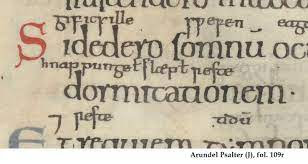
glosses on Vulgate Psalm 131:4, Si dedero somnum oculis meis (If I shall give sleep to my eyes)
 

            But there is a Goldylockian mean.  Not all monks could be emaciated maniac lone wolves, so to speak, and such types became pretty scarce.  Benedictine monasticism, as it developed after the sixth century, was a populous, highly social institution.  A huge number of men and a large number of women, segregated by sex, lived a communal life in which literally hours of each day were devoted to the performance of the “office" (duty) of singing the Latin psalms, all 150 of which were recited during the week.  That is upwards of 50,000 words, about the length of The Great Gatsby or Fahrenheit 451.  Try singing: “In my younger and more vulnerable years my father gave me some advice that I’ve been turning over in my mind ever since...  A slightly weird exercise perhaps, but at least you can read the words.  Few novices (beginning monks) would have known Latin, so one of the first tasks was learning to read it.  Thus in all the vernacular languages of Europe the very earliest surviving vernacular records are glossed Latin psalters in which interlinear English, French, German or (whatever) cribs tell the learner what the Latin word means.  The Book of Psalms is for the same reason the most commented upon of medieval books, because even if you can sound out the word nycticorax, and figure out it must be some kind of bird, it is a word that needs to be explained.  Like Bellini, you might need one day to paint one (also last week’s post).  The search for moral perfection for our ancestors was largely a literary matter—reading, meditating upon, inwardly digesting, and then writing about biblical texts, especially the psalms.  For many centuries the meaning of theology was “study of the sacred page,” i.e., the Bible.


            The origins of our humanities curriculum are to be found in the monastic schools established to train young monks.  In the fifth century Augustine, in a very influential  introduction to biblical studies, had stressed the learning and hard work required to penetrate the meaning of the Scriptures.  Your job was to know the Bible, but to know that you needed to know so much else.  This was particularly true of the Psalms.  They were full of unfamiliar words and things, reflecting the time and topography of their composition.  He also insisted that the pages of the pre-Christian writers we now call classical—though lacking biblical inspiration and at times grossly errant--were useful in the seeker’s task of understanding scriptural passages.  The old writers’ works were full of gold and silver, the “gold” being their wisdom, the “silver” being the elegant language in which the wisdom was enshrined.  The attitude toward the “humane” texts of Antiquity was practical and functional, utilitarian really.  They were aids in approaching the “sacred” page.  But the monks read and preserved them.  Ovid’s books were in many monastic libraries.  A religion centered in a written revelation necessarily encouraged literacy, grammatical analysis, and interpretation.  The elementary “three roads” of the Seven Liberal Arts—the trivium of grammar, logic, and rhetoric—remain in large measure the foundations of education until this day.  The elementary nature of the trivium is revealed in the etymology of the English word trivial. The crisis in American primary education is thus “trivial” as well as life-threatening.


*https://www.nytimes.com/2023/05/25/opinion/college-students-monks-mental-health-smart-phones.html

Wednesday, June 14, 2023

Frick Madison

San Francesco nel deserto (G. Bellini)

We are pretty chuffed with ourselves at the moment, to use one of my wife’s Anglicisms.  Our self-congratulatory sentiments are stimulated by the fact that, for the first time since the beginning of Covid we made a trip to the big city under our own steam.  The meeting with our friends Susan and John at the Dante Reunion (reported on two blogs ago) was so much fun that we determined to repeat it as soon as possible.  Susan suggested a joint visit to the Frick Collection, temporarily moved from its Renaissance palazzo on its Fifth Avenue corner, closed for doubtless spectacular renovations,  to a brutalist box on Madison Avenue.  It was there—the Frick Madison--where we all met up, as though by magic at exactly eleven o’clock last Friday.


What I am calling a brutalist box is to other people a distinguished building by Marcel Breuer.  It is one of the former homes of the Whitney Museum, most recently transported to magnificence at the foot of the High Line in lower Manhattan.  In fact the Frick Madison is a box of boxes, the walls of which suggest the genre used for lining victims up to be shot.  But their emphatic mural functionality emphasizes the virtues of the paintings placed against them.  I used to “know” the Frick paintings very well, as I visited them several times each year.  But seeing them after a long visual drought, and in these settings, was truly to see them anew. 


There is space for the images to spread out and revel in a new independence.  Though of course the space is limited, and the curators had to leave out some very old favorites.  In exchange there are some things I had never before seen, including some rarely displayed Fragonards in a dedicated Fragonard room, or perhaps I should say cell.  Fragonard was a genius, but his subjects go a long way toward summarizing the provocations behind what Lady Bracknell in The Importance of Being Ernest calls “the worst excess of the French Revolution.”  There is also a dedicated Rembrandt room.  Imagine having the dough to have a dedicated Rembrandt room.  Those robber barons! 


To one of their paintings—the Star of India in the museum’s opulent jewelry box, as it were —the curators have devoted a whole room of its own.  I know this painting particularly well, so well that I regard myself as its spiritual owner.  (Spiritual ownership saves a lot of money on insurance premiums.)  I refer to the work usually simply called “the Bellini Saint Francis,” produced by the great master Giovanni Bellini in the late fifteenth century.  What he called it, and what it is, was San Francesco nel deserto, “Saint Francis in the wilderness.”  The “wilderness” is crucial to the painting’s conception.  It is the wilderness through which the Hebrews marched toward the promised land, where Moses received the Law, whence John the Baptist emerged, to which Jesus retired at the beginning of his mission, in which St. Anthony of the Desert established the vision of Christian asceticism, a vision reinterpreted by Francis on the wilds of Mount Alverna in Tuscany.  I believe this is the greatest European Renaissance painting in the United States, and that is saying quite a lot. 


Renaissance paintings can have meaning no less than do Renaissance poems.  So I published a detailed iconographic study of the painting using, for the first time really, the learned Franciscan sources, popular and arcane, upon which Bellini himself was obviously relying either directly or indirectly.*  What Bellini has to say is very profound and very erudite, though conveyed through visual images anyone with an eye for detail will appreciate for their living “truth to nature”.  Forty years later I wish I had done things a little differently.  I might have toned down some of my soupy Franciscan rhetoric, and I should have caught the single primitive Franciscan book in which most of Bellini’s major themes had indeed been brought together in a single literary “source” of sorts. But I do not apologize for directing a few sallies in the direction of some great art historians, who did their best over two generations to “secularize” the painting, often making of it a kind of horticultural study. 


Nearly every detail in this painting has a Christian spiritual “meaning”, many of them very specifically related to Franciscan history and theology.  Though he was not learned in scholastic theology, Francis himself did nurture a strange selective erudition.  He adopted for his personal “sign” and signature, the tau cross, essentially a majuscule Latin “T”—the actual form of the cross used in Roman crucifixions.  This tau became a therapeutic sign in the middle ages, often on the costumes of hospital workers,  because of a passage in the prophecy of Ezekiel (9:14f.): God commands an angel to spare the few righteous persons in Jerusalem in the following way: “Go through [the city of Jerusalem] and set a mark upon the foreheads” of the few penitents who will be saved from the righteous slaughter to come.  That is the authoritative translation of the passage in The Holy Scriptures as translated by the Jewish Publications Society; the Septuagint (the old Greek translation of the Hebrew) has for “mark”  semneion, “sign”, root of English semiotics.  But the Latin Bible (the Vulgate of Jerome), which was canonical for our late medieval writers, has the reading signum Thau since tau, usually spelled thau, did come to mean “mark” or “sign.” In this the Hebrew letter was like other cross-words indicated graphically in modern European languages by the letters x or t (plus sign).  “X marks the spot.”  Illiterates could make an X-mark on legal documents as the place indicated (by others) as “his mark.”  “Hot cross buns!”  Cruces (crosses) marking editorial issues in learned editions of old texts.  The tau had already become a “sign” of Anthony of the Desert (often called the Father of Christian monasticism); it became Francis’s signature, and the sign of the Order of his humble brothers, and in the later Middle Ages the sign of the hospital Order of Antonines.  (There are many identifiable desirable plants in the Bellini’s landscape but also a few weeds, and if I go too deeply into them for your comfort in this paragraph and the next, I promise to end with gastronomy.)


 Saint Anthony of the Desert


         Actual autograph of Francis of Assisi
 

 An indispensable iconographic attribute for Anthony had been the tau-shaped walking stick.  Though usually a complete “T,” artists did a streamlined version of the head of the cane with a half handle.  To the viewer's view in the extreme lower right of the Bellini there is one leaning up against the latticed frame of Francis’s little dwelling.  Notice that Francis has left his sandals behind to go and gaze at Bellini’s version of the burning bush.  That is because Francis is a modern version of Moses, who must respond to God's command (Exodus 3:6) “Take your sandals off your feet, for the place where you are standing is holy ground.”  Incidentally and  iconographically, his rustic cell is a Christian version of the shacks or “booths” erected for the Jewish harvest Festival of Succoth/Booths, when harvesters slept overnight in the fields for a brief period of the year.  I here lack the leisure to explain the eschatological associations the festival had accrued in the Judaism of Jesus, but you can find something about them in any decent commentary on Matthew 17.  What regularly makes medieval and Renaissance paintings so inexhaustibly rich from the intellectual point of view is their silent appropriations of the allegorical biblical commentaries of a thousand years of monastic exegesis.  But Bellini gave me some help I couldn’t get from the  Bible.  


Walking stick by G. Bellini


Walking stick by J. Fleming


 When I found myself becoming long of tooth but short of breath and increasing unsteady of gait, a lucky wind-fall of a black locust limb on my son’s farm allowed me to make my own version of his homemade walking stick.  That you yourself are lame need not mean your cane has to be lame as well.  Unfortunately, physical prosthesis is probably as close as I will ever get to the saint I so greatly admire. But I do have an important national affinity.  I still eat Italian food with the best of them, as I discovered over scrumptious polenta when John and Susan treated us to lunch at a classy little trattoria just around the corner of 73rd south of Madison.


 *From Bonaventure to Bellini: An Essay in Franciscan Exegesis (Princeton University Press, 1982.)


Wednesday, June 7, 2023

Getting into College


            There has been a lot of public discussion recently about college admissions.  A large number of applicants are very keen in their pursuit of a smaller number of places available in highly esteemed institutions, and blood is in the water.  In 2019 there broke upon the world the scandal and criminal conspiracy cleverly named “Varsity Blues.”  Alert citizens reeled when confronted by two pieces of information spread across the quality press.  The first was that a young person can considerably improve her chances of admission if she can produce a photograph of herself sitting in a racing eight with a resolute expression on her face, and her hands firmly grasping a pair of oars.  The second was that there are real people in the real world able and willing to pay a bribe of one hundred thousand smackers to get their kid into the University of Southern California.  It is hard to say which bit of news is more astonishing.  The subject returned to my mind a few days ago when I read a David Brooks column in which, with uncharacteristic violence of language, he encourages us to “smash the college admissions system.”


            There is, however, no single identifiable “system” to smash.  Admissions criteria range from very “highly selective” to “come one, come all.”  Most of the anxiety swirls around a relatively few institutions in the first category, some of which (immorally in my view) actually encourage hopeless applications, as a low acceptance rate in itself is a badge of institutional prestige.


            There are in my opinion at least three hundred good institutions of higher education in this country, probably many more.  There may well be that number of good public institutions, even before we get to the relatively few famous private ones that seem to monopolize the discussion of college admissions.  I apply the adjective “good” to an institution with a clear and useful educational mission, one that works hard and successfully to provide the material resources required by its mission, and one that invigilates and evaluates in a responsible fashion the performance of its faculty and the progress of its students in carrying out its mission.  Largely because of its many very different exemplars of high quality institutions, American higher education has long been the envy of the world.  If that reputation is somewhat diminishing, as it probably is, it is in part because of the Americanization of so many universities in various parts of the world, especially Europe.  Oxford continues to laud its spectacularly inefficient “tutorial” system, for instance, but in its government, fund-raising, and academic alliances it looks ever more like Cornell.


            Especially to be execrated are legacy admissions, admissions partially based in some personal association between candidate and institution.  This is yet another topic that needs to be thought through dispassionately, but it would require a substantial essay of its own.  Take a parodically extreme hypothetical case.  Mrs. Gotrocks comes to the president of Aspiration College and says “We’d like to give you another seven and a half million dollars….Mr. Gotrocks and I so admire what you are doing at Aspiration, and we would be so very proud if our own little Jessica, who graduates from Peabody Springs next year, might have the privilege of being an Aspirer just like her great granddaddy “Groove” Gotrocks, legendary tight end and Heisman contender on the legendary Team of Destiny.  Go, Marooners!  Little Jessica may actually be a slightly flighty party monster, but she has respectable SATs and is certainly going to graduate from her undistinguished prep school.  Experience suggests she would graduate from Aspiration in the third or fourth quintile of her class, the lower end of whose admission profiles she fairly closely matches.  Is there anywhere in this world the college president, trial lawyer, Speaker of the House, high tech tycoon, or street vendor of falafel so dumb as to turn this implicit deal down?  Is the evaluation of a college application actually an exact science as opposed to a good faith guess?  Good old Aspiration ought to be able in good faith to educate one little Jessica and in equally good faith exploit the resources needed to educate a couple hundred much desired but impecunious applicants on their wish list.


            As parodic as my tale of Aspiration U. is, it does not exceed the extravagance with which many critics respond when they hear the phrase “legacy admissions.”  I have already said that legacy admissions deserve an essay of their own, but I shall note here that they come in different shapes.  I began my own teaching career at a great university located in Madison, Wisconsin.  I admired the institution, and I’d probably be there today if the administration had seen fit to accommodate my reasonable demands for much milder winter weather.  One of the things I most admired was the way they handled their legacy admissions policy, now long gone.  Still maintaining an old belief that the university had been founded and financed by the citizens of Wisconsin primarily with the citizens of Wisconsin in mind, the college authorities pursued a brazenly discriminatory policy.  Their admissions policy was that any young person who graduated from a public high school in the state of Wisconsin had the right to matriculate at the University.  Admission was theirs by legacy.  Out-of-state applicants (there were many) had no such right, and the relatively small number who were admitted paid a considerably higher comprehensive fee than in-staters.  There was a rub.  Admission got you in, but to stay there you had to perform in your first semester at a standard deemed satisfactory for a Madison freshman-- a pretty high standard.  This system, essentially self-selection, worked about as fairly as any other I have seen.  I certainly noticed a lot of very hard workers in the freshman class.


            Let me express again my opinion that a great strength of American higher education is its variety.  The word diversity falls easily from the lips of college administrators, but its applications by academicians are actually highly selective.  We need to acknowledge the useful diversity of educational institutions themselves, beginning, perhaps, with the dramatic differences in their financial resources.  If you have an endowment of ten to forty billion, as most of the institutions most frequently discussed do, you can pretend your admissions process is simon-pure and renders results of scientific exactitude.  The major Ivy League institutions, and many others, are in fact largely charitable foundations and engines processing the redistribution of wealth.  But there are many schools, including some distinguished ones, heavily dependent upon tuition revenues.  If the ability of an applicant to pay is a top priority, other desiderata may well excite a reduced urgency.  One thing leads to another.


Wednesday, May 31, 2023

Class Reunions


The manner in which art imitates art imitating art is demonstrated in the many riffs on a great Thurber cartoon itself riffing on a not-so-great line in a Swinburne poem: “I said, ‘The hounds of spring are on winter’s traces’, but let it pass…”  Well, around here we had three nearly perfect days, alias the Memorial Day Weekend, in which the Stallions of Summer appeared to be sniffing the air with satisfaction.  The sun shone brightly; community swimming pools opened; and the Princeton University class reunions ran their many decibelled course without the inundation from the skies I had thought was a necessary requirement of the occasion.


For the most part we had a distanced experience of the celebrations this year.  We live perhaps a mile from the center of campus festivities, close enough to hear the distant shouting from athletic events and the base line of musical groups and to see something of the fireworks show; but not close enough to be annoyed or kept awake.  But the fact that the house is within fairly easy walking distance for a reasonably fit younger person has its payoffs.  Though it is wonderful to see old student friends, the typical Reunions encounter is brief, hurried, and unsatisfactory, allowing insufficient opportunity for any significant or serious communication.  Our plan this year, which worked to perfection, was to have a few “quality” off-campus meetings with friends we especially wanted to see.  In fact we participated in only one on-campus event, and that one was hardly typical of the bacchanalia for which Reunions are famous.  That was the “Dante Reunion.”


One of the greatest scholars in the history of Dante scholarship was Robert Hollander of Princeton, who died just about two years ago.  He was not merely my colleague in the study of medieval literature, but a very close personal friend for decades.  Probably every college has a few small courses that over the years gain a reputation for their  exceptional challenges and their exceptional rewards, and at Princeton one of those for about forty years was Hollander’s undergraduate Dante course.  It regularly attracted a small cohort of the brilliant and the eccentric, about half of whom were not majoring in literary study at all.  I don’t know the exact origins, but at some point Hollander and a group of the course’s veterans from the years past came up with the idea of having a seminar on Dante as one of the optional events at class reunions.  The rest is, as they say, history.  A most enjoyable part of that history for Joan and me is that as the fame of the event grew in tandem with the generosity of some of the alumni dantisti (as the poet’s votaries are known in the Italian tongue) it became possible to have the luxurious supplement of a week-long summer seminar in a medieval Tuscan castle.  Life doesn’t get much better than that.  I was sometimes invited along as one of the preceptors, or discussion leaders.


Bob’s death (after a long and punishing illness), though a terrible blow for the dantisti, did not quell their enthusiasm for Dante.  His successor in the Italian section is Simone Marchesi, one of his few graduate students, and a brilliant, charismatic, and energetic young scholar whose work has already catapulted him to prominence in his field.  He has taken over leadership of the Dante Reunion.  Having now taught the Dante course for several years, he has many enthusiastic alumni of his own, all of them new to me of course.  Lots of them showed up, joining forces with alumni of earlier generations, including a couple of greybeards from the days of an all-male student body.  The seamlessness of the event was beautifully symbolic.  Dante, the life of scholarship, the scholarly life of the mind—all these are ever the same yet ever changing.  The event was a poignant testimony to the power of an immortal poet, to the inexhaustible plenty of thoughtful reading, and to the vitality of the still precious privilege of higher education.


Our good friends Susan and John, practically cut off from us during the long reign of Covid, came down from New York.  Joan and Susan were partners in walking the Compostela pilgrimage together over several summer stints, during some of which John and I (in a comfortable car) drove around the countryside seeing interesting things.  So many happy memories, and one unhappy one.  (Five beautiful sausages I bought in the market at Carcassonne were seized by customs officials at Newark Airport.)  The four of us went to dinner after the seminar to an excellent new Italian restaurant in nearby Kingston.  It was not quite Siena, but tolerably close.  We had plenty of time for a real catch-up conversation.  One of the joys of old friendships is their easy renewability even after long dry spells.


I always have a number of phone calls from old students a day or two before Reunions, and some particularly nice ones this year.  We had three special pre-arranged home visitations, two of them by old students still connected with us through the Dante seminar.  Another, Annalyn, I had been lucky enough to supervise in the English Department.  I should have known from her senior thesis on Virginia Woolf that she would one day win a Pulitzer Prize for her criticism, as she and her husband did in 2005 for their joint biography of Willem de Kooning.  She was later a trustee of the university for a while and therefore in a sense my supervisor  Another, Carolyn,  is a recently retired professor of Hispanic literature with a specialty in the earlier periods; we have many long-standing personal and intellectual connections, especially a shared late friend, going back to the 1970s.  She gave me the gift of a book that already has me hooked, and I reciprocated with my little monograph about Luis de Camões, for which she is a member of the small ideal audience for whom it is intended.  Small?  Minute, perhaps.  Another couple—Bill and Anne—take me back even further, practically to the very inception of my career here.  Bill, a member of the great class of 1969 (!) was in a raucous undergraduate course in Old English I taught so long ago that it has the flavor of a dim racial memory.  But memory is what both class reunions and history are all about.  How blessed I have been to have been given so many happy ones.  It is a good thing from time to time to bring them together—that is, to reunite them.


Wednesday, May 24, 2023

Grandparental


            In general I try in these essays to observe the remit suggested by my blog’s name—that is, learning and teaching-—but this one will be a little different.  A while back a correspondent told me, intending a compliment, that what I wrote was not a “real” blog.  Context suggested that he thought a “real” blog would deal in personal musings and reflections and not “covert lectures on medieval philology.”  So this one will be short, self-indulgent, and personal.  I propose a brief encomium extolling the joys of being a grandfather, with particular reference to two of our younger grandchildren, John Henry Putney Fleming (who will soon be eleven) and Hazel Elizabeth Fleming, who turned nine yesterday.


            We have six grandchildren in all, five of them females, all of them delightful, ranging in age from nine to twenty-nine.  Four of them, who live in New York, we get to see with frequency, especially as one of them doesn’t exactly live in New York anymore, having just completed her first year at—Princeton.  Visits from John Henry and Hazel are naturally less frequent, but I have just enjoyed a most delightful one.


            It is an ill wind that blows no good.  Regular readers already know that my distinguished brother-in-law, the architectural historian John Newman, Joan’s only sibling, recently died in England.  Joan of course flew over for the funeral, but not without some necessary thought to the logistics.  She is sprier than I am, but still does not undertake international travel unadvisedly.  Her trip was greatly eased because our elder son Richard was able to go also as companion and chauffeur.  That left me as the problem.  Just at the moment I was not able to go, or to do a few other needful things, even with some excellent home health care.  So our younger son Luke, a professor in Montreal, flew down to spend a week with me here.  We had a great time.  He fairly recharged my batteries.  He got me back into the library.  He is starting to write a new book and got me to think I might possibly do the same.  Possibly.  Thus at the mere cost of seriously disrupting the lives of two families, and imposing yet further demands upon two already sufficiently occupied daughters-in-law, the Princeton gerontocracy continued apace.


            The big payoff for me came over the weekend.  It happened to include my birthday, for which the only semi-secret festive family plans had been overthrown by the death of Joan’s brother.  But a hastily arranged Plan B was implemented.  Luke’s wife Melanie drove down from Montreal with John Henry and Hazel to spend a couple of days before Joan’s homecoming, and then to return to Canada with Luke.  That was a lot of driving for one geriatric birthday dinner.


            The disappointing abandonment of earlier plans, Covid related, had meant that we had not seen the Montreal kids for too long a time.  At their ages, both physical and personality development is rapid.  Both had gained several inches of verticality and a significant if not precisely measurable depth of consciousness since we had last been together.  They were bubbling over with surprising conversation, jokes, riddles, high jinks of all kinds.  The inches we recorded in quasi-permanent pencil on the white wainscotting of the kitchen.  We simply enjoyed the increment of mental agility.  Our wild back garden seemed to them to rival all the provincial parks of Québec in which they have camped.  They were fascinated by the rampant wildlife of our corner of suburban New Jersey, which includes a couple of foxes who ambulate up and down Hartley Avenue as though it were the Promenade des Anglais in Nice.  They teased and spoofed us.  Hazel, deploying Academy Award level skills, extracted from me, all unaware of her covert purpose, the information she and her mother (a professional caterer) would need to surprise me with what I can only call the birthday Cake of Ages.  I do not mention any precise age.  The weather was perfect for walking and working in the yard.  It is the season for the battle of the bamboo.  We attacked both the quick and the dead, the shooting tender spikes that move so fast you can hear them growing, and the old dead, hollow trunks, halfway to being flagpoles, whitening with age.  Young John Henry threw himself into this task with all the energy of his Stakhanovite namesake.  How could I possibly deserve—how could anyone—these beautiful and brilliant infants, shining mirrors of affection and promise?  Heaven, even as imagined in the colors of Fra Angelico, is not easy for me to conceive.  But that suggested by Jesus works for me: a place full of children.  I’d like to think that the vibe would be more that of a kids’ project at a daycare center than a session of the Congress of Vienna.


            Somewhere in the garden shed is a ghastly pewter plaque, which somebody paid five bucks for in the shop of an Interstate rest stop, with the stamped image of a geezer with a pipe and the legend: HAPPINESS IS BEING A GRANDFATHER.  It’s one of those things somebody gives you to put in the garden shed.  The presentation so tacky, but the message so true.  And it all begins when they are mere babes in arms.  You get to cuddle and rock them.  And when they poop—hand ‘em back to Mom!  The next thing you know they’re backpacking in Nepal or closing six-figure deals in some glass cage on the forty-seventh floor.


Joan and Richard returned from England in time to spend a few hours with the Montrealers before they had to get into their big Dodge van and headed back north.  They reported a soft landing after a long day’s drive.  The kids didn’t even miss a day of school, because it was a Canadian national holiday, Victoria Day, named after you-know-who.  Only in Québec, where the politics are a little edgy, it’s the Journée des Patriots.  But reports of changing the name to Meghan Day are baseless rumor.