Showing posts with label trivium. Show all posts

Wednesday, June 21, 2023

Monastic Studies


The courtyard of the Bodleian Library, Oxford
 

Now and again I run across something in the press that catches my attention both because of its information and ideas and because of its congruence with issues concerning which I actually do or at least should know quite a lot.  Recently Molly Worthen, an historian of American religion  at Chapel Hill, published a Times op ed essay entitled “Why Universities Should Be More Like Monasteries.”*  It is a very interesting essay in and of itself, and it stimulated interesting letters from Times readers.  Concerning Professor Worthen I know nothing more than what I find on her Wikipedia page, but that was pretty arresting.  The final sentence of her brief biography is “She recently converted to Christianity.”  I’m guessing that is a pretty unusual event in the history department at UNC, but who knows?  I have never converted to anything.  I’m just got put a rut in stayed there.  According to a piece of paper to which I have access I became a Christian at a baptismal font in 1936, but I have to take that—how does the phrase go?--on faith.  I was about six weeks old.  These days I have difficulty remembering what happened when I was sixty years old, let alone six weeks.


Prof. Worthen is dealing with a variety of topics, and she brings them together in an elegant fashion.  One topic, a pretty familiar one these days, is slavery to electronic screens.  Though this is particularly a crisis of youth, most of us are more or less indentured to “streaming” communication and (mis)information, a good deal of it vapid, to some degree or another.  A second strand of the essay has to do with the initiative of a religion professor at Penn, Justin McDaniel, who teaches an unusual but highly subscribed class commonly called the “Monk Course.” In it the students study various forms of the monastic life as practiced among the world’s contemporary religions.  They actually commit to imitate their different monastic practices for a period of time.  I presume in all instances this requires ditching electronic devices entirely, but that is only for starters;  students apparently go considerably farther, adopting protracted periods of monastic silence, for instance.  Though I have some difficulty crediting the reports of the fidelity with which this is done, the concept of the course strikes me as brilliant.  The way these two strands come together, their “intersection” as we now say, is in the idea of education as a contemplative pursuit of truth.  Many institutions have some such phrase in a mission statement, but that is about as far as it goes.


All this interests me personally, since I have spent most of my career studying the cultural products of Christian asceticism, among which is the unique institution of the Western university.  One needs to stress the uniqueness.  All of the world’s major religions are important for the development of what can loosely be called educational institutions, but the modern university descends explicitly and uniquely from Christian spiritual practice.  It is not going too far, indeed, to say that the university’s origins begin in a single biblical book—the Psalter.  I shall attempt to explain this cryptic remark in a moment.


One must first acknowledge that the monastic contribution to the history of education is a disputed topic.  A wonderful book no longer adequately appreciated is The History of European Morals from Augustus to Charlemagne (1869) by the Anglo-Irish historian William H. Lecky.  This brilliant author, a graduate of Trinity, Dublin, probably represents as well as any other Victorian scholar the northern European ideals of classical humanism.  This is what Lecky has to say about Saint Anthony of Egypt, the legendary founder of Christian monasticism, and the old guy with the tau-stick in last week’s post: “A hideous, sordid, and emaciated maniac, without knowledge, without patriotism, without natural affection, passing his life in a long routine of useless and atrocious self-torture, and quailing before the ghastly phantoms of his delirious brain, had become the ideal of the nations which had known the writings of Plato and Cicero and the lives of Socrates and Cato.”  Not what you might call a ringing endorsement of the monastic cultural contribution.  If you don’t like that one, though, you can read one of the (literally) million copies of How the Irish Saved Civilization (1995) by the Irish American, all-but Jesuit historian Thomas Cahill (1940-2022).  There you may find that we owe it all to the monks.
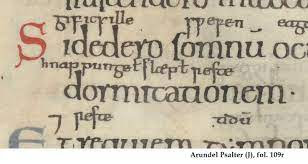
glosses on Vulgate Psalm 131:4, Si dedero somnum oculis meis (If I shall give sleep to my eyes)
 

            But there is a Goldylockian mean.  Not all monks could be emaciated maniac lone wolves, so to speak, and such types became pretty scarce.  Benedictine monasticism, as it developed after the sixth century, was a populous, highly social institution.  A huge number of men and a large number of women, segregated by sex, lived a communal life in which literally hours of each day were devoted to the performance of the “office" (duty) of singing the Latin psalms, all 150 of which were recited during the week.  That is upwards of 50,000 words, about the length of The Great Gatsby or Fahrenheit 451.  Try singing: “In my younger and more vulnerable years my father gave me some advice that I’ve been turning over in my mind ever since...  A slightly weird exercise perhaps, but at least you can read the words.  Few novices (beginning monks) would have known Latin, so one of the first tasks was learning to read it.  Thus in all the vernacular languages of Europe the very earliest surviving vernacular records are glossed Latin psalters in which interlinear English, French, German or (whatever) cribs tell the learner what the Latin word means.  The Book of Psalms is for the same reason the most commented upon of medieval books, because even if you can sound out the word nycticorax, and figure out it must be some kind of bird, it is a word that needs to be explained.  Like Bellini, you might need one day to paint one (also last week’s post).  The search for moral perfection for our ancestors was largely a literary matter—reading, meditating upon, inwardly digesting, and then writing about biblical texts, especially the psalms.  For many centuries the meaning of theology was “study of the sacred page,” i.e., the Bible.


            The origins of our humanities curriculum are to be found in the monastic schools established to train young monks.  In the fifth century Augustine, in a very influential  introduction to biblical studies, had stressed the learning and hard work required to penetrate the meaning of the Scriptures.  Your job was to know the Bible, but to know that you needed to know so much else.  This was particularly true of the Psalms.  They were full of unfamiliar words and things, reflecting the time and topography of their composition.  He also insisted that the pages of the pre-Christian writers we now call classical—though lacking biblical inspiration and at times grossly errant--were useful in the seeker’s task of understanding scriptural passages.  The old writers’ works were full of gold and silver, the “gold” being their wisdom, the “silver” being the elegant language in which the wisdom was enshrined.  The attitude toward the “humane” texts of Antiquity was practical and functional, utilitarian really.  They were aids in approaching the “sacred” page.  But the monks read and preserved them.  Ovid’s books were in many monastic libraries.  A religion centered in a written revelation necessarily encouraged literacy, grammatical analysis, and interpretation.  The elementary “three roads” of the Seven Liberal Arts—the trivium of grammar, logic, and rhetoric—remain in large measure the foundations of education until this day.  The elementary nature of the trivium is revealed in the etymology of the English word trivial. The crisis in American primary education is thus “trivial” as well as life-threatening.


*https://www.nytimes.com/2023/05/25/opinion/college-students-monks-mental-health-smart-phones.html

Wednesday, December 11, 2019

School Daze


Though hardly less exercised about our current political situation than most of my compatriots, I rarely deal with explicitly political issues in these essays.  Most of us feel awash, if not drowning, in political commentary.  I have no special insight or authority in political issues.  Furthermore, most of my political ideas, which are often uncongenial to my family and friends, are unlikely to be of interest to a general audience.  But I sometimes make an exception regarding issues at the intersection of politics and education.  Do note in the first place that “intersections” are all the rage, and since I have spent most of what is now a long lifetime pursuing education as a profession as well as a private aspiration, here is an intersection I can perhaps occupy with some plausibility.

I begin with a possible factoid for which I have no solid source.   There are international statistics concerning student performance, presented in charts organized by nation states.  In terms of demonstrated ability in mathematics, American high school students apparently are tied with Italian students in twenty-eighth place.  If, however, you ask American high school students what country is tops in math education, a majority will answer “the United States.”  There is the man who knows he knows not.  Teach him.  There is the man who knows not, and knows not he knows not.  Pity him.

Within the last month we all got some very bad news.  Since it had nothing explicitly to do with disgraceful behavior by elected officials, the dysfunctionality of our legislative institutions, murder, mayhem, terrorism, or cultural vulgarity, this bad news was not prominently featured in our national press.  The bad news was that despite untold millions of dollars thrown at our public education facilities, and despite the substantial implementation of the so-called “Common Core” approach in our high schools, the actual test scores for English and math have on a national level either remained flat or actually fallen during the past decade.  The idea of the Common Core itself—which I champion at least with “two cheers” enthusiasm—has now been roundly rejected by the educational “experts” both left and right.

This is not really a left or right thing, however.  To force it to be yet another episode in the culture wars, or another aspect of racial politics, is actually to trivialize it.  The world is changing around us very rapidly.  The principal tasks of our public education system are two.  The first --not necessarily in order of importance—is to educate our young people to the point that they are capable of meaningful participation in our democratic political system.  The second is to prepare them for productive work that the real world is willing to purchase with adequate compensation to allow them to enjoy decent lives.  That we have been failing pretty abysmally at the first task should be at least hinted at by our current political regimes.  If a few phony ads on Facebook are enough to constitute “serious foreign interference in an American election,” the fragility of our democracy may already be approaching the fatal stage.  As for the contemporary workplace, it has changed dramatically from that of my young manhood, and unrecognizably from that of my parents.  High school Wood Shop and Home Ec are simply not going to cut it these days

The big gripe about the Common Core is that it is all about testing, which encourages “teaching to the test.”  I am no lover of academic tests.  And I suspect I have at least a soupçon of authority in the matter, as I have constructed and, God knows, had to evaluate, a very great many of them over the years.  There are often much better motivations for teaching and for learning than test preparation.  But the idea that tests, even bad ones, don’t actually reveal valuable educational data is pure poppycock.  For some years I was a member of the ETS committee that made up the Advanced Placement exam in English.  And while I acknowledge the sometimes risible extent to which our efforts were influenced by various “multicultural” enthusiasms, I never read a completed exam that left me in substantial doubt, within a menu of reasonably fine gradations, of the capacities of a student to do “advanced” work in English language and literature.

We can either honor that information or reject it on some other (probably political) grounds.  I have to say this for Bill DiBlasio, loathsome politician though he be.  He is capable of unsettling honesty.  When faced with the fact that black and hispanic students are grotesquely underrepresented among the admittees to the small number of elite high schools in New York City, his very straightforward solution is to get rid of the entrance exam.  That appears to be doable.  Supplying minority students with a quality primary school education that might prepare them for the exam on a competitive basis with their less pigmented colleagues is apparently not doable.

The crucial subjects in which American students are so conspicuously wanting on the international stage are the same subjects tested by the elite New York Schools: Math and English.  Math must stand for all the STEM fields, which are of ever-increasing importance in the “new” economy.  “English” must stand for all the arts of the old trivium—arts of literacy--reading, writing, and speaking well.  Though the STEM fields must claim a special priority, the skills of literacy remain indispensable for competent citizenship, not to mention a seriously fulfilling life.  I cannot presume to give advice about the math exam, but I can suggest a question that I think should be on the English test.  And if candidates know in advance that it will be there, so much the better.   The question arises in my mind for a somewhat curious reason; it was stimulated by comments I have heard or read in some of the currently abundant and polemical discussion concerning the pronouns appropriate to use of transgendered persons.  Advocated neologisms such as zee, shay, shim, they (singular) and zer are not without their cultural interest, and will perhaps offer the materials for a subsequent essay.  For the moment it is the concept of the pronoun itself that captures my attention.  So my hypothetical exam question is this: “What are the parts of speech in the English language?  Very briefly define their syntactical functions.”  One might suppose that asking an English-speaker that question is rather like inquiring whether an artist knows the primary colors, or whether a musician is familiar with Guido’s scale.  That is, the question asks for elementary, indeed foundational linguistic information.  But you might be surprised.  According to one report, published in the middle of the Iraqi war, only sixteen percent of American high school students, when presented with a world map, could find Iraq on it.


Wednesday, July 16, 2014

Trivial Pursuits?


Others mistrust and say, "But time escapes:  Live now or never!"
He said, "What's time? Leave Now for dogs and apes! Man has Forever."
Back to his book then: deeper drooped his head: Calculus racked him:
Leaden before, his eyes grew dross of lead: Tussis attacked him.
                        from “The Grammarian’s Funeral,” by Robert Browning


On many days, when we get back from the gym about eight o’clock, Joan and I share a most pleasant quarter of an hour over the breakfast table reading aloud to each other from the Times.  Our material usually comes from the Op-Ed pages, and often enough from the letters to the editor.  On Monday four letters, headed “How to Teach Reading and Writing”, responded to an earlier article (which we had not read) entitled “The Fallacy of ‘Balanced Literacy’,” by Alexander Nazaryan. 

            I had never before encountered the phrase “balanced literacy,” and I have found no very precise explanation of its meaning.   I take it that what is being “balanced” is some formal instruction by a teacher and a variety of more free-form activities undertaken by individual learners.   I will not condemn what I know so little about.  It is easy for a college professor to pontificate about what is going on in our schools, and I know, as I have said several times on this blog, the fundamental problem in our contemporary classrooms is not necessarily in the classroom.  A schoolteacher not supported adequately by a student’s home environment, has   little hope of success.   Still I do think that elementary teachers need to teach rather than to “facilitate”, especially as I know from long experience that the skills of literacy are among the things that actually can be taught.  Sharing with young people my ideas about the meaning of the whale in Moby Dick may or may not prove useful to them; but if I can teach a student to read I know I have done something.  Reading and writing really are special.

There are many ways of differentiating human life from the rest of the animal kingdom, but surely the most fundamental and obvious is the very rich development of human language, which in spoken forms makes possible social transactions of considerable complexity, and in its written forms has allowed us to make a vast storehouse of the practical and theoretical knowledge achieved or posited by our human ancestors.  Our Western educational practices, for all their variety and trendiness, are still mostly related to a few classical ideas about two thousand years old.  They are designed to teach, and then to exploit, the fundamental skills of literacy—the uses of language.

The language in which our educational theories developed was Latin.  A place where three roads (tres viae) met was in Latin called a trivium; so this was the term used by medieval school teachers to denote the three fundamental “language arts” leading to learning: grammar, rhetoric, and logic.   Grammar explained the structure of language and the rules governing its use.  Rhetoric was the science of writing and speaking effectively.  Logic was the art of probable argument.  What was “trivial” to the old Romans was not what was unimportant but what was commonplace.   Anybody claiming to know anything had to command the trivium before doing anything else.  That is why “grammar school” was once the universal term for “elementary school”.

Ms. Grammatica: Not an Easy Grader

            Latin has long since been effaced by the modern European vernaculars, but a contemporary command of grammar remains indispensable, in my view, for an educated person of the twenty-first century.  Americans, whose national language is English, for now and for the foreseeable future the greatest of world languages, have a particular privilege, but also a cultural responsibility.            If that is too ethereal or too pompous a claim, just consider the advantages of being reasonably well spoken in trying to get a job today. 

            From the historical point of view widespread literacy is a novelty.  The vast majority of men and women who have ever lived, including hundreds of millions today, have done so entirely without any formal training in their native tongue.  But just because it is perhaps possible to subsist on a diet of roots and berries does not render such a diet ideal.  It strikes me as bizarre that some “educationists” should congratulate themselves on having removed grammar from grammar school.  Some of them seem honestly to believe that an innocence of knowledge of the parts of speech, the construction of a functional sentence or paragraph, the effective uses of the marks of punctuation, the norms of correct pronunciation and spelling, leave the young mind free and unfettered to pursue “independent” and “critical” thought.

            The English language, especially American English, is a vital, robust, and dynamic tongue.  There is not the slightest danger of its being emasculated or pollarded by dry-as-dust grammarians.  But in general people are comparatively good or less good at using complex systems in direct proportion to the degree to which they understand their structures.  English grammar is the detailed description of the complex (and fascinating) system called the English language.  And just as childhood is the ideal time to learn a second language, it is the ideal time to master the grammar of a first language.
           
Anyone who has known young children in a domestic situation must recognize their love of, and capacity for, expertise, detail, distinction, and classification.   Certainly the manufacturers of baseball cards, Barbie dolls, and Pokemon figures recognize it, to their considerable material profit.  Surely you have met an eight-year-old who knows more about dinosaurs than Warren Buffett knows about the stock market.  I don’t actually remember all that much, specifically, about my early schooldays, but I do remember how I loved diagramming sentences.  Do American children even diagram sentences any more?  You want to do some real critical thinking?  Diagram the sentences of the “Gettysburg Address”.