Showing posts with label Bronzino (Agnolo). Show all posts

Wednesday, August 25, 2021

Medici Monuments


Excitement, of course, is to be judged according to a sliding scale, but by what might be called the geriatric-pandemic index, the Flemings have had an exciting week.  We escaped.  We broke out.  We found ourselves in New York City not once but twice, enjoying ourselves thoroughly on both occasions.  The trips were of quite different kinds, but both were to upper Manhattan. 


            On Tuesday we went up to visit with an old and dear friend, Christine Stansell, and to have lunch with her and her companion at a place called the Café d’Alsace, on 2nd Avenue, a nice and airy space with what seemed like acres of “social distancing” in which to savor our large pots of delicious moules marinières.  When I call Chris an old friend, I am going back to about 1970 when she was among the first class of Princeton women undergraduates.  We knew even then that she was destined for greatness, which she went on to achieve as an historian at Bard College, then at her alma mater and finally at the University of Chicago.  Among her admired books is City of Women: Sex and Class in New York 1789-1860.  She was an Ohio girl, but she came to love the city she wrote about and wanted to live there in her retirement.


            On Saturday we were in New York again, pretty much the same latitude but a tiny bit west in the longitude, at the Metropolitan Museum of Art.  We went there to see the big Medici show—an extraordinary gathering of Renaissance portraits of, or relating to, members of the famous first family of Florence.  This trip, too, came about because of a dear friend, another long-ago student and one-time colleague, Frank Ordiway.  Frank lives in Princeton, where he operates a highly respected private educational consultancy.  He is a classicist as well as a great expert on Italian culture of the Middle Ages and the Renaissance, and he has made a special study of the Florentine scene.  So we could not have had a more competent guide or, to use a possibly yet more appropriate term, cicerone.  And when you are driven from your back door to the Metropolitan’s parking garage in a spiffy blue Honda, you maximize gain while minimizing pain.


            I am by no means an expert on Florence.  But like anyone who has ever been there I love it.  I feel a little disloyal to Dante in saying this, but there is a statute of limitations on vicarious grudges.  The Medici have a rather lurid reputation among the general population.  It may have something to do with all the torture chambers, false imprisonments, assassinations, papal copulations, and that sort of thing.  I am reminded of Edward Arlington Robinson’s nifty stanza in “Miniver Cheevey”:


    Miniver loved the Medici,

                Albeit he had never seen one;

    He would have sinned incessantly

                Could he have been one.


    But to get to the exhibition within the Met, we had to go through some of the Sackler galleries.  Joan made an excellent point and a masterful analogy.  Just as it is necessary to distinguish between the Good Sacklers and the Oxycontin Sacklers, one must distinguish between the peccant and the pious Medici.
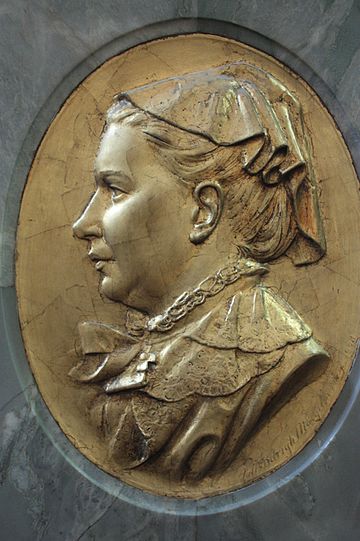


                                                         Mrs. Oliphant
             

             Pandemics have some slender silver linings.  I can’t remember another major Met exhibition so sparsely attended that you could actually see and contemplate the exhibits.  I learned a lot.  Until very recently my knowledge of early Florence derived mainly from commentaries on Dante supplemented by a magnificent but eccentric book called The Makers of Florence (1876) by the prolific Victorian novelist and amateur historian Mrs. Oliphant (Margaret Oliphant Wilson Oliphant, yes, married her cousin).  Mrs. Oliphant ends with the late fifteenth century and Savonarola, while most of the “popular” Medici (popes, queens, etc.) came later.  The materials in the Met show are sixteenth century.  Yet Oliphant’s qualified view of Medici magnificence in general is perhaps sufficiently indicated by her judgement of Lorenzo (1449-1492): A man of superb health and physical power, who can give himself up to debauch all night without interfering with his power of working all day, and whose mind is so versatile that he can sack a town one morning and discourse upon the beauties of Plato the next, and weave joyous ballads through both occupations—gives flatterers reasons when they applaud him.  Ah, if only I could have been one!  The Medici were a large clan, and liked to name their males Cosimo, but the chief of these for art historians was called Cosimo I de’ Medici, Grand Duke of Tuscany (1519-1574).  He is much on display in the Met.


            A young friend of ours, Billy Magnuson, a brilliant law professor in Texas and a reader and speaker of Italian, is in the process of publishing a book about the development of the business corporation through history.  One of his chapters is on the emergence of the Medici bank.  He asked me to read through that chapter in manuscript and make any “medieval” comments that might be helpful.  I was able for form’s sake to make one or two very minor suggestions, but mainly I was learning, appreciating in a new and revelatory way the extraordinary importance of the emergence of a money economy for modern cultural developments. 


            Historical “elites” are increasingly objects of discomfort and even scorn among historians, and especially of course elite historians.  It may be disconcerting that rich people are disproportionately prominent in our social, cultural, and political histories, but the explanations are so easy and so obvious that it seems to be obtuse to fret about it.  Holding a grudge against rich people of the Italian Renaissance is not particularly productive.  It would be easy to walk through those museum galleries full of portraits of the high and mighty and see little more than the heedless hauteur, self-regard, and naked power of early robber-barons.  That is, to be sure, one thing to be seen.  I saw it and was rattled.   But it is far from the only thing.  In the current cultural climate, anachronistic virtue-signaling across the centuries is becoming a recognizable historical genre.  The impulse to cancel, suppress, erase, abolish from mind and memory those things that we don’t like is a strange exhibition of the thirst for justice.  A verse of the revolutionary anthem called the Internationale pleads thus: Let us make a blank slate of the past.  That way of thinking has not had happy practical results.  The impulse of the museum is quite the opposite, an impulse to conserve, rescue and display for study.


            One of the stranger series of Medici portraits depicts aristocratic Italian youths in the personae of sacral figures—Saint Sebastian, protector against plague, John the Baptist, patron saint of Florence and harbinger of Christ.  One that is particularly captivating imagines Cosimo as Orpheus.  A lot is going on in what seems a rather spare painting.  The mythological Orpheus, who harrowed hell to bring back from death his beloved Eurydice, had been a “Christ figure” in Christian art since late Antiquity. But no simple moral allegory fits the treatment here.  Cosimo-Orpheus sprawls in an awkward position, holding the neck of his elaborate stringed instrument in his left hand while fingering its bow in auto-erotic suggestion with the right.  The head of a large mastiff hound, emblematic I suppose of the whole animal kingdom charmed by Orpheus’s music, forces its way insistently into the scene.  It is hard to know what all this may mean.  The portrait is the work of the Duke’s court painter, Bronzino, creator of one of the most disputed, and certainly one of the most libidinous paintings of the Renaissance.*  We may be mystified by the meanings and motives behind works of art that have come down to us from the remote past, but we must first marvel at the miracle of their survival.  Visiting museums has been among our favorite pastimes.  This was our first post-lockdown museum after well over a year of enforced recusal.  I regard that as a little allegory of resurrection all on its own.


*See https://gladlylernegladlyteche.blogspot.com/2020/10/appalachian-baroque.html


Wednesday, October 21, 2020

Appalachian Baroque


            The pandemic has effected many dramatic delays, postponements, and reversals, most of them unfortunate and some disastrous; but at the domestic level it has afforded me one or two useful permission slips.  In recent years I had been making some effort to downsize my library, a very painful task.  That has come to a screeching halt and indeed something of a reversal.  If you can’t get to a big research library, indeed rarely leave your own precincts except for walks in open places, you need to import reading material.  I am allowing myself to buy at least  such volumes of the magnificent Library of America as I lack and want.  That is how a beautiful, two-volume boxed collection of the short stories of Peter Taylor arrived at my house recently—1,397 pages of them to be exact.


James Agee (1909-1955)


            There are at least two great Tennessee writers of the twentieth century, James Agee and Peter Taylor.  If names count for something we would have to add a third, Tennessee Williams, though he was not really a Tennessean.  It is only because a medievalist feels safer in judging defunct writers that he  says nothing of the very powerful and happily extant Madison Smartt Bell.  All three of the older guys have connections with my alma mater, Sewanee, the University of the South, though none of them attended it.  Taylor and especially Agee were significantly influenced by Fr. James Fly, a priest who long taught at the St. Andrew’s School just beyond the Sewanee domain.  Taylor lies buried along with Flye and many of my own revered teachers in the extraordinary Sewanee cemetery.  Agee and Taylor were both serious, unsettled Christians.  Tennessee Williams much admired his grandfather, a Mississippi priest who was a Sewanee graduate, and in his honor left the college a sizeable legacy in his will.  Late in his life Williams, never particularly religious,  joined the Roman Catholic Church, though I think rather in the manner of an American Oscar Wilde, and for much the same reasons.   The greatest of them in my view was Agee, who died far too young.  Nobody has written better film criticism.  And his unfinished novel, A Death in the Family, is a great work of art.


Peter Taylor (1917-1994)


            The current topic, however is Taylor’s art.  I began with one of his substantial older and more famous stories—“Venus, Cupid, Folly, and Time” (1958, the year I graduated from Sewanee).   It was, I think, the first thing I ever read in the Kenyon Review, twin, as we thought of it, to our Sewanee Review.  The plot is rather fantastic, but you don’t mind.  A really great fiction writer can always get a reader not merely to tolerate but positively to collude in the famously “willing suspension of disbelief.”  The Dorsets, an aging, unmarried brother and sister, living in isolation and genteel poverty in a decaying mansion in what I think must be one of the more sizeable old towns in an imagined geography somewhere beneath the western extension of the Mason-Dixon line, are  largely disapproved of by the town’s “society”, who disdain their standoffish eccentricities and geriatric slovenliness.  Yet they have long hosted a  single elegant annual social event—a house tour and dinner party for a select group of the town’s graduating high-school seniors, strangely endorsed by the young people’s parents.  So we have mysterious people, a mysterious party, and a mysterious house in which, very mysteriously indeed,  the sole piece of art on display is a magazine reproduction of a mid-sixteenth-century work of the Florentine Mannerist Agnolo Bronzino.: his so-called called “Allegory of Love” or “Allegory of Cupid and Venus” in the National Gallery of Britain.  We get the story of what happened the year of the last dinner party, the year that Bronzino met the Junior Varsity of the First Families of Virginia, so to speak.


            As you can see if you didn’t already know, it is one hell of a painting.  Does Bronzino’s incestuous theme extend to the  aging Dorset siblings?  Who are the strange onlookers?  Taylor’s short story is, among other things, a subtle and softcore example of Southern Gothic, perhaps most famously exemplified by Faulkner’s necrophiliac short story “A Rose for Emily”—echoed by Taylor—and the recent spectacular novel by Donald Ray Pollock, The Devil All the Time, which enthusiastic critics have praised as “Hillbilly Gothic”—a  possible upgrade?  What is Taylor’s story really about?  Since I’ve  got 1,368 pages of other stories still to go,  I can keep thinking about it as I move along.  What I am thinking about just now are the commodious convergences of life, a pattern of personal and mental implosions  that transform seemingly random and disparate personal experiences into a plausible if fragile coherence: Taylor, Tennessee, Sewanee, then in widening, fainter rings so much of Southern literature, John Crowe Ransom, Robert Penn Warren, Allen Tate and Caroline Gordon, Andrew Lytle, lesser lights yet, with all of whom I had some fleeting, obscure, spear-bearer’s association.


            The Bronzino was a different matter.  I doubt, at the time I first read Taylor’s story, that  I had the slightest clue of who he was or the good sense to think that he and his painting might have some specific role in the strange narrative.  That all changed when I got to graduate school and read Erwin Panofsky’s Studies in Iconology, first published in 1939, one of a small shelf of books that directed me to a major theme of my life’s work.  Iconology, more precisely than the broader term iconography, is the study of the figurative or allegorical meaning of the images (in Greek, icons) in the visual and plastic arts.  Very often such images have their origins and/or parallels in literary texts, especially in the classical poets or the Bible and its early exegesis.  Panofsky was one of the great German art historians scattered through the Anglophone world by Hitler’s madness, and one who became a colleague of Einstein’s at the Institute for Advanced Study in Princeton.  His book on iconology was already twenty-five years old when I met him.  His principal iconological interests were secular and often arcane—the commerce between the profound revival of classical learning in Renaissance Europe and the visual art of that period.  I now believe that some of his interpretations are too ingenious by half, but his deep discussion of the Bronzino was for a time the last word on the subject.  It had to have been directly or indirectly from Panofsky, I now see, that Taylor had taken the painting’s very title: Venus, Cupid, Folly, and Time.  Well, there are few permanent  “last words” in humanistic study, but three out of four ain’t bad.


Erwin Panofsky (1892-1968)


            I tried to do a quickie catchup on Bronzino studies of the last few decades, as best one can do such things at a home computer screen.  The most interesting thing I turned up along these lines was an essay in which a young scholar identifies the subject of the painting as “bisexual eroticism” deriving from an ancient debate renewed in the Renaissance, largely but not entirely whimsical, concerning the comparative pleasures on offer from the lower orifices of schoolboys and nubile maidens.*  That day I read no further—in Bronzino studies that is.  Hillbilly Gothic seemed the safer and chaster choice for the moment,


            Naturally I claim to know what the Bronzino painting really “means”, and I could tell you, but then of course I would have to kill you--a violation of Google's rules for its bloggers' platform.  So I shall end by returning to my beginning.  The point I wanted to make was that even among the constraints, constrictions, and limitations of a pandemic lockdown of unpredictable duration we are not without resources.  As Milton’s Satan said when faced with a drastic downgrading of his real estate options, “The mind is its own place, and in itself / Can make a Heav’n of Hell, a Hell of Heav’n.”


*Will Fisher, “Peaches and figs: bisexual eroticism in the paintings and burlesque poetry of Bronzino,” in Sex Acts in Early Modern Italy: Practice, Performance, Perversion, Punishment, ed. Allison Levy (Ashgate, ca. 2010), pp. 151-164.  [This time, three out of four are bad].  I should not gratuitously choose to impose possible indelicacy upon my genteel readership, but I think it important to remind ourselves from time to time of just how cool and edgy the study of dead white males can sometimes be.