Wednesday, February 2, 2022

Dangerous Words


            There is a little shuttle train that runs two or three miles from the Princeton station to Princeton Junction where you can get on a big train going either in the direction of New York or of Trenton/Philadelphia.  At the only level crossing on the shuttle line there are automatic barrier gates and flashing lights, along with a sign reading DO NOT PARK ON THE TRACKS.  Some years ago an anonymous wit supplemented this sign by adding a comma and two additional words: YOU FOOL.  And, indeed, public warnings of danger frequently imply a less than flattering view of the general intelligence of the citizenry: quite possibly with justification.  The first time I rode on an Italian train I noted with interest an elegant brass plate reading E PERICOLOSO SPORGERSI, IT IS DANGEROUS TO LEAN OUT.  I was of course immediately seized with the desire to open the window, stick my head out, and see whether there was a corresponding sign on the outside.


            The more fruitful train of thought induced by the experience had to do with the dangerous words in English, by which I mean words having to do with danger.  Italian is Latin in its old age, and it is easy to see the relationship between the modern pericoloso and the ancient periculosus (adjective) from periculum, danger.  Now that bilingual Spanish and English signage is quite common, most people know that a freshly mopped wet floor presents peligro as well as danger.  English has its own set of periculum words: peril (via the French, péril), imperil, perilous, and parlous, a wondrous adjective on life support and in need of revival.  But those are all fairly fancy words.  The word we ordinarily use is danger.  Though everybody knows exactly what it means, it remains one of the mystery words in our tongue.


            This seems as good a time as any for the mandatory digression.  In 1962 I wrote a doctoral dissertation about the Romance of the Rose (Roman de la Rose), a very long French poem of the late Middle Ages, enormously popular with the aristocracy and consequently surviving in a large number of fourteenth-century manuscripts, many of which are beautifully illustrated.  My hope was to use iconographic analysis (interpretation of the pictures) to help elucidate the poem’s literary meanings.  It was a golden time for us, first travelling in an old Citroën Deux-Chevaux to libraries in many parts of Europe, then hunkering down in a little village in Provence to do the actual writing.  This allegorical poem tells the quest of a passionate lover (Amant) in pursuit of a rosebud.  (So it’s sort of like Citizen Kane, only different.) 


He gains admission to a walled garden in the center of which is the fountain of Narcissus.  Reflected in its pool he sees a rose of rare beauty.  The rosebud begins as an emblem of a woman but increasingly and very naughtily becomes the emblem of a part of a woman.  In the poem various allegorical characters help the Lover in his mad quest to possess it (her) while others hinder him.  The helpers have names like Fair Welcome, Sweet Talk, and Good Looks.  The chief hinderer is a gigantic, boorish guy with a big club. 

His name is Danger (Dangier in the French).  The poem describes him as a shameful vilains (i.e., peasant).  "His name was Dangiers, and he was the keeper of the roses."


            It was easier to see Dangier’s narrative function—to keep the horny Lover away from rosebud—than what, exactly, his name was supposed to mean.  What is obvious upon reflection is that this allegorical personification cannot represent what is meant by the modern English and French words “danger,” which is a generalized sense of peril or jeopardy.  He has a specialized role within an erotic economy.  He is a kind of super-chaperon.   This takes us back to etymology, where we discover two rather different meanings, one of them explicable and the other still puzzling.  There is in post-classical or “low” Latin a feudal term, dangerium, referring to a very strict relationship imposed by a lord upon a vassal.  A fief held “in danger” was one held under specific onerous conditions all too susceptible to technical violations that could damage or ruin the subordinate party.  The great seventeenth-century lexicographer of medieval Latin, Charles du Fresne, more commonly known by his title of nobility as the Sieur du Cange, wrote a mini-essay on this subject in his definition of dangerium.  Danger is the power of a binding legal arrangement that carries with it great risks to one subjected to it.  This is clearly the origin of the danger we may associate  with the streets of Chicago, railroad crossings, slippery tiles, playing with matches, etc.  The danger pictorially represented as a redneck with a club is something else.  The fourteenth-century illustration I provide gives a memorable visual impression.   It shows the Lover seeking admission to the garden from the doorkeeper (Oiseuse, or Idleness), with the pool of Narcissus at its center, and Danger, club over his shoulder, hulking over the high wall at the left.


            Chaucer’s works contain many passages in which the adjective dangerous appears in a sense that has dropped out of modern English but obviously is related to that in the Roman de la Rose.  Leaving aside the several examples that are to be found in the fragments that have survived from his Middle English translation of the French poem itself, we find the following in the great monologue of his sexiest character, the woman from Bath, usually called the Wife of Bath.  This woman knows a good deal about the birds and the bees.  Like the woman whom Jesus meets at Jacob’s well in the fourth chapter of the Gospel of John—who is obviously her literary prototype—the woman from Bath has been married five times, “not to speak of other company in her youth”.  She is a serial widow and seems even now on the prowl for a sixth marital opportunity.  Her magnificent monologue, ostensibly the prologue or introduction to her short tale (about an Arthurian rapist), is actually a free-standing autobiography in verse, composed like a fine piece of music in varying tempos and movements.  One movement is a recitation of her marital history.  With a perversity hardly unknown in real life, she tells us that she loved her fifth and last husband best, despite the fact that he abused her and was often stand-offish.  “I trowe [warrant] I loved him best, for that he/ Was of his love dangerous to me.”  The extended passage, as well as many other passages in medieval texts, makes it clear that danger here means niggardliness, especially in terms of sexual availability.  This fifth husband was ungenerous in addressing his wife’s sexual appetite.  He was dangerous. 


            The meaning is sufficiently clear, perhaps, but the concept itself remains mysterious.  In medieval romance, no doubt as in medieval life, sexual repression could be evidenced both in an internalized feminine timidity and as an externalized social constraint.  The club or shillelagh on Dangier’s shoulder is a material exemplification of a potent social force in aristocratic circles.  Christian ascetic doctrine was overtly anti-sexual, and the transmission of secular power in theory depended  on the purity of bloodlines and paternal authority.  Hence the attitude of “Lock up your daughters”—no small part of the function of medieval women’s religious institutions—not to mention “honor killings” and vendettas, sometimes pursued on a grand scale, as in the Trojan War.  The anthropologist Mary Douglas studied some of these connections in her engaging book Purity and Danger.


            Chaucer uses danger in other senses as well, including the one with which we are all familiar today. But danger as sexual parsimony, standoffishness, hard-to-getness has departed our language as mysteriously as it arrived.  For no philologist has yet come up with a really satisfactory explanation of how it could relate to dangerium and the perils of narrowly defined feudal privileges.  If you have one, I’d love to hear it.  I myself would find it dangerous even to speculate.

Wednesday, January 26, 2022

Bar Sinister


            The abrasive metal file is an ancient tool, the ancient English name of which (feol) has changed little since the days of the Anglo-Saxon bards who in their search  for involuted and ingenious ways to denote the deadly weapons of their warriors would call a sword “the leavings of the file”—what was left of the iron when the file had done its work.  Long before I learned that, though, I learned in a metal shop class in school another strange philological file fact.  Our teacher, an old guy who had once been a lathe machinist turning parts for Model Ts, introduced us to something called a flat bastard, a heavy hand file of medium coarseness suitable for lots of ordinary jobs.  The tool’s name, first recorded in 1677, is very racy, as this guy knew.  The word bastard was ordinarily serious profanity, unutterable by the civilized.


            That was probably seventy years ago.  Since then the very concept of serious profanity has disappeared from our culture.  No Hollywood movie has even a chance of success without drowning its audience in a cesspool of former obscenities now so commonplace as to have lost any shock value.  This once forbidden vocabulary is but  imperfectly replaced in daily speech by a few political shibboleths and unutterable verbal thought crimes.  The anecdote can serve to introduce today’s subject, however, because it can suggest just how recently the topics of bastardy and illegitimacy, along with others relating to sexual matters, were often considered taboo.  Recent figures suggest that each year about a million American children are born out of wedlock.  It is hardly any longer a matter of notice from the ethical point of view, except to the extent that children of single mothers are, from the statistical point of view, alarmingly threatened by poverty and its associated social pathologies.


            The revolutionary character of the shift in social attitudes would be difficult to exaggerate, as becomes apparent from reading almost anything in our older literature.  Think of the bastard Edmund in King Lear.  His bastardy is not merely a social awkwardness or family embarrassment: it is an essential, malign moral state.  Even today, to the extent one hears the word bastard at all, it is as a generalized term of moral opprobrium having nothing to do with the marital circumstances of parents.  If there is a dangerous social myopia in contemporary attitudes—as I think there is—things were hardly better in the good old days of penitentiaries, orphanages, workhouses, and orphan trains.


            Last week, more or less by accident, I found myself praising Fielding’s Tom Jones.  I don’t know if I ever persuade anybody else to look at books I talk about, but I am great at persuading myself.  So I took it down from the shelf.  The opening chapters are especially good.  At the same time winter is really setting in.  We are pretty well locked down.  We go practically nowhere and don’t do much that is memorable.  Instead of just walking, I now spend my exercise hours gathering and processing firewood Carpathian-peasant style, so we enjoy supper around a blazing hearth most nights.  Joan suggested that we revive an old custom: reading aloud at the fireside some good poetry, or a chapter or two of a Dickens novel.  But which novel?  There are so many good ones.


            In the background through all this there is in our household, as probably in most in the country, a disquieting undercurrent of political anxiety exacerbated by the uncertainties of the pandemic.  For us, the anxiety is easily expandable to England where friends, and one in particular, keep us abreast of the perceived high crimes and misdemeanors of the embattled British Prime Minister, Boris Johnson.  In one blistering critique forwarded to us by our friend, Mr. Johnson was somehow brought into comparison with Oliver Twist in one of his more hapless phases.  That was the sign from heaven we were looking for.  The next night’s fireside reading had been chosen for us.


            Such were the circumstances in which I was re-encountering, more or less simultaneously,  two classic English novels—one from the mid-eighteenth and the other the mid-nineteenth century—which both open with essentially the same situation.  That  situation is the fallout in proper society from the perplexing and scandalous imposition of a presumably bastard baby.  The actual title of Fielding’s novel is The History of Tom Jones, a Foundling.  A foundling was just that, an abandoned newborn that somebody found dumped on a trash heap or in a wicker basket at the scullery door or (the best case scenario, but still not all that great) secretly delivered to the Foundling Hospital.  In Tom Jones, Squire Allworthy finds the infant in his own bed!  Such things, though not unknown today, are no longer commonplace.  They once were, and until surprisingly recently.  We actually witness the birth of the luckless lad who would become Oliver Twist—a birth fatal to his mother—in a hideous charitable institution recognizable from its current heirs in the  “Family Services” lineage.  For both these babes the question is the same: Who is the father?


            This is a wonderful device to kickstart any narrative.  Readers know from the beginning that there is somewhere they will eventually have to go.  The journey is a long one, especially in Tom Jones.  Both Fielding and Dickens were Christian humanists who seldom disguised their own moral perspective.  Both were unsparing in their satirical treatment of hypocrisy and self-righteousness, of which there is plenty on display in both their books.  Dickens can be downright brutal.  Yet at the same time you know from the start that somehow even for these great-hearted writers these babes will not be allowed to be what they seem—two more bastard children among so many others.  From Sophocles to Shakespeare, through epic, through romance, through our folklore, “good” blood will out.  The princeling raised by shepherds will eventually reaffirm his majesty.  The birthmark, barely noticeable, is irradicable. 


            I lack the space, and certainly the competence, to deal with the serious studies of family structure to which so much of the attention of anthropologists has been devoted.  The variety of  human experience may seem nearly infinite, but for most of the world for most of recorded history the prevailing attitudes toward human procreation have been dominated by long established and long-lasting concepts of legitimacy, a word invoking both laws man-made and those thought to be revealed in Nature.  If the societies of the West are fundamentally abandoning that view, that is real news.  History is a patchwork of stasis and change.  Change itself can be minor or major, gradual or abrupt.  It can involve material reality or mental constructs.  I doubt that metal shop still exists in any high school today.  Nor is much industrial machining done in this country, especially with the use of hand files.  A flat bastard might amuse a teen-ager these days, but would hardly shock or titillate one.  Now Heaven knows, anything goes. 

Wednesday, January 19, 2022

1749


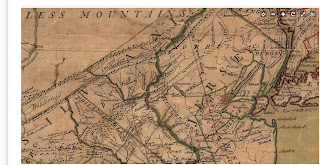
                                                                   Middle Colonies Map (1749) detail
 

I have never been good at dates, a liability manifested early in my meager social life as an adolescent and later in my repeated chronological confusions in mastering the canon of Chaucer’s poetry.  With Medjools I have done somewhat better--but who wouldn’t?  Yet from time to time a calendrical date does stick in my mind, and the sticky one at the moment is 1749.


            I have several times written essays relating to the beautiful colonial farmstead that our elder son Richard and our daughter-in-law Katie Dixon have in Hunterdon County NJ near Frenchtown on the Delaware River.   Well, very good friends of ours in Baltimore, Charlie and Lydia (Belknap) Duff, know about it too; and they just made Richard and Katie a lovely gift.  Since the gift’s recipients were living in Spain at the time, it came to me as an intermediary.  It is an elegant large-format scholarly monograph written by Lawrence Henry Gipson and published by the Historical Society of Pennsylvania in 1939.  Its title, and of course its subject, is Lewis Evans.  I had never heard of Evans, but I knew a little about Gipson, enough to make me read the book myself.  Lewis Evans was a pre-Revolutionary Welsh-American surveyor and geographer who in 1749 published in Philadelphia what I learn is a famous monument of early American engraved cartography—a map of the “middle colonies,” New York, New Jersey, eastern Pennsylvania and Delaware.  More or less in the map’s center is the Hunterdon County forest at Kingwood, where Richard and Katie’s house would rise some thirty years later.  While engaged in a library downsizing operation, our generous Baltimore friends thought of this Kingwood property.  There are pioneers and pioneers.  The cartographer Evans anticipated the Lewis and Clark expedition by half a century!  I already knew something, a little, of L. H. Gipson, a famous American historian of the first half of the twentieth century.  Admittedly I had never read a page of his fifteen-volume magnum opus about the British Empire before 1776.  What I knew was that in 1964, when I was teaching in my first job at the University of Wisconsin, Gipson had been one of the small band of surviving members of the first American class of Rhodes Scholars (1903) to matriculate at Oxford.  There had been a reunion of these legendary veterans that had been much bruited about in the Rhodes world, and I had followed it in the press.


            Evans, though he left a spare biography, was well known among the fledgling scientists of pre-republican North America.  The naturalist John Bartram, with whom he published A Journey from Pennsylvania to Onondaga in 1743 (printed by Benjamin Franklin) called him “a queer fellow”--perhaps a compliment roughly equivalent to “ingenious” among early boffins.  His map is hardly beyond criticism.  You certainly wouldn’t want to use it to try to drive to Allentown.  But you can see from this lavish book how extraordinary it must have appeared to the frontiersmen of 1749.


            I already knew when examining this book that one publication of 1749 must bring another to mind.  For I am a true believer in the theory of the association of ideas often attributed to Locke, and perhaps for me most memorably preserved in our classical literature in the opening pages of Sterne’s Tristram Shandy.  During the very coital act destined to bring Tristram into the world his mother’s mind is seized by a pressing question: did anybody wind the clock?  For forty years I have been telling students that this is a marvelous comic exemplification of Locke’s associative theory, and urging them to watch out for stray thoughts wanting to intrude upon their private moments. That’s not exactly wrong, but just now, in nosing about a bit, I discovered that the more powerful expression of the associative theory was in David Hartley’s Observations on Man published (naturally) in 1749.


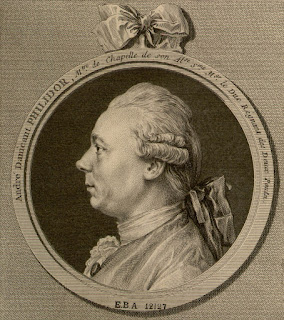
                                                        François-André Danican Philidor (1726-1795)


            Hartley was new to me but my mind was already seized of another epoch-making publication of that year.  I am a chess player, and my son Luke is a really good chess player.  One of the great figures in the history of chess, whom I have studied intensively, is the French musician François-André Danican (1726-1795), best known as Philidor, the honorific name bestowed upon his numerous musical family forebears in an earlier generation.  This Philidor was one of the tragic geniuses of the late Enlightenment.  To be the premier opera writer of eighteenth-century France is not the same thing as being the premier opera writer of eighteenth-century Italy, but it’s not chopped liver either.  And to be that and a chess genius and the author at age twenty-three of the revolutionary Analyze des Echecs—probably best translated simply as Chess Theory—is really something.  I am not a rare book collector, but I do own a copy of the first edition, published  in 1749 in French but in London, under the patronage of the Duke of Cumberland, third son of George II, alias the Butcher of Cullodon.  That is one of few bibliographical distinctions my private library could share with those of Rousseau, Diderot, the Baron d’Holbach, Ben Franklin, and Thomas Jefferson, among dozens of the chess fanatics of the late Enlightenment.  Philidor’s revolutionary approach to the game was summarized in his epigrammatic doctrine: the pawn is the soul of chess.  I am convinced that the book was literally revolutionary and an influence on the famous pamphlet published forty years later, a few months before the storming of the Bastille in 1789, by the Abbé Sieyès: What Is the Third Estate?   The third estate was of course the vast majority of ordinary Frenchmen who were not nobles or clergy.  Sieyès didn’t say it was the soul of the state,  but he came close.  Yet Philidor, insufficiently woke for the likes of Robespierre and the Committee on Public Safety, died a banished man in London with a price on his head in his native land.


            Sitting here at the distance of the new year of 2022, that’s a fair amount of excitement for the year 1749; but you could doubtless find commodious, interesting, or provocative synchronic connections for practically any date of your choice.  There are of course printed annals, and now Wikipedia pages—organized precisely by year and indeed by month--designed to help you do just that.  I must say, I cannot recommend Wikipedia for this, however.  The eccentric nature of its editorial criteria is perhaps suggested by its treatment of May 20, 1936: Wikipedia’s entry records the implementation of the Rural Electrification Act but is mute concerning my birth.  Go figure!  The online annal for 1749 says nothing of Evans’s map or Philidor’s analysis, let alone of Hartley’s forgotten work on associative psychology.  But there is one book that necessarily makes the cut: Henry Fielding’s Tom Jones.  There can scarcely be more than, say, twenty plausible candidates for the greatest novel ever written, and this is one of them.  There are not many seven-hundred-page books whose readers truly wish they could have been just a little longer.  Like so many great books, like such competitors as Dante’s Commedia and Cervantes’s Quixote and Melville’s Moby Dick, it is the story of a road trip (remembering that in Old English one term for the ocean is “the whale’s road”).  Tom Jones conquered the European literary world in 1749, and one of those conquered was François-André Danican Philidor, who seems to have read it while he was seeing his Analyze des Echecs through the press.  If you have heard of him at all, it is probably because of the opera into which he later transformed the novel.


Wednesday, January 12, 2022

Begging the Question


In the near isolation imposed by Covid I have been doing  more on-line reading of current newspapers and “thought” journals than usual, enough to get a clearer sense than I usually have of actual linguistic trends.  I have noticed for example, that there is a good deal of questionable question-begging going on.  I shall try to elucidate this doubtlessly cryptic remark in a moment or two, after stating a truth about language in general.  Complex language is one of the definitive characteristics of our human species.  Some have said that it is the definitive characteristic, the one that separates us from all other biological life.  Not so much homo sapiens (a thinking human) as homo loquens (a talking one).   Yet as an element of culture, spoken language is markedly mutable.  Language is ever changing.  Our own English language has changed so dramatically over the centuries as to make many of our early documents and texts incomprehensible to today’s native speakers.  But it is easier to spot the linguistic change when reading the Canterbury Tales than when reading the current New Yorker.


            In my experience most Americans seem to believe there is such a thing as good or correct English, and that the sole conceivable job of an English professor must be to know what it is.  I deduce that from years of meeting strangers at cocktail parties who, upon hearing of my profession, would answer uneasily, “Well, I better watch my grammar.”   Surely, however, it should be obvious that nobody is invigilating our national speech, certainly not English professors.  The fact of linguistic change, indeed,  makes even English professors hesitate about prescribing what is and what is not prescriptive “good” English.  Good English is a real thing, but also a moving target.  Good English is the English spoken by careful and educated speakers.  It is written in books, but not chiseled in stone, so to speak. I was taught that should I pick up the phone to the question “May I speak to John?” the correct answer was “This is he.”  Alfred the Great didn’t have a phone, but had he had one, he would have said the equivalent of “That’s me”.  That was the Queen’s English in the ninth century and even kings spoke it.


            There is a difference between sensible flexibility and abandoning the very idea of a linguistic standard.  Though it is difficult to document, I think that the quality of the spoken language is in noticeable decline in this country, especially among the young.  The decline is not simply a matter of slovenly grammar or overused slang.  Many people seem not to realize that the purpose of spoken language is to communicate their needs, ideas, observations, requests—all things requiring a minimal degree of precision and discrimination.  We do need to hold the line somewhere.  The linguistic hill on which I fear I shall die is the necessary but apparently doomed distinction between the verbs lie (intransitive) and lay (transitive).  That seems to be a lost cause.  Could I have better luck with begging the question?  All of a sudden people—including people one might think ought to know better—are saying that such-and-such begs the question when what they mean is that such-and-such raises or invites the question.  The answer to my own question—can I do anything about it?—is of course No.  But it practically begs for a quixotic blog essay.  


            Begging the question is actually the English translation of a learned Latin term from the classical rhetoricians: petitio principii.  One expert defines petitio principii as “a form of logical fallacy or circular reasoning in which the resolution of contestable matter is assumed in the premise in which it is advanced.”  Sort of like one of the witticisms of Sir John Harrington: “Treason doth never prosper, what’s the reason?  For if it prosper, none dare call it treason.”  Begging the question—not a good thing, a habit of weak thinkers, fraudsters, and political hacks.  This is very different from the neutral and declarative way in which I see the phrase used today.  “The power exercised by a single senator from West Virginia begs the question of the viability of current Senate filibuster rules.”  How does this come about, linguistically speaking?


            Words can outlast the objects of their signification, often for a long time.  Fifteen miles north of us there was for a long time an intimidating traffic circle at the junction of two major roads and a couple of minor ones.  Nearby was a large automobile dealership called Circle Ford.  Eventually the highway department rebuilt the site as a more conventional junction governed by traffic lights.  The erasure of the traffic circle had no effect on Circle Ford, of course.  Think of all the places in America still bearing the names of milling operations that disappeared a century or two ago.  A notable linguistic scholar of the Victorian period, the Rev. Isaac Taylor, wrote a wonderful book, Words and Places,* showing the remarkable continuity of place-names, among the oldest surviving words in our languages, so ancient as to be in effect prehistoric.


            But just as history leaves behind the material things our nouns denote, so also does it abandon the beliefs, ideas, whole world views they reference.  The orphaned words may simply die, but they often find foster homes.  At least since the time of the Renaissance and until fairly recently, some rudimentary training in classical rhetoric was a part of youth’s basic education.  When Falstaff says to Prince Hal (1Henry IV: 2, 4) I deny your major, what was supposed to be funny even to the groundlings in Shakespeare’s audience is the old sot’s ignorant garbling of some technical Latin rhetorical terms relating to the major and minor premises of logical propositions.  My own parents, rural high school graduates of the 1920s, were actually taught things called “elocution” and “public speaking,” the arts of speaking in a precise and effective manner.  To beg the question is simply too good a phrase to abandon simply because you don’t know what it means.  Make it mean something else.  Or keep it even in an apparently meaningless form if it speaks to you.  According to legend we get one of the greatest of all British pub names from the pious Puritan apothegm God encompasseth us.  


*Isaac Taylor [1829-1901], Words and Places, or Etymological Illustrations of History, Ethnology, and Geography, a true golden oldie first published in 1864 with frequent re-editions, some with expansions, into the 20th century.  There were several erudite Isaac Taylors, including this man’s more famous father, also a clergyman, and also well worth reading if there be world enough and time.


Wednesday, January 5, 2022

Annals of Gastronomy: the Nativity Variant


            Janus, the god after whom our first month takes its name, has the bizarre iconographic form of a man with two faces, one face looking back in retrospection, the other peering into the future with—well, with what exactly?  The custom of the “New Year’s resolution” reflects a general perception that the inadequacies of our previous behavior may perhaps be rescued by intentional life changes: more time doing this, and less doing that.  I have to ask myself anew whether publishing a weekly essay, as I have now done for the last six hundred weeks and more, is of the slightest conceivable social significance.  The honest answer is “Probably not,” but…

            Word comes to me second hand that a friend, who is a regular reader, found my recent excursus on the hypnotic trance in its supposed relationship with recovered memory and clairvoyance heavy weather.  That was the very term used: heavy weather.  Go figure.  I myself of course found it fascinating.  Most people who write things, even or perhaps especially when they publish them, know that they are actually writing for themselves.  I’ll probably keep doing that but let me at least begin the New Year with the relief of some light weather: the story of our Christmas dinner in the garage. 


            This is a family story and like most family stories, alas, requires a certain amount of background information.  I’ll be brief.  Item, you may have already heard about a Covid pandemic?  Well, there is one, and it is a real killjoy in terms of its effects on human sociability.  Item, some members of my family observe Jewish dietary law; others do not.  Item, our exemplary children are fanatically protective of their aging and immunocompromised elders.  Throw these three items together into the planning of a family Christmas dinner and you may end up with one situation.


            We had no hope for our locked-down and snowed-in Canadians, but there seemed an excellent chance of convening the other 66.6% of our offspring families for a Christmas feast.  One of them would be returning for Christmas more or less at the last moment after a lengthy stay in Spain.  From the cook’s perspective that would mean the smallest turkey we could find (probably still too large) or the largest roasting chicken (possibly a little meager).  However, things change from hour to hour in Covid crisis.  We know from Gerard Manley Hopkins that Nature is a Heraclitian fire: changes, changes, constant changes. What might be called Omicron Angst flared up, and the chief executive among our children made the prudential but disappointing decision that the whole event be postponed to sometime in January, sine die.   


            One does what one can to transform life’s lemons to lemonade.  In the previous week I had happened to glance at the NYTimes annual article on “Ten Great Christmas Dishes,” one of which was ham with a root beer glaze*, which sounded both scrumptious and trendy .  I used to live in a farming community where many people raised a hog or two and processed their own pork—a delicious Christmas ham being a special delicacy.  Covid was an ill wind, indeed, but not so ill as to blow no good.  As we would now be on our own, how about a succulent Christmas ham for the first time in approximately fifty years?  We already had the chicken, but it could keep.  I now set out on one final lightning grocery strike, grabbing a small but expensive ham, together with the right mustard, the right brown sugar, the right exotic vinegar, and a king-sized plastic bottle of A&W.  But by the time I got home Heraclitus had struck again.  The aforementioned daughter-executive called again to say that though her spouse (the principal kosher-observer) would be in recusal recovering from Covid redux, we could have a modified family Christmas dinner if we were willing to observe a couple of simple but non-negotiable health precautions, to wit (1) nobody under eighty years old could actually enter our house, and (2) the feast would be served off garden tables in the open-air of the car-port.


            Flexibility being my middle name, on Christmas morning I was up before Santa or his elves preparing the glaze for the religitimated ham.  It was necessary that the kitchen be cleared before ten o’clock for the unencumbered preparation of the main event: chicken and many vegetables.  So I threw myself into the preparation of the glaze.  You begin with a deep frying pan containing about two inches of the root beer, which you bring to the boil before introducing the other ingredients, then keep boiling for quite a while until it suddenly thickens to a goo.  To explain what happened next, I must appeal to the benevolent reader’s good sense and common knowledge.  What, I ask you, does A&W stand for?  The answer, of course: ROOT BEER.  A&W Root Beer Stands dot the map of our great nation.  It was only while I was pouring the liquid into the pan that I found that for some inexplicable reason the label on the soda bottle said A&W CREAM SODA!  My rush through the supermarket had been a little too rushed.  There was no rich, manly aroma of root beer!  The sense of betrayal was acute.  I had the sinking feeling that “ham with cream soda glaze” was not among the Times’s ten greatest culinary hits, nor even those of the Gopher Springs Gazette.  But I soldiered on and am so glad I did.  I hope you read in school Charles Lamb’s classic essay entitled “A Dissertation Upon Roast Pig” in his Essays of Elia.  It posits that the discovery of roast pork was a happy (if expensive) accident, the unanticipated invention of  a young lad in Old China who was “fond of playing with fire, as younkers of his age commonly are.”  Well, if such a carnivore’s delight came into existence through inadvertence, why not its perfectly inadvertent gastronomic ornamental glaze.  I wonder if I need a patent lawyer.

            After clearing the carport of its cars, expelling from its tarmac floor half a cubic yard of miscellaneous pulverized crud with a leaf blower, and setting up separate folding tables for purposes of gift exchange and of eating, our chief problem was the cold.  Richard softened the cryotherapy imaginatively by setting up on the tarmac apron of the garage the fire pit he had given us for the previous Christmas.   An animated blaze at the mouth of the carport offered a possible illusion of warmth, and as you know, illusion is at least halfway there.  Between the oohing and aahing over various modest gifts, and the oohing and aahing over the absolutely delicious meal, the echoing carport was noisy with the animal satisfaction of feasting Flemings.  Corny wit accompanied the corny ale, fruit juices, and bottled water laid up for the occasion.  My best hope had been to pluck mere survivable defeat from the jaws of disaster.  Instead of the whole thing being a flameout, it was a flagrant success.  By no means everyone sneaked a taste of the Cream Soda Glaze.  But the happy few who did had to agree that it was delicious—kind of like light brown sugar mixed with dark brown sugar on a bed of crusted white sugar.  Experience of the Nativity Variant led to a family parliament in which it was proposed that all future family feasts be held in the garage—a decision facing possible reversal should the Republicans recapture the House.


  *https://cooking.nytimes.com/recipes/1022799-root-beer-ham

Wednesday, December 29, 2021

What Didier Did or Didn't


Alexis Didier (1826-1886) in his mature years


            Last week I wrote about a German novelist who claimed to have been able under medical hypnosis to reconstruct from memory the lengthy unique manuscript of a novel that had been confiscated from him by his captors years earlier.  This topic came fortuitously into my life at a time when I was already mulling over the mysterious relationships between sleep and heightened consciousness.  This week it is a nineteenth-century French youth, Alexis Didier, said to be the most remarkable clairvoyant to emerge from the great century of celebrity mediums, table rapping, ectoplasm, spirit photography, trance writing, Spiritualism, and the heyday of the Society for Psychical Research..


            I depend on my son Luke, a linguistic anthropologist at the University of Montreal for all sorts of intellectual tips.  He is big on French intellectuals, supplying me many great recommendations, and occasionally one that is a little out there.  That is how I would characterize Bertrand Méheust, a French expert on the history of parapsychology and (according to his Wikipedia page) an ufologue—a wonderful word meaning, one presumes, an expert on UFOs.  He is also an expert on Alexis Didier, to whom I shall come presently.  His book about Didier is raggedly written, though a piece of cake compared with his Mad Professor English-language lecture on the same subject.*  But I must not bite the hand that feeds me.  There are not a lot of Didier experts.


            Of several individual seances discussed by Méheust, one invigilated with suspicion by the famous illusionist Jean-Eugène Robert-Houdin in May of 1847 can perhaps serve as well as any to exemplify at once the mystery, the questionability, and the eventual practical banality of the young man’s powers.   Didier was twenty-one, and his fame was growing.  Robert-Houdin, in his early forties, was already established as the most famous illusionist and prestidigitator in Europe.  That is, he was a theatrical performer whose claims to achieve actual “magic”  were generally understood by everybody to be rhetorical adornments of unfathomable tricks of skill rather than physical miracles.  But since nobody knew how he did it, the difference between the two might often seem moot.  Didier on the other hand, not a  conspicuous showman, presented himself as a psychic, a person possessed of extraordinary, inexplicable mental powers rather than a baffling thespian genius.  To have Robert-Houdin investigate Didier was as much as to say it takes a thief to catch a thief.  At this séance a blindfolded Didier, in addition to other “blind” perceptions (1) correctly identified by suit and value many specific playing cards that he had not seen and could not have seen; (2) described in convincing detail the eccentric decoration of a distant room he had never seen and never could have seen; (3) was partially successful in reading phrases from specifically identified pages of a book unknown to him; (4) was able to identify by name the writer of a letter—a person wholly unknown to him--when touching its unseen paper sheets to his forehead.    Robert-Houdin was very far from catching a thief.  Convinced that he was a witness to the paranormal, he signed a testimonial that it was impossible to classify Didier’s feats “among those that are the object of my own art and labors,” meaning of course theatrical magic.


            Didier was a somnambulist, meaning not that he was a sleepwalker, but a sleepseer—somnus being roughly a Latin equivalent of Greek hypnos, words meaning both sleep and the trance or mental alteration of sleep, somnambulism or hypnotism.  Some version of this indeterminate state, perhaps that of which Saint Paul writes:--“whether in the body I do not know, or whether out of the body I do not know, God knows”—was required for Heinrich Gerlach to recover the lost memories of his novel about Stalingrad and for the psychic Didier to read from the pages of tightly closed books.  This led me to my question in the last essay: Do we know things when we are asleep that we cannot know when we are awake?


                                                             D. D. Home raising the roof


            Perhaps the first scholarly article I published was inadvertently about ESP (Extra-Sensory Perception).  It is a linguistic essay about Robert Browning’s dramatic monologue of 1864, “Mr. Sludge, the Medium,” a barely disguised attack on Daniel Dunglas Home, an American spiritualist, psychic medium, and levitator, who conned his way through high-society seances on two continents.  Browning  heaped contempt upon this fraudster.  (The oblique point of my own essay was not about ESP; it concerned Browning’s attempts to capture distinctive Americanisms in Sludge’s English speech.)  More than forty years later, animated by very different interests, I published a book called The Dark Side of the Enlightenment, in which I did deal a little more directly with the history of the “paranormal” quest.  That the quest was a serious project of Enlightenment is itself telling.  The theory of  “animal magnetism” of the German physician F. A. Mesmer (1734-1815), embraced by an army of progressive “magnetizers” (hypnotists), is now regarded as one of the exotic mental aberrations of history, something akin to alchemy, also an Enlightenment enthusiasm.  But Mesmerism beat at the doors of the Temple of Science for decades  and came surprisingly near to gaining admission.  The only actual distinction between alchemy and chemistry is that one retained its Arabic article.  And as the alchemists developed laboratory techniques and procedures that greatly advanced the chemists, so also is there a line of reluctantly acknowledged filiation from Mesmer to Freud and Jung, to all ideas of subconscious or unconscious mind in its relationship to curated sleep, hypnosis.


            Méheust is particularly good on one point.  Most psychics, including Didier, failed more often than they even appeared to succeed.  A large number were exposed as active frauds, often of a cruel and mercenary sort, and we are right to harbor suspicions of many others.  But only by an illegitimate extrapolation can a thousand exposed frauds be thought to disprove even one evidentiary claim made on behalf of Didier or dozens of others.  One of Chaucer’s subtlest stories, that of the Canon’s Yeoman, presents us with an alchemist who practices fraud not because he does not believe in the power of the Great Art but because he does believe.  All he needs are the resources to finance one more experiment, and, yes, one more….What did the mathematician Blaise Pascal mean when he said “The heart has its reasons which reason knows nothing of…”?  The same thing, I think, as Jesus when he said “Man does not live by bread alone.”  The French Academy in the nineteenth century became so irritated and embarrassed by the erudite madness in which certain topics floundered and drowned that they actually cancelled the topics, forbidding their discussion in their august lecture halls and publications.  One such topic was the origin of human language, another the hypnotic trance of animal magnetism.

 
tabling the motion


*B. Méheust, Un voyant prodigieux: Alexis Didier 1826-1886.  (Paris: Le Seuil, 2003); for the lecture: https://vimeo.com/37790155