Wednesday, June 1, 2022

Thoughts of a Gun Owner


            Amidst so much talk of privately owned guns, I feel compelled to say a word about my own, for I indeed am a gun-owner.  My gun is a forty-five caliber Colt revolver, a genuine original “six-shooter”.  It probably was manufactured in the 1880s.  It belonged to my maternal grandfather, who was an employee of the Denver & Rio Grande Railway, stationed in Salida, Colorado.  For a country showing signs of political senility, the United States is a comparative infant.  My father knew a man who had known a man who had known George Washington.  My grandfather was born shortly after the Civil War and my mother, his youngest child, was not young when I was born.  Three family generations easily occupy more than half our national history.  My gun is an antique from America’s antiquity.  It has been fired once—meaning one shot--in the last seventy years.  My late elder brother, who inherited it in 1950, wanted to see if it still worked then.  It did.  He hit a tree at about fifteen yards.  I don’t know where he came up with a projectile for it.  We have never tried to find any.  It has been preserved ever since in a safe place in the metaphoric mothballs of a leather holster probably dating from the early twentieth century.  At rare intervals it gets a light wipe with a faintly oiled cloth.  I don’t want anybody to take this gun away from me.  My hope is that it will be passed on through generations yet unborn, a significant antique, a beautifully precise steel forging from a great age of American industry, and an intriguing material link to a proximate but vanished past.


            My grandfather never heard of an event like that in Uvalde, though such events now seem almost common.  Just how common?  It depends upon whether you address the question from an ethical, a comparative, or a statistical point of view.  From the ethical point of view, which must command the attention of every person with a conscience and surely commands our communal national consciousness at this very moment, the mass murder of young children in a primary school is an event so obscene as to render the question just asked about it obscene as well.  The suggestion seems to be that we should establish a baseline number of annual school massacres against which the actual number might be deficient or excessive in any given year.  If we use the language of ought, there ought to be no such events.  But the tragic empirical fact is that there have been many, precisely documented by police and medical officials, and recorded and broadcast by journalists.  We are thus provided with a very sound basis to make the comparative judgement that the United States is the runaway world leader in such atrocities.


            It is the third approach to the question, the statistical part in its narrowest sense, that proves troublesome.  How statistically likely is it that a given student will be murdered at any given school by a maniac?  I don’t know the answer, except that it is very unlikely.  On the day that the school in Uvalde was attacked, just about a hundred thousand other American public schools were not attacked.  But current thinking about “safety measures” seems about as antiquated as my grandfather’s six-shooter.  It accepts as a matter of grim possibility that all our schools are potential abattoirs.  They are all “targets” to be “hardened” with high security techniques possibly appropriate for a military laboratory conducting classified research but hardly conducive of a wholesome and open educational experience.  Teachers and students are further to enhance their own safety by training in simulated attacks.


            According to Wayne La Pierre  of the National Rifle Association, the appropriate response to a bad guy with a gun is a good guy with a gun.  This is a strategy of war.  It was the strategy of Roosevelt’s Lend-Lease policy in the Second World War.  It is the strategy of President Biden and other Western leaders in the ongoing Russo-Ukrainian war.  Here’s the idea: you supply the good guys, Mr. Zelensky, we’ll help supply the guns.  In civil society the authorized armed good guys are the police.  There were many police on the scene in Uvalde including a small group specially designated as school-protectors.  We have learned that as many as nineteen of these assorted good guys stood by in uncertainty and inaction outside the door of a schoolroom within which children were being murdered.  This is now the cause of probably justified criticism and even outrage, but can I honestly claim that I would have been the first to rush at that barricaded door?  Or can we believe that a hundred thousand schools can indefinitely maintain honed and effective defense plans against rare events?  Perhaps this grotesque episode at least provided a useful hint of the likely results of proposals, should they come into effect, to “Defund the Police!”


            The patent renewal date stamped into the metal of my six-shooter is 1874.  In the manufacturing of killing machines there have been giant strides since 1874.  I will not fault vocal advocates of “gun rights” for introducing the language of military strategy into school safety, but surely there should be an update in the strategy reflecting revolutionary developments in the military weapons being used by the perpetrators.  What military commander would begin by ceding a would-be assailant all the ground up to your very front door before taking action?  If a disturbed youth armed with war weapons makes it to the school door, let alone penetrates a classroom, it will be a near miracle to escape without carnage.  My own quixotic suggestion would be to rescind the second amendment, as Americans had the good sense to rescind the high-minded, well-meaning nineteenth (prohibition of alcohol) when it led to disastrous unintended consequences.    Then our legislators could start afresh, liberated from eighteenth-century technological assumptions and the further mystification of an ambiguous ablative absolute about well-ordered militias.  I already said this idea was quixotic.  In fact it would probably embarrass the old hidalgo himself.  So I move on.  But even back in the surreal world of Columbine, Sandy Hook, and Uvalde there are intelligent and, yes, truly “common-sense” initiatives to address the problem of school shootings that do not await the firing of the first shot in a third-grade classroom to implement and that do not interfere with the right to own and bear arms any more than driver’s ed courses, vision tests, and insurance requirements interfere with an unenumerated right to own and drive a car.  I will not rehearse these common-sense proposals.  They are in the press every day. They reflect two main ideas.  The first is that in America the available armory has changed quite a bit since the time of Natty Bumppo.  The second is that it is best to keep mentally disturbed people and known criminals away from guns.  These common-sense ideas do not rest on the assumption that gun owners are knuckle-dragging knuckleheads or that the Brady Center to Prevent Gun Violence is a sodality of effete leftists.  They do begin with the assumption that Americans, polemically divided as they may be, are still bound together by a bond of common human decency, and for all their parochialism still wish to exhibit (as Jefferson put it) “a decent respect to the opinions of mankind.”  This may already be a bridge too far.  But everybody else in the world surely thinks we are crazy.


Wednesday, May 25, 2022

Replacement


            What I am going to talk about this week is my excitement as we anticipate the wedding of our eldest granddaughter, Sophia, at the beginning of June.  But this seems to require that I tell you what I am not going to talk about , and not talk about at considerable length: namely, the theory of the so-called “Great Replacement,” according to which sinister forces with sinister motives are consciously attempting to alter the broad ethnic composition of the populations of the United States and various European nations.  This is a topic that has been much in the news of late, especially in the wake of a murderous rampage perpetrated by a homicidal maniac in Buffalo NY ten days ago.  I do not use the word “maniac” idly.  The killer is a mentally disturbed teenager whose mind, if we can judge by on-line evidence scattered about the Internet, is crammed with hate-filled thoughts and crackpot and randomly gathered ideas, one of which is a racially inflected version of the Great Replacement theory.  In the prevailing political climate, this horrible event was immediately discussed mainly in political terms; but it is now already the day before yesterday’s news.  Yesterday’s news, the slaughter of small children in a Texas elementary school, Sandy Hook redux,  has effaced it.   While ideas can have consequences, I myself doubt that rational theory inspires such wickedness; I am more reluctant than some others to use the word reason to denote the rationalizations of infirm minds.  The mystery of iniquity remains for me mysterious—though mainly iniquitous.


            Brett Stephens, an official conservative paladin of “viewpoint diversity” at the New York Times and in my view among the writers with one of the higher ratios of matter to manner on their editorial pages, had what I thought was an excellent essay about “replacement”.  While in no way dignifying the febrile “theory” of political kooks, he does point out that “replacement,” sometimes violent and sanguinary, sometimes as imperceptible as the mutation of old growth forests, has been the recurrent pattern of American history.  He begins with the removal and frequent liquidation of the populations native to this continent in the seventeenth-century by newly arriving Europeans.  He could have begun earlier, with the inter-tribal Indian genocides, some of them documented to a degree, which ante-dated the arrival of the principal European colonists from Spain and England.  And what was the history of these newcomers themselves?  Iberia had for centuries been an arena of struggle, of conquest and reconquest, a clash of races and religions.  In the British Isles invading Germanic tribes overwhelmed and literally marginalized a mixed Celtic population.  After a great deal of further national and international strife the resulting “Englishmen” themselves were conquered by the Normans, who, as their name might tell you, were originally Scandinavian Vikings, though long enough settled in the last place they had conquered to pick up its French language.


 And really so it goes, but not (one hopes) in infinite regress.  Because the recurrent pattern of American history is in fact the pattern of history, period, just as replacement is the recurrent pattern of human biology.  So far as I can tell from what science can teach me my only actual purpose on earth is to cooperate in my own replacement.  This is one of the reasons I prefer to look to philosophy and religious tradition for the guidance needed to interpret the teachings of science.  Being replaced, after all, is a continuous process, and mostly not all that scary. You remember chairing that committee back in the ‘nineties.  Somebody moves into your old office.  You used to be able to play tennis with your son.   Now he plays with his son.  Are these evident “replacements”?  Heterosexual mating, though now talked about by some of our advanced thinkers as a mere option among a bewildering array of others, has had a pretty long and successful run in perpetuating the human species, and as I write this, I see little prospect of its abandoning that role any time soon.  Yet in individual life a point arrives when the sexual imperative, which supervises the replacement business,  loses its imperium.  Then, if not before, the realization of one’s own impending and definitive “replacement” can become quite concrete.  Though I admit the subject’s gloomy potential, I am just now finding it rather joyful and energizing as I contemplate the young couple about to be wed and poetically designated as our replacements.   At least I was until our national pathology once again rendered joyful thought difficult.  Weddings are by nature family events.  The marital partners, formed by family, come together to form a new family.  Our granddaughter Sophia—beautiful, brainy, ethically rock solid, and in her late twenties already strikingly successful in a useful and productive profession—is as fit for the world’s fight as anyone my imagination could conjure up.  Her radiance is her own, but the sparkle of her loving  and talented parents is there as well.   I naturally know her better than as yet I know her fiancĂ© Raymond, our future grandson-in-law (if there is such a thing), but I can see that he is a gentle genius with a great and loving heart and an impulse to leave our world a better place than he found it .  I shall be most content to be “replaced” by the likes of Sophia and Raymond.


But surely the whole notion of “replacement,” as often used, is a retrograde idea that is not well suited to a forward-looking world.  It seems to me to derive from modes of thinking no longer very helpful: categories of hereditary royal dynasty and aristocratic lineage.  In  the dynastic mode of thought too much attention is focused on a glorious past and too little on a possible future.  Perhaps a better term would be the “great continuation” or even the “great advance”.  It is obvious from current world events that old and violent modes of population exchange  have not disappeared from the earth, but they are no longer the norm as they were in the times of the Barbarian Migrations or of Genghis Khan.


 I have to hope that my posterity is marked with some benign traces of my influence, but their world should be what they are able to make of it, not what I have saddled them with.  Perhaps the metaphor here should be that of flow, as in the great Isaac Watts hymn, “Time, like an ever-flowing stream…”  Heraclitus tells us one can never wade in the same stream twice.  Strong families are like fine works of art as described by Eliot in his wonderful essay on “Tradition and the Individual Talent.”  A great artist can reflect the work of a predecessor with respect and admiration even while setting off in an entirely new direction.  Like Heraclitus’s stream: the same, but not the same.


Wednesday, May 18, 2022

Barnes Foundation


The constraints of the pandemic have proved trying for us as for everyone else, especially as they have coincided with those of aging.  The cloud’s silver lining has been an enforced leisure.  Though I have not exploited it as I undoubtedly should have, indeed though I have sometimes found it rather trying, it has allowed me the time and the impetus to think a little more deeply about certain questions that have long interested me.  Against the backdrop of really terrible world and national problems, I have had the luxury to read and think about art, literature and music with licensed self-indulgence.  Mark Twain famously  said that “A classic is something that everybody wants to have read and nobody wants to read”.   Quite a crack, and too close to true.  I now realize that as a young man I invested much time in reading classics of this sort, books that I didn’t quite “get” but I knew on the excellent authority of somebody else were very good for me.  One of these was Nathaniel Hawthorne’s The Marble Faun.  I didn’t get it at all, but about thirty years later something of Hawthorne’s plan may have dawned on me when I started reading Henry James seriously and began to understand the degree to which so many nineteenth-century American intellectuals were ambivalently fascinated by Old Europe, and especially by its opulent artistic heritage.  One never stops learning, thank God, and I may have progressed a little further in understanding this matter on Friday last.


The pandemic has surely been particularly severe for elderly people who have been isolated or solitary.  We have been blessed to enjoy the constant, cheering support of our children and grandchildren and, at the local level, numerous good neighbors and friends.  One of these, who is both a former student and a former colleague, has done us innumerable kindnesses.  It was he who on Friday drove us door-to-door to Philadelphia to visit the art collection of the Barnes Foundation.  This was our first visit , but I certainly hope not our last.


Albert C. Barnes (1872-1951) was a Philadelphia physician who accumulated considerable wealth by developing an eye medicament called Argyrol.  As sources of nineteenth-century baronial fortunes go, Argyrol had a good deal more social beneficence than most.  Barnes had developed a serious interest in art, especially what was “modern painting” around the year 1900.  While not exactly a conventional philosophical deep thinker, he had definite ideas about aesthetics and the educational role that art could play in public life.   He had a pioneering sense of the potential role of elite art in a democratic society.  It was with a large if at first unformed sense of social mission that he set out energetically and purposefully to construct a great collection of paintings.  In retrospect his success seems nearly incredible.  He was the right man in the right place at the right time.  Barnes was a high school chum and artistic soulmate of William Glackens, a prominent leader of the “Ashcan School” of painters, and a man with a faultless eye.  As Glackens was setting off for a trip to Paris in 1912 Barnes slipped him a line of credit in the amount of $20,000 with a commission to buy up some post-impressionists of the sort both men admired.  It was not the most famous transatlantic voyage of that year, as it evaded icebergs, but it was of signal importance in the history of American art collections.  At the time Barnes was particularly interested in Renoir.  Glackens was able to negotiate essentially wholesale prices and scored thirty-some now priceless works by Renoir, Cezanne, Van Gogh, Picasso, and others.  Twenty grand was a lot of money in 1912, but still…Such was the nucleus of one of the greatest private art collections ever constructed in America—or anywhere else, for that matter.


Barnes’s private residence was in Merion, a ritzy Main Line suburb west of Philadelphia, and it was there that the treasures were housed.  Once started in his self-conscious role as collector, it was full steam ahead, and he never again bought a painting he had not himself first examined.  He read voraciously among the leading art authorities of his day, and he cultivated personal friendships among artists and intellectuals, particularly the educational guru John Dewey, a fellow patrician democrat in the Emersonian tradition.  By the 1920s, his collection burgeoning, he built a separate gallery in Merion to house it and established a foundation to preserve and shepherd it. 


                                      Giorgio di Chirico: Albert C. Barnes


There is much more to be said about Barnes the man, but I need to say at least a few words about the paintings.  He had very definite ideas about how they should be displayed.  When in an act of the highest philanthropy—a word meaning the love of mankind—he gave them over for public access, he did so in a narrowly framed will that required them forever to be displayed in the Merion gallery and in the exact spatial configurations in which he had left them at his death in 1951.  Residential Merion, PA, was never a great site for a public museum intended to attract crowds.  It became ever less so in the next five decades.  A half century after his death the Foundation eventually gained legal authority to build a new and magnificent gallery, itself a work of art, on Philadelphia’s “Museum Row,”  and to remove the paintings to it.  But his personal (eccentric?) concept of presentation continues to be honored.  That is, the paintings are displayed in the clusters or groupings (he called them ensembles) exactly as they were in Merion. 


ensemble presentation 


Barnes thought painting should be appreciated with as little intermediation as possible, with a minimum of textual explication.  (This was also the theory of the “New Critics” behind the teaching of poetry in my undergraduate years in the 1950s).   Most of the paintings merely have small brass plaques with the artist’s surname.  As for their organization on the walls, arrangement is not by artist, period, or genre.   The controlling principles seem to be harmony of size and placement.  The collector’s principal interests naturally took him to what was for him recent or contemporary, so there is a lot of the late French nineteenth century.  But along the way he picked up classical artefacts, African art, and numerous old masters.  So you will find an El Greco flanked by a French post-impressionist and a panel separated from a medieval altar, if the sizes seemed right.  He also loved Pennsylvania Dutch “primitive” cabinets and dowry chests, one of which is centrally placed in most rooms, and little bits and pieces of old forged iron.  And through it all runs the bright red thread of thought touched upon in my initial paragraph: questions of the universality of art, the nationality of its expression, the possibilities of its democratic appreciation and influence.  Maybe that’s what The Marble Faun is about, though I somehow doubt it.


 Around the periphery of this fabulous modern collection are some almost accidental delights for a medievalist.  One that surprised and captivated me is a small panel (“Westphalian, About 1400” says the little brass marker) of Dives and Lazarus, otherwise known as the Rich Man and the Pauper (Luke 16: 19-31).  My Franciscan preachers loved this text’s apparent support for their doctrine of evangelical poverty.  The chief indication of the wealth of Dives seems to be his very classy hat.  But the context in which I came upon this surprising piece complicates the usual interpretation of the parable.  Barnes was a rich man whose private wealth is now the public good of thousands.


Wednesday, May 11, 2022

Supremes in Dubious Battle


            The week’s domestic news has been dominated by a leak of the draft of a Supreme Court decision in a legal action called “Dobbs versus Jackson Women’s Health Organization,” a case with implications for the legality of fetal abortion.  The leak’s ethical breach is appalling, but in the context of a politics in which appalling is the default setting, it seems of small importance, especially as no one appears confident about the leaker’s “side” and motives.  We probably already knew that whatever decision the Court renders will exacerbate serious social divisions and, indeed, invite rage.   I wrote about the abortion issue once and vowed to write of it no more.  So I won’t.  But as an American citizen I do allow myself comments on how our government does or does nor work, and as an English professor I can say a word about John Milton.


            Among a few unstated but governing assumptions of the founders of our nation was one seldom mentioned for the reason that it was taken for granted.  I mean their assumption of a literate electorate.  If the people were in any real sense to practice “self-government” through representative legislators they needed to be able to communicate with them in written form and to understand the written results of their deliberations.  In the eighteenth century the hope of a fully literate adult citizenry was an ideal rather than an achieved reality, as it remains still today.  But we have good reason to believe that a significant majority of adult Americans were literate in the 1780s, perhaps as many as ninety percent.  As we know also the books used to school them and the books most likely to circulate through their homes, we have some sense of the level as well as the mere fact of literacy.


            The staples of the modest home libraries of the early republic are hardly surprising, given the religious constitution of most of the English colonists.  The most common single title was unsurprisingly the Authorized (“King James”) English Bible of 1611.   The “authorization” had been Anglican, but the book was authoritative for virtually all Protestants.  Another staple was Pilgrim’s Progress by the Baptist preacher John Bunyan, first published in 1678 and itself deeply influenced by the English language of that Bible.  The evidence of reading in Milton’s Paradise Lost (first published in 1667, but much of it certainly written earlier) is more surprising, given the poem’s erudite content and classical presentation.  The first of many early American editions of the poem, however,  antedates the Constitution.  Thus, eighteenth-century Americans found their preparatory literary nourishment in some seventeenth-century texts written in a living and changing language.


            I shall assume you know at least a bit about Paradise Lost.  It is the imaginative retelling, in learned language and epic form, of the story of the corruption of Adam and Eve by Satan in the Garden of Eden.  The poem, though it could hardly be called unsophisticated, is based in and expounds the unquestioned beliefs of many previous centuries, that God is good and Satan is bad.  It is Genesis at one artistic remove.  But during the revolutionary period of the end of the eighteenth century another great English poet, William Blake, famously said this: In Paradise Lost, Milton was “of the Devil’s party without knowing it.”  I should stress the final phrase: without knowing it.  Not a few modern literary critics have followed him.  And one does have to say that in grabbing people’s literary interest,  nasty generally trumps nice.  Milton’s Satan is rebellious, daring, dynamic, and ingenious.  Milton’s God is, well, you could even say patriarchal.  I know exactly what Blake means.  He thinks that Milton must have had the same ideas about poetry that he himself has, even though Milton himself didn’t know it.  What Blake offers is a brilliant hypothesis of literary criticism though, in my opinion, an errant one.  It tells us what Blake consciously thought, not what Milton’s subconscious was discovered to have leaked.  Blake wrote in an intellectual and spiritual milieu very different from that of Milton.  Social and intellectual change are real things.  And we are now considerably farther away in time from the writing of the Constitution than the Continental congressmen were from the writing of Paradise Lost.


            From whence arises the crisis of the current moment?  Our founding document lays out the functions of three branches of government.  After explaining the principal function of our legislature—which is to legislate--and then of the executivethe Constitution turns to the third branch, the judiciary.  “The judicial Power of the United States, shall be vested in one supreme Court…” Article III of the Constitution says that  “The judicial Power shall extend to all Cases, in Law and Equity, arising under this Constitution, the Laws of the United States, and Treaties made, or which shall be made, under their Authority…”  Note the unequivocal all in “all Cases, in Law and Equity.”   Both the matters of “Roe versus Wade” and of “Dobbs versus Jackson Women’s Health Organization,” clearly being cases at law, are thus subject to the judicial power.  And in order to decide the present case (Dobbs) it appears that it may be necessary to review the manner in which the older case (Roe) was settled in 1973.


            Even many of the most committed legal experts supporting the substance of the decision in “Roe versus Wade” have been worried about the “fragility” of its form.  While obviously controversial, it had the superficial appearance of unassailable strength.  It enjoyed a big majority (seven to two) and Harry Blackmun, its author, was a Republican.  But it relied for its constitutional validity not on concrete legislative enactment but on a “right to privacy” said by Blackmun and others to be implicit in the Constitution’s fourteenth amendment and important in the resolution of an earlier crucial case (Griswold), this one involving contraception.  Here is the perceived point of “fragility”.  The English language benefits from an extraordinary reference tool: an exhaustive dictionary “on historical principles” usually called the Oxford English Dictionary or simply the OED.  It naturally has a substantial historical entry on the word privacy in its several nuanced connotations at various historical moments.  It has seemed to many, including me, that the concept of privacy invoked by Blackmun did not exist in the eighteenth century.  Blackmun found it the way Blake discovered Milton’s partiality for Satan, through a bold act of literary criticism.


            The philological history of the word privacy is hardly a definitive argument, or much of an argument at all.  There are lots of things that didn’t exist in the eighteenth century or its English lexicon that are very much a vital part of the twentieth-first century and effectively addressed in our legislative codes, like wire fraud and grand-theft-auto and everything else concerned with the huge increments in the technological, scientific, and medical knowledge of two centuries.  But it is our legislators in our Congress, not our judges on their benches, who are charged with making our laws.  Law-makers can make any law they want so long as it does not violate the supreme controlling law, which is the Constitution.  The power of deciding the constitutionality of any law is the province of  “one supreme court…”  We now have a good idea of gist of their forthcoming pronouncement about “Dobbs versus Jackson Women’s Health Organization.”  What happens next, apart from more bitter division?


            I am not an admirer of either of the current party leaders of the Senate, both in my view narrowly political and partisan in the worst sense and largely devoid of the instinct of statesmanship.  But I think that Senator Schumer’s stated intention to introduce a debate and a vote on an actual legislative proposal that would affirm the last half century’s implementation of “Roe versus Wade” in legislative terms, not those of literary criticism,  is a positive step.  He may be presenting the initiative as a largely symbolic and performative act, but a very great deal that happens in our Congress is performative, and at least he is being honest about it.  More importantly, it is a move that returns this vexed, divisive, but absolutely urgent matter to its proper venue, the Congress of the elected representatives of the people, who are not merely authorized to deal with it but in my mind duty-bound, in the current circumstances, to do so. Despite the bold confidence of so many others, I am far from certain how the matter would go.  In a democracy, there are by the very nature of things opinions that prevail and opinions that do not prevail.  It is indeed a crucial requirement of democracy—one so recently questioned by some among us—that losers as well as winners accept democracy’s results.  Such civil commitments are imposed upon us all—differentiating us from Milton’s Satan and his minions, openly committed to the “study of revenge, immortal hate,” and to  the “resolve to wage by force or guile eternal Warr.”


S

Wednesday, May 4, 2022

Ampelopsis brevipendunculata


 porcelain berry runs amok

            Ampelopsis brevipedunculata.  It’s a funny name, but no funnier than most of the names imposed by botanists in the Linnaean tradition.  It is very common.  Of course the more common the plant, the more likely is it to be buried within a confusing anthology of differing vernacular names, and thus all the more in need of a definitive and unique designation in Latin.  I call it porcelain berry, but I have heard it called several other things, including wild grape (which is a real thing, though  definitely not this thing), peppervine, and most commonly and accurately simply the creeper or creeper vine.  If you live in the northeast or mid-Atlantic states, you are bound to be familiar with it.  I think of it as Yankee kudzu, though by now kudzu has long since escaped the South.


 varietal leaves/berries

             The reason that I have ampelopsis on my mind is that I spent the better part of the week engaging it in dubious battle.  My horticultural tastes, whether guided by aesthetics or sloth, tend definitely in the direction of simplicity.  We do not have an abundance of ornamental plantings.  The deer population is so large and hungry that such flowering spring plants as we enjoy are in the category of the “safe yellows”—meaning mainly a number of large, coarse forsythia bushes and an abundance of daffodils. Some of these are actually in shades of pink and white.   As any gardener knows, tulips won’t work.  They are like caviar, or maybe Cadbury chocolates, to the deer.  So once the spring glory is finished, we are mainly dependent on various shades of green, the essential color of Nature.


            The porcelain berry, an Asian native, is the second powerful Eastern adventurer to threaten us.  We are already saddled with the bamboo I have written about in the past.  I believe our house was built about 1960 by an eminent scientist, whose scientific expertise was not, however, in botany.  Cherishing happy memories of his boyhood home in California, he imported a few boulders and planted among them some baby bamboos which he apparently thought would offer the effect of a delicate Chinese print.  By the time we moved in thirty years later his little patch had become a forest in which the boulders are now invisible.  By a ruthless policy of infanticide each May I have been able to direct the spread away from the house.  For the last couple of years I have been fairly ambitious in harvesting the edible shoots.  The vigilance and rigorous thinning required really pays off.  Our bamboo grove, shifting and swaying with the breeze, spectacular when bowed down with winter snow and ice, by early summer vibrantly alive with mostly hidden bird life in the thick upper leaves, is a real delight.  But the price of enjoying it is eternal vigilance.


 innocent-looking infant


            The porcelain berry is a different matter.  The reproduction of the bamboo is achieved through long subterranean rhizomes or lateral roots shooting out unseen in straight lines.  The new sprouts pop up in regular formations, like the soldiers sprung from the dragons' teeth scattered by Cadmus.  The phenomenon is alarming but still manageable.  The porcelain berry, on the other hand, soon becomes incorrigible.  The vines are very much like wild grapes.  The can multiply by reduplication at any point they touch the earth.  They also spread, easily, by seed.  This means they can show up anywhere that birds can poop, and birds can poop anywhere they can fly.  Fresh seedlings are easily uprooted, but if left on their own they soon become unmanageable.


            Unfortunately, those around here have been left on their own for the better part of three years, giving them time to form root clusters the size of small trees and spread their suffocating tentacles ten yards or more through established plantings.  Seizing the opportunities presented by natural pathologies—my own debilitating illness and the more general , wide-spread disturbances of the pandemic—they moved unopposed through a mighty forsythia hedge I had established just beyond the liminal stone wall of my back garden.  This year, instead of a vigorous wall of yellow, there was an ugly jungle of large but dead forsythia bushes wrapped in the unappealing thick green and muddy brown spaghetti of wild vines.


                                                                     mummified Concord Grape arbor


            I can’t say that I exactly tackled this challenge.  My days of horticultural tackling are over.  The better phrase would be “whittled away.”  But slowly and in fits and starts punctuated by frequent wheezing sit-downs I have finally cleared part of the mess.  It took me only ten days to achieve what I once could have done in three hours.  The experience left me enervated and, by nightfall, aching in muscles I didn’t even know I had.  I employed two principal tools: an industrial-sized limb-lopper and high-grade hand secateurs.  At the end I could use a chainsaw to remove dense, thick trunks of the dead forsythia.  I have temporarily left one huge, naked ampelopsis vine, just to remind myself what I was up against.  I want to involve some grandchildren in its ceremonial execution.


            There are some famous lines in “In Memoriam” (1850), among the language’s most powerful poems about death, in which Tennyson is thought by many to presage the “Victorian crisis of religious belief” induced by advances in biblical and scientific knowledge and already evident before the publication of Darwin’s Origin of Species in 1859.  One phrase in particular has gained permanent fame: …“Who trusted God was love indeed/And love Creation’s final law–/Tho’ Nature, red in tooth and claw/With ravine, shriek’d against his creed…”  This is an unforgettable statement of the discovery of a pathology of Nature incompatible with the harmonious Providential order imagined by the eighteenth-century philosophers.  Like most other people, I had to come to terms with the Victorian crisis of belief a long time ago.  Coming to terms with natural malignancy in its very personal form is for most people the unfinished task of old age.


            There is something sufficiently disturbing in the very thought of actually noxious plants, amply represented in these parts by an abundance of poison ivy.  But at least poison ivy is native to New Jersey.  The snakes lurking in the grass ought at least to be of a native species.  The ampelopsis is identified by botanists and horticulturists as an invader, like the Russian conscripts dealing out mayhem in Mariupol.  Here the analogy itself is defeated,  as the “victory” of several days of hard work is nothing more than a hundred and fifty square feet of ugly scraped earth.  And I already know I haven’t gotten all the roots out yet.  


Victory (genus pyrrhic)

 Post number 660 in the continuing series

Wednesday, April 27, 2022

Death and the Maiden


                     All art has the power to move us, but there is a particular potency in music.  Augustine’s treatise about music (De musica), an early work that antedates his full conversion to Christianity, is derivative and in truth very dull, yet nonetheless of interest in suggesting some of the widely shared aesthetic assumptions of Latin antiquity.  It was a common Neoplatonic belief that experiencing music could actually move the soul for good or ill, thus presenting the listener with an ethical problem as well as a perceptual one.  The rational faculty, supposedly unique to the human race, was required for the appreciation of music.  Boethius and others use the image of “the ass before the harp”—a brute animal unable to respond to celestial harmonies.  This may be a slander against jackasses, of course.  Recent studies suggest that even houseplants thrive more vigorously if frequently exposed to classical music.  The old doctrine is difficult to understand, since it requires as a preliminary the belief in something called the soul, or at least a union of the material and the immaterial in the self.  Self-conscious spiritual experience is hard to come by, but I am more likely to find it at a concert than a church service.  And “spiritual experience” is the term I would choose to describe my sense of a performance of the Tetzlaff Quartet last week.

Franz Schubert

            They played three pieces so beautifully that I was able to respond even to the Alban Berg, whom I continue to regard as a far-out modernist, despite the fact that he died the year before I was born. But the piece that transported me—really all of us, I think—was Franz Schubert’s string quartet “Death and the Maiden”.  We call the impulse to the preservation of life the essential human instinct.  What “maiden” means in the Germanic languages is a young woman, a sexual virgin, with implications of innocence and a tender vulnerability and sacred potentiality.  And if life’s preservation can seem an unquestionable imperative even to one ancient of days and already much reduced by natural decay, how much greater is the cosmic insult of the death of infancy or youth?

                What is “Death and the Maiden” about?  Are works of art about?  Archibald MacLeish gained permanent fame with two short lines: “A poem should not mean/ But be.”  My own view is that all art is about aboutness, an aboutness prone to vary considerably among readers, viewers, and especially listeners.  This is because it is a necessary collaboration with moving parts between a creator and an audience.  “Death and the Maiden” (the quartet) is in one sense about “Death and the Maiden” (the poem written by a minor poet named Matthias Claudius and set to music by Schubert), which is itself about the whole tradition of the Danse Macabre or Dance of Death, which is about the somber fact that in Adam we all die, and seldom in our view opportunely.  It is also implicitly about love, because Schubert was a Romantic and that’s the way he saw things.  If there is a beginning to the romantic tradition, surely it is in the first line of the Old French Tristan: “Milords, would you hear a beautiful tale of love and of death?...”


            The implication of a theory of aesthetic cooperation is that no two experiences of a work of art are likely to be identical, or perhaps even markedly similar.  We all recognize that in music the quality of performance plays its role.  No less do the associations brought by the audience.  Schubert wrote the quartet in 1824.  He had a dread disease and knew he was dying—which he did four years later, at the age of thirty-one.  The sorrow of young death is timeless, boundless.  But any lover of English poetry who hears this piece and knows something of its circumstances must immediately think of another doomed youth whose early death seems a similar cosmic crime: John Keats.  Keats was already three years dead when Schubert composed “Death and the Maiden.”  He had died at twenty-five!  Surely some scholar—literary critic or musicologist—has written about this parallel.  Perhaps many scholars have.  For Keats, too, wrote brilliantly on Schubert’s subject and in the same complicated way.  He wrote a song “about” a song.  Keats’s “Death and the Maiden” is his “Ode to a Nightingale,” written in 1819 amid a burst of genius without which the history of English poetry could not be as it is.


 Keats's gravestone

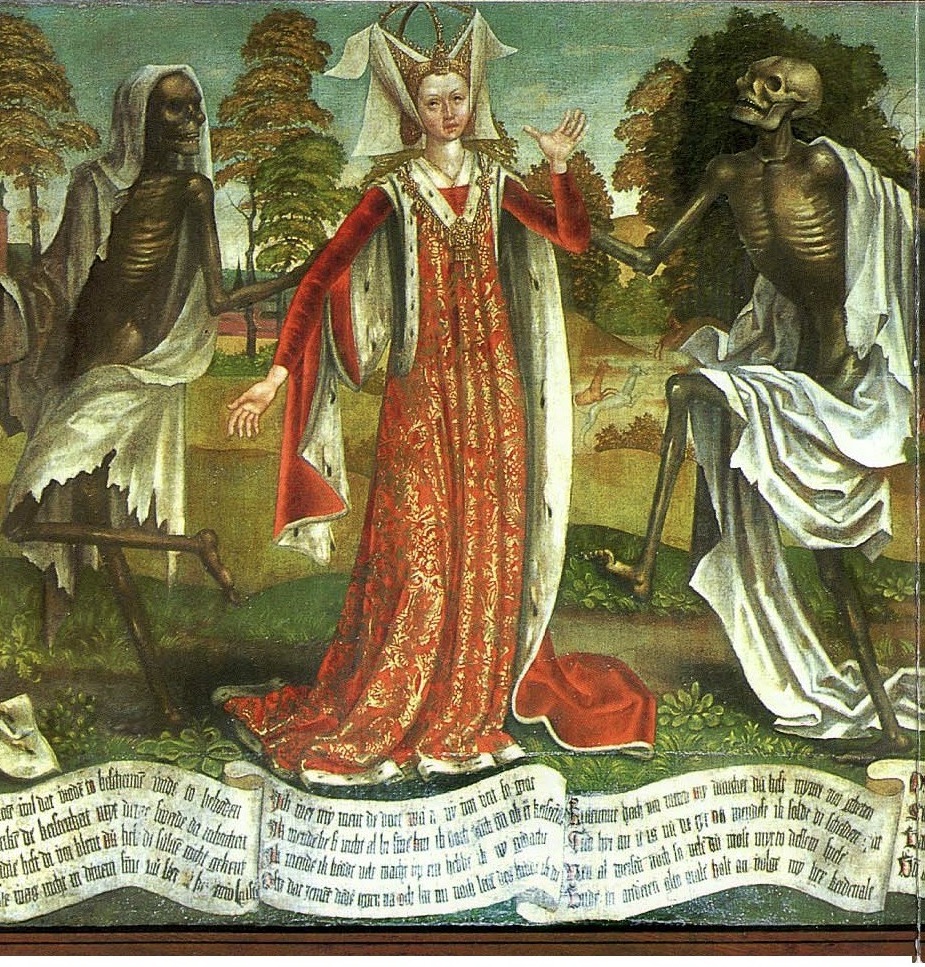
            The medieval Dance of Death was a grave moral genre that applied to human morbidity the gloomy attitudes of the ascetic mind as it meditated upon the terrors of a punitive theology.  The ubiquity and capriciousness of human mortality, a reality of the actual conditions of human existence, were there for all to see, and all to dread.  Death, the Universal Enemy, though a Latin feminine (mors) was almost necessarily personified in masculine form--as an animated skeleton, or the Grim Reaper, or the Fourth Horseman of the Apocalypse, pale rider on pale steed.  In Schubert the terror is made more ambiguous, and in Keats it is perhaps finally overcome entirely.  In both there is an element of complicated eroticism: love and death, as in the romance of Tristan and Iseult.  Death was the fourth element added by the Romantics to the scandalous triad known in our own age as sex, drugs, and rock-and-roll.


            The “plot” of “Nightingale” is ostensibly simple.  The poet is thrilled by the singing of a nightingale, rather as I was thrilled, I suppose, by the Tetzlaff Quartet’s rendition of Schubert’s “Death and the Maiden”.  The bird’s song makes him think of his own mortality—in a world where youth grows pale, and spectre-thin, and dies—but it also seems to offer a kind of immortality through art.  The poem behind Schubert’s composition borrows the medieval legend, but is Romantic in substance.  Death is an importunate male lover, the Maiden the terrified object of advances against which all resistance is futile.  The eroticism is overt.  The Maiden is loath, indeed, but Death’s seemingly benign promise to her is rest within his arms.  The situation in Keats is very different.  For many a time/I have been half in love with easeful Death/called him soft names…/Now more than ever seems it rich to die,/to cease upon the midnight with no pain/while thou [nightingale] art pouring forth thy soul abroad/in such ecstasy!  


            There is another ancient legend complicit in “Death and the Maiden” and the “Nightingale” ode: that of the swan’s song, an achieved supernal beauty so great as to be fatal.  Not everyone who uses the term swan-song to denote an artistic finality or indeed a last act of any kind may be familiar with its ancient origins in the unnatural natural histories of Antiquity and the Middle Ages.  The swan, a bird whose beauty inharmoniously contrasted with its honking and hissing voice, was supposed, just before the moment of death, to sing one song of transcendent loveliness.  The fatal beauty of art is a common theme in the Romantic period.  Schubert’s own response in his “Swan-Song” * might be described as something to die for.  Metaphorically of course.


*https://www.youtube.com/watch?v=J7CXom-D