Wednesday, August 25, 2021

Medici Monuments


Excitement, of course, is to be judged according to a sliding scale, but by what might be called the geriatric-pandemic index, the Flemings have had an exciting week.  We escaped.  We broke out.  We found ourselves in New York City not once but twice, enjoying ourselves thoroughly on both occasions.  The trips were of quite different kinds, but both were to upper Manhattan. 


            On Tuesday we went up to visit with an old and dear friend, Christine Stansell, and to have lunch with her and her companion at a place called the Café d’Alsace, on 2nd Avenue, a nice and airy space with what seemed like acres of “social distancing” in which to savor our large pots of delicious moules marinières.  When I call Chris an old friend, I am going back to about 1970 when she was among the first class of Princeton women undergraduates.  We knew even then that she was destined for greatness, which she went on to achieve as an historian at Bard College, then at her alma mater and finally at the University of Chicago.  Among her admired books is City of Women: Sex and Class in New York 1789-1860.  She was an Ohio girl, but she came to love the city she wrote about and wanted to live there in her retirement.


            On Saturday we were in New York again, pretty much the same latitude but a tiny bit west in the longitude, at the Metropolitan Museum of Art.  We went there to see the big Medici show—an extraordinary gathering of Renaissance portraits of, or relating to, members of the famous first family of Florence.  This trip, too, came about because of a dear friend, another long-ago student and one-time colleague, Frank Ordiway.  Frank lives in Princeton, where he operates a highly respected private educational consultancy.  He is a classicist as well as a great expert on Italian culture of the Middle Ages and the Renaissance, and he has made a special study of the Florentine scene.  So we could not have had a more competent guide or, to use a possibly yet more appropriate term, cicerone.  And when you are driven from your back door to the Metropolitan’s parking garage in a spiffy blue Honda, you maximize gain while minimizing pain.


            I am by no means an expert on Florence.  But like anyone who has ever been there I love it.  I feel a little disloyal to Dante in saying this, but there is a statute of limitations on vicarious grudges.  The Medici have a rather lurid reputation among the general population.  It may have something to do with all the torture chambers, false imprisonments, assassinations, papal copulations, and that sort of thing.  I am reminded of Edward Arlington Robinson’s nifty stanza in “Miniver Cheevey”:


    Miniver loved the Medici,

                Albeit he had never seen one;

    He would have sinned incessantly

                Could he have been one.


    But to get to the exhibition within the Met, we had to go through some of the Sackler galleries.  Joan made an excellent point and a masterful analogy.  Just as it is necessary to distinguish between the Good Sacklers and the Oxycontin Sacklers, one must distinguish between the peccant and the pious Medici.
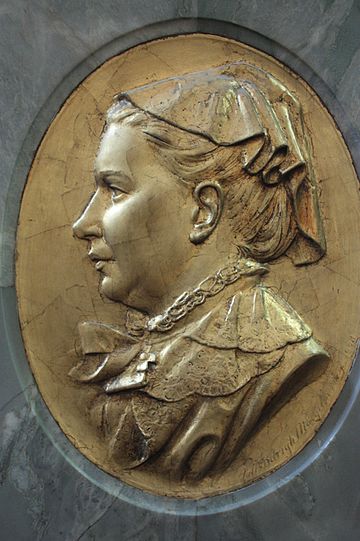


                                                         Mrs. Oliphant
             

             Pandemics have some slender silver linings.  I can’t remember another major Met exhibition so sparsely attended that you could actually see and contemplate the exhibits.  I learned a lot.  Until very recently my knowledge of early Florence derived mainly from commentaries on Dante supplemented by a magnificent but eccentric book called The Makers of Florence (1876) by the prolific Victorian novelist and amateur historian Mrs. Oliphant (Margaret Oliphant Wilson Oliphant, yes, married her cousin).  Mrs. Oliphant ends with the late fifteenth century and Savonarola, while most of the “popular” Medici (popes, queens, etc.) came later.  The materials in the Met show are sixteenth century.  Yet Oliphant’s qualified view of Medici magnificence in general is perhaps sufficiently indicated by her judgement of Lorenzo (1449-1492): A man of superb health and physical power, who can give himself up to debauch all night without interfering with his power of working all day, and whose mind is so versatile that he can sack a town one morning and discourse upon the beauties of Plato the next, and weave joyous ballads through both occupations—gives flatterers reasons when they applaud him.  Ah, if only I could have been one!  The Medici were a large clan, and liked to name their males Cosimo, but the chief of these for art historians was called Cosimo I de’ Medici, Grand Duke of Tuscany (1519-1574).  He is much on display in the Met.


            A young friend of ours, Billy Magnuson, a brilliant law professor in Texas and a reader and speaker of Italian, is in the process of publishing a book about the development of the business corporation through history.  One of his chapters is on the emergence of the Medici bank.  He asked me to read through that chapter in manuscript and make any “medieval” comments that might be helpful.  I was able for form’s sake to make one or two very minor suggestions, but mainly I was learning, appreciating in a new and revelatory way the extraordinary importance of the emergence of a money economy for modern cultural developments. 


            Historical “elites” are increasingly objects of discomfort and even scorn among historians, and especially of course elite historians.  It may be disconcerting that rich people are disproportionately prominent in our social, cultural, and political histories, but the explanations are so easy and so obvious that it seems to be obtuse to fret about it.  Holding a grudge against rich people of the Italian Renaissance is not particularly productive.  It would be easy to walk through those museum galleries full of portraits of the high and mighty and see little more than the heedless hauteur, self-regard, and naked power of early robber-barons.  That is, to be sure, one thing to be seen.  I saw it and was rattled.   But it is far from the only thing.  In the current cultural climate, anachronistic virtue-signaling across the centuries is becoming a recognizable historical genre.  The impulse to cancel, suppress, erase, abolish from mind and memory those things that we don’t like is a strange exhibition of the thirst for justice.  A verse of the revolutionary anthem called the Internationale pleads thus: Let us make a blank slate of the past.  That way of thinking has not had happy practical results.  The impulse of the museum is quite the opposite, an impulse to conserve, rescue and display for study.


            One of the stranger series of Medici portraits depicts aristocratic Italian youths in the personae of sacral figures—Saint Sebastian, protector against plague, John the Baptist, patron saint of Florence and harbinger of Christ.  One that is particularly captivating imagines Cosimo as Orpheus.  A lot is going on in what seems a rather spare painting.  The mythological Orpheus, who harrowed hell to bring back from death his beloved Eurydice, had been a “Christ figure” in Christian art since late Antiquity. But no simple moral allegory fits the treatment here.  Cosimo-Orpheus sprawls in an awkward position, holding the neck of his elaborate stringed instrument in his left hand while fingering its bow in auto-erotic suggestion with the right.  The head of a large mastiff hound, emblematic I suppose of the whole animal kingdom charmed by Orpheus’s music, forces its way insistently into the scene.  It is hard to know what all this may mean.  The portrait is the work of the Duke’s court painter, Bronzino, creator of one of the most disputed, and certainly one of the most libidinous paintings of the Renaissance.*  We may be mystified by the meanings and motives behind works of art that have come down to us from the remote past, but we must first marvel at the miracle of their survival.  Visiting museums has been among our favorite pastimes.  This was our first post-lockdown museum after well over a year of enforced recusal.  I regard that as a little allegory of resurrection all on its own.


*See https://gladlylernegladlyteche.blogspot.com/2020/10/appalachian-baroque.html


Tuesday, August 17, 2021

Gubernatorial Valedictory


            Andrew Cuomo’s resignation as the Governor of New York had a long news run these past two weeks, remaining competitive even in the face of Olympic autopsies, pending Afghan catastrophe, and Haitian earthquakes.  The achievement of catastrophe in Kabul finally got him off the front pageThe news concerning Mr. Cuomo varied from day to day.  First there was speculation concerning whether such a dramatic development as a gubernatorial resignation might, well, develop.  Then came the countervailing stories about how it couldn’t really happen and how it certainly would happen.  The governor’s chief of staff resigned, charges of unsisterly collaboration with the Man swirling about her head.  She had been “Cuomo’s Ghislaine Maxwell,” somebody said, referring to the intimate friend of the late Jeffery Epstein, alleged to have helped Epstein bed teenagers.  The governor’s firm denials that resignation ever could happen were followed within twenty-four hours by apparently definitive statements that it would indeed happen, that it had in a sense already happened, though it would not take effect for another two weeks.  But the stories continue: insider revelations of desperate last-minute pleas and ploys, postmortems before the issuance of the death certificate, and attempts to find out something about the highly obscure lieutenant governor, who will soon be elevated.                                                                                                                                                                                       This is not an essay about Andrew Cuomo, however, only a meditation on certain aspects of his situation.  I am not a resident of New York, nor a knowledgeable observer of its politics.  I have to admit that my generally unfavorable view of the departing governor, who always struck me as arrogant and self-regarding, is of long-standing.  Many people, including the dispensers of Emmies, seem to have admired his nearly daily coronavirus pep talks; but I thought they were long-winded and hectoring.  And that voice!  Furthermore, as a democrat I have an aversion to our family political dynasties that began when John Adams sired John Quincy Adams.  A country with a population of over three hundred million probably has more competence and talent spread widely around than that found in a few favored families. That said, I would choose to avoid joining in the pile-on and offer some general observations about the curious contours of political cancellation.

            I am hardly the first to note that there is a certain capriciousness that operates here. Grabbing at third rails does not always prove fatal to Democrats.  Consider the following two cases. You will remember that Senator Al Franken was photographed simulating lascivious intent toward a woman asleep in an airplane.  This was a theatrical, performative mime designed to represent to others, beginning with the photographer who was recording it, that Al Franken found a woman’s boobs desirable and arousing.  It was crude and it was sophomoric and to anybody even slightly distanced from the moment it certainly failed to amuse, but it was not an actual sexual aggression.  Harassment may be difficult to define, but at a minimum I should have thought it required actual and direct tactile and/or verbal contact, or at least concrete material signs (unwanted bouquets of roses, murdered pets, slashed tires, etc.) of which a victim is made consciously aware.  Nonetheless several other women had their say, and Franken was out.  The drop in the average IQ of the Senate was mere collateral damage, the price of purification.

            But then we have another photogenic politician, Governor Ralph Northam of Virginia.  In the hierarchy of political criminality race generally trumps gender.  So it certainly looked as though Northam’s goose was cooked when a photograph of him from his college days, in which he appeared pigmented as an artificial negro, turned up out of nowhere—nowhere meaning the research files of his political enemies.  I will not go into any of the actual ambiguities of “blackface” because nobody else did.  People simply called for his resignation.  Northam abased himself with apologies in a series of intermittent struggle sessions.  Right thinking people continued to demand that he go.  This was two and a half years ago.  A few are demanding it still in a ritualistic sort of way.  It is not going to happen, because there are big differences between Cuomo and Northam, quite apart from their offenses.  One minor difference is that there were some people who liked Northam.  But the real reason was that the election of a Democrat in Virginia was regarded as halfway between miracle and revolution, and the Democratic Party wanted in no way to jeopardize a hard-won foothold which it hopes to secure and expand.  There hasn’t been a Republican governor in New York since Pataki, and there may well never be another one.  Under these differing circumstances it is possible that similar loudly proclaimed high moral principles will lead to dissimilar concrete results. 

            Mr. Cuomo’s theory that he is a victim not of his own grotesque behavior but of changing social rules in the sexual arena is perhaps a small step toward righting the serious imbalance of trade in cognitive dissonance amassed by Republican leadership during the Trump presidency and its aftermath.  "In my mind, I've never crossed the line with anyone, but I didn't realize the extent to which the line has been redrawn. There are generational and cultural shifts that I just didn't fully appreciate."

            If there has been an evolution of mores in in these matters, surely it has been in the opposite direction to that posed by Mr. Cuomo.  That is to say, social relations between the sexes have become ever more relaxed and permissive, with a tone ever more “liberated”.  In our country and many others this trend has been noticeable, and well noted, since the end of World War I, which is to say for a full century.  Don’t take my word for it when you can consult the testimony of the genius sociologist Cole Porter.  He wrote “Anything Goes” in 1934, two years before I was born.  “In olden days a glimpse of stocking / was looked on as something shocking, but now, God knows--anything goes.”  And he added another verse of special interest to literature professors: “Good authors too who once knew better words,/ now only use four letter words/writing prose, anything goes.”  Too true.


Cole Porter

            The goalposts have been moved?  The line has been redrawn?  The rules have been rewritten?  Mr. Cuomo seems to suggest that according to some unstated rule of the good old days of his youth, any big shot man was entitled to feel up any female target of opportunity he might come upon.  But surely no normal, decent person of either sex or any party can have believed that then or thinks that today.  To the extent there has been a rule change, it has been among journalists rather than politicians.  In JFK’s day you simply didn’t write about off-topic stuff like that.  The media engines of excess mentioned by Cole Porter are “those little radios.”  He knew nothing of our social media which leave no stone unturned and no slug or elephant bug beneath the upturned stone unrevealed or without its thousand “likes”.  Let it all hang out, or in this instance, crawl out.  I don’t know that anything goes, but Cuomo is going.

Wednesday, August 11, 2021

Inscribed History


            Last week I was bragging about being able to unload about two hundred books, slightly relieving the distressed shelves of my library and slightly relaxing marital tension, with what was generously described as “a good first step”.  The essay was a self-indulgent ode to bibliographical virtue.  This week you get the palinode—a fancy word for “retraction” or in politic-speak “walking back.”


            I had gathered the books I purged last week more than ten years ago when I was writing The Anti-Communist Manifestos.  This was a work of literary history unlike anything I had done before.  There was no single reason I undertook it, but a decisive influence was my accidental discovery of a writer previously unknown to me, Richard Krebs, a German immigrant who wrote in English under the name of Jan Valtin.  Only a few experts respond to the name of Jan Valtin today, but in 1941he was America’s best-selling author, and the controversy swirling about him and his blockbuster book (Out of the Night) remains an important episode in the curious history of American Communism.  Valtin, as I will call him, had been a Communist agent working in the German merchant marine.  He may also have been a Nazi agent.  He entered America illegally in the mid-1920s, was convicted of armed robbery in Los Angeles in 1926, and served time in San Quentin before being deported in 1929.  He returned to America, again illegally, a decade later, jumping ship in Virginia and making his way to New York with the intention of making it here as a writer.  His success in achieving that goal was astonishing, but fame brought its own problems.  One of them was that he was an enemy alien and a convicted felon who was in flagrant violation of American law simply by being here, but I will say no more of that for a moment.  The problem as he and his publisher saw it was this: how quickly could he put together a best-selling sequel to Out of the Night?


            The only thing he had in the ice box, so to speak, were some random sketches he had published in the San Quentin prisoners’ literary journal when he was a stripling youth.  These had been assignments in an extension writing course offered by the University of California, and taught by a high-minded and socially engaged journalism professor.  The pieces are not very good, and the book Bend in the River is more or less, well, blah.  It pretty much flopped.  But it is a genuine Jan Valtin book, and the copy I was about to give away is inscribed by the author.  This is not unusual.  He was lavish with his authorial signature.  But I had forgotten that this copy was signed, and I decided that I must keep it.  And since I was keeping it, maybe I’d better actually look at the inscription: To Mary E. Gallagher in appreciation of her gallant and selfless friendship.  Jan Valtin.  March 12, 1942.  Hmmm. 


            I then did something mad.  I presented the name “Mary E. Gallagher” to my friend Google.  As expected, there were approximately three million hits for approximately four hundred people named Mary E. Gallagher.  But I didn’t give up.  I then tried “Mary E. Gallagher Jan Valtin.”  For this you get precisely one suggestion, but it made my day.  If the general history of radical movements in twentieth-century America should be something that interests you, I suggest you do the same thing and I promise you the same results.  For what shows up is a substantial typed document, the transcript of a long interview given by Mary Gallagher to a researcher in an oral history project at the University of California on December 18, 1955.*


            Mary Gallagher would have at that time been 72.   Her immediate ancestors were Irish famine refugees.  She had spent most of her life—like so many of our lives, directed by personal inclination interacting with accident and opportunity—in the radical labor movement.  She knew most of the leaders of the International Workers of the World (the IWW or “Wobblies”) and experienced the effects of the national hysteria of the “Red Scare” of World War I and its postwar aftermath.  As a girl in Chicago she had fallen under the sway of the charismatic Honoré Jaxon, who had been the right hand man to the leader of the Métis (mestizo) rebellion in the Northwest territory of Canada in 1885.  She knew Emma Goldman.  She abandoned her Catholicism before she was twenty, but seems not to have replaced it with a doctrinaire political dogma, of which plenty were available at the time.  Her heart burned for justice.  What the Berkeley historians seemed most interested in were her roles in leading the defense committees for Tom Mooney and, later, Warren Billings, IWW martyrs long imprisoned in San Quentin on manifestly framed-up charges.  The Mooney-Billings affair (1916) is probably still regarded today by most labor historians as second only to the Sacco-Vanzetti case of the 1920s in the celebrated iniquity of its injustice.  (And there’s a pretty good chance that Sacco, at least, was guilty of murder.)  Eventually Gallagher’s work paid off.  First Mooney, and then Billings, gained release.  There’s more, much more, fascinating material in Gallagher’s interview.  She was involved in important episodes of American racial injustice.  Her second husband was a vaudeville performer, and she invested much energy in the National Theater Project.  I’d like to know a good deal more about this amazing little old lady, but I have to fast-forward to page 114 of her interview to get back to Jan Valtin.


            In 1941 the real Jan Valtin, Richard Krebs, was the sensationally successful author of a supposed autobiography that was, among other things, a devastating exposure of international Communist criminality.  Unfortunately, he was also a criminal himself.  Powerful forces, including the surprisingly influential American Communist Party and its legion of fellow-travelers, joined in strange alliance with right-wing super-patriots like the popular columnist Westbrook Pegler, were doing everything they could to get him discredited and deported.  Of several hoops he must leap through, the first was presented by his criminal conviction for armed robbery in Los Angeles fifteen years earlier.  This problem could go away only with the active intervention of the sitting Governor of California with his pardoning power.  In my treatment of this problem in The Anti-Communist Manifestos I struggled to figure out how Krebs pulled this off.  As I surveyed my materials, Culbert Olsen, the governor in question and the most radical governor in America, possibly in American history, seemed to me the unknown unknown.  I got it mainly right.  Krebs was backed by (among others) the head of the ACLU, by an influential Democratic congressman from Los Angeles, and by a celebrity Iowa farmer who had Olson’s ear.  Those were the intermediaries I knew about and invoked.  But all the time more important testimony lay hidden in the uncontemplated inscription that Krebs/Valtin had written on the fly-leaf of my battered ex-library copy of Bend in the River on March 12, 1942.  Krebs had been rescued by the “gallant and selfless friendship” of Mary E. Gallagher.  Gallagher, head of the Mooney Defense Fund, had worked closely with Olson.  The two were soulmates in their thirst for justice and their attitudes toward underdogs.  Krebs surreptitiously travelled to California to consult with her.  She introduced him to Olson, as she explains in her interview.  She could not have known, because scarcely anyone alive knew, the actual political ambiguities of Krebs’s past.


            One serendipity leads to another.  I hope to find out more about Mary Gallagher, and perhaps write a little something about her in collaboration with a dear old friend, Christine Stansell, my one-time colleague and now a University of Chicago professor emerita.  She has written important books in the field of American women’s history and hence knows a lot I don’t know.  She was in the first class of Princeton undergraduate women; and half a century ago she spent time with our family and other young friends battling the wilds of the Ozark wilderness in the attempt to construct a log cabin.  We are now both getting a bit long in the tooth, so this imagined collaboration may never happen.  But the inevitable unpleasantness of the aging process can be softened by harmless pipe-dreams.  And as Browning puts it in “Andrea del Sarto”: Ah, but a man’s reach should exceed his grasp, or what’s a heaven for?  In light of my subject I point out that the word man there is not gender specific.  In the old usage it means humankind. 


*https://digitalassets.lib.berkeley.edu/roho/ucb/text/gallagher_mary.pdf.


Wednesday, August 4, 2021

Anti-Communist Purge


                                                 a boot-load of books
 

            In 2010 I published a book unlike any other I had previously published or even thought about writing.  It is called The Anti-Communist Manifestos.  It deals with four famous or at least once-famous books which first appeared in England or America between 1940 and 1952, and, if my argument is correct, exercised considerable influence on Western attitudes toward Communism in the period of the Cold War.  Perhaps the best known of the four, and the only novel among them, was Arthur Koestler’s Darkness at Noon. The other three, in chronological order of publication were Out of the Night by Jan Valtin (pseudonym of Richard Krebs), I Chose Freedom by Victor Kravchenko, and Witness by Whittaker Chambers.  Don’t be alarmed if you haven’t even heard of one or two of these.  I did say famous or once-famous.


            Though I was confident that I could say at least a few interesting things about each of the individual authors and their books, the general intellectual background—the political history in Europe and America of the interwar period, with special emphasis on international socialism—was a vast topic for which I had to read very widely.  As I said at the time, to write knowledgeably about four books required me to read some hundreds of others.


            For many years the second-hand book market in this country—in marked distinction to that in Europe—has been very advantageous for impecunious readers.  The reasons for this are interesting, and might in and of themselves offer material for another essay.  But one reason is that a huge Internet aggregator, which brings thousands of sellers together on a single site, provides motive and means to undersell competitors, especially for items that have little or no rarity value, meaning probably 98% of all books ever published.  You will find church rummage sale prices combined with nearly endless selectivity.  I can almost guarantee you that the red-hot book on the front page of the Times review (current price $39.95) will be available for $15 on Ebay within a couple of months.  Ten years from now Better World Books will practically be giving it away.  That even most best-selling books enjoy but a fleeting fame or popularity was an implicit theme of my study.


            In any event, attempting what for me was a novel kind of writing—a book with a broad subject intended for a general audience, a book with substantial factual presentation and arguments, but without the bibliographical supplements of an academic study—led me to a new model of production.  I wrote the book mainly at home rather than in a research library.  I was able to do this by putting together, in my study, a library of two or three hundred books I actually needed or thought I might need, practically all of them bought very cheaply second-hand over the Internet.  I still had the resources of a major research library when I required them. But if for five bucks you can own a book with a permission slip to scrawl upon it at will and leave as many food stains and tea-cup rings as are needed, fold down pages, or leave overnight to be rained on in the back yard, why on earth would you expend the energy, time, aggravation, and gasoline to drive across town to the library in the never certain hope that the desired book will be on its shelf?


            It was a great system, and one I continued to use in writing two subsequent books.  But of course there is a “downstream” problem, as you doubtless can anticipate, even if I did my best not to anticipate it.  The day will arrive when the world has one more book than it needs—the one you just published—and you have three hundred more than you need.  What do you do then?  Temporize, of course.  What I did was to pack up many carboard cartons and plastic milk crates with the sub-library I had amassed for my project.  I then stacked these containers in piles in a partially available closet—the supposed “empty nest” never approaching anything close to actual emptiness with the departure of our adult children over the years.  I was able to force the door shut and forget about it, sort of, for about a decade.   But even the most long-suffering and supportive spouse has a limit, and in our house the limit is considerably less than three hundred unvisited books in milk crates.  Judgment Day has come, and with it the urgent obligation to transport the slag heap from the quarry for The Anticommunist Manifestos to the intake depository warehouse at which donations for the annual Bryn Mawr Book Sale are accepted between the hours of ten and noon on Wednesdays and Saturdays.  This Bryn Mawr sale is a very big deal in our town, and it seems to have morphed into the “Bryn Mawr/Wellesley Sale” while I was not looking.  As you either already know or can easily guess, it is an annual fundraising effort organized by alumnae of distinguished liberal arts colleges in support of their alma mater.  I don’t know how many years it has been running, or how many more it can survive.  The constraints of the coronavirus regime are (we pray) temporary; but several seismic shifts in the world of book culture generally are not.  My hope, of course is that the sale could go on forever.  There is something admirable about a community shake-up and redistribution of library materials in the aid of educational institutions, the advancement of knowledge, and the increase of pleasure.


            With regard to the books I am offloading, it is impossible to avoid commenting upon convergent themes of purgation.  Stalin’s phony purge trials and their accompanying judicial murders clouded the rosy view that many western intellectuals had managed to maintain of the Russian “experiment”.  In its high-minded attempts to preserve its political purity by purging everything that was impure, Bolshevism did a fair job of destroying itself, quite apart from piling up mountains of collateral damage.  I recall a lurid passage early in Whittaker Chambers’s Witness (the last of my four “anti-communist manifestos”) in which he identifies as a decisive moment in his own political conversion, in 1935 or 1936, the year of my birth, his first awareness of Stalin’s Great Purge.  “The Communist Party of the Soviet Union had begun to condition itself for the final revolutionary struggle with the rest of the world by cutting out of its own body all that could weaken or hamper it in that conflict.  It was literally sweating blood.”  I am trying to be a little less apocalyptic and to keep the blood-sweating at the figurative level.  I am not consigning all my books to the basement of the Lubyanka prison.  I hope indeed I am offering them a new lease on life, or at least a brief extension of the old one.  And as for the bourgeois sentimentalism so despised by Ivanov, the “bad cop” interrogator in Koestler’s Darkness at Noon, I am afraid I rather revel in it.  I have exempted a half dozen titles from the purge out of personal affection.  And I don’t have it in me to give away books inscribed to me by their authors.

Wednesday, July 28, 2021

Tongues in Trees

                                                               Rosalind.  Well, this is the Forest of Arden
 

            It still seems unclear whether or not we have reached a real turning point in beating back the plague.  Some signs are good, but as viral variants spread and vaccinations  lag, there is a persistently pessimistic tone in much of the press.  At best, the tentative liberations we are now enjoying reinforce the realization of the constraints, limitations, and contractions that have shriveled our lives.  That what doesn’t kill you makes you stronger is an aspirational thought, but no more convincing than most in its genre—that of whistling in the dark.  It is truer to say that what doesn’t kill you can still do you a pretty severe damage.  The whole world has suffered, and continues to suffer, a wound that will leave its continuing scars.


            Ordinarily one can safely turn to the world of nature for philosophical comfort.  The old belief was that the balm for the sores created by human cupidity and its corrupted institutions is to be found in the simplicity of the natural world.  One of the most famous set pieces in Shakespeare, the Duke’s “Forest of Arden” speech early in As You Like It, gives classical expression to the idea of the superiority of the honest roughness of rustic nature to the smooth but noxious sophistications of high society.  Sweet are the uses of adversity, which, like the toad, ugly and venomous, wears yet a precious jewel in his head.  And the Duke goes on with a famous statement of the benign didacticism of Mother Nature.  “And this our life, exempt from public haunt, finds tongues in trees, books in the running brooks, sermons in stones, and good in everything.”


            A once famous twelfth-century poem, now known only to experts whose obscurity matches that of the objects of our attention, is called The Complaint of Nature.  Its author was a theologian named Alan, from Lille, in northern France.  The poem is built about a startling conceit.  Nature is imagined and personified as a radiant woman clad in a sumptuous panchromatic dress, the brilliant colors of which display the full beauty of the natural world in all their variety and sparkle.  It is, in fact, the whole of the material creation represented in textile form.  But Dame Nature has a great sadness, allegorized by a single glaring flaw in this garment—a tear or fissure in that part of it representing human beings.  The complaint or lament of Lady Nature’s soliloquy is that human beings alone, out of all  the natural creation, behave in perverse and unnatural fashions.  I hesitate to debate matters of divinity with Alain de Lille or any other medieval doctor of theology.  Still it seems to me that he may have missed something.  He didn’t face coronavirus, but he would have been quite familiar with several other nasty plagues and hideous illnesses.  But he still did anticipate the circumstance of a natural world damaged and wounded by human dereliction.  This is the world we read about in stories about raging forest fires, eroding seashores, and poisonous smogs.


            If you read my last post you will know that like the Duke I am one inclined to find tongues in trees and sermons in stones, and the walk I took yesterday was a little disturbing in this regard.  I wrote about the cicada phenomenon a couple of months ago.  It is over, but its evidences are still quite visible, and some of them are unpleasant.  The stinking corpses and the creepy little exoskeletons are mainly gone now, but there are other archaeological remains.  Any patch of bare earth on the footpaths through the woods is likely to be perforated by a dozen or more dark holes, about the thickness of a cigarette.  These are the mouths of the little tunnels from which the midget monsters emerged after their seventeen-year hibernation. The buzzing bugs emerge to lay their eggs along the tender twigs of trees, and they seem to favor some of the most beautiful ones in our parts, including old oaks and beeches.  By some process I do not understand, they make a series of little cuts, surgical incisions really, along the length of the twig ends.  These look almost mechanically precise, as though made with a sewing machine.  They so weaken the little stem ends that they often crack, especially if jostled by strong winds.   Sometimes they actually break off and fall to the ground, but mainly they simply hang there, dead and brown.  I remember reading somewhere in one of the tougher mystery writers—Chandler, perhaps?—that people who are serious about slitting their wrists always start at the wrist and drag the blade down along the length of the forearm.  The cicadas are very serious about laying their eggs.  The continuity of the species pretty much defines the whole duty of a cicada.  I don’t know that they can actually kill a mature tree, but they can certainly uglify it.  The dispiriting visual effect is depressing, and with trees free-standing in fields or house yards it is augmented by the nasty litter of dead and desiccated fronds about the tree base.


            The tongues in these trees do not tell so happy a story.  The portents are not good.  However poignant, the autumnal shedding of leaves has its commodiousness as well as its inevitability.  But these ugly dead twig ends attest to violence and pathology, not  a seasonal rhythm as old as time.  What we see here is abrupt, premature, disturbing.  I am writing this on a hot, sultry July day, but somehow I am forced to face adumbrations of summer’s end.  It’s not a very good feeling, though I know my reaction actually has less to do with the weather than with family movements.  We have seen a good deal of all three of our children this summer, but that long-awaited and too rapidly passing pleasure will soon enough come to an abrupt end.  Richard and Katie Dixon and daughter Ruby are seizing the rare opportunity of a respite in their professional lives to give themselves a kind of cultural sabbatical and educational enrichment program by moving to southern Spain for a few months!  They have already lined up what looks like a gorgeous house in Granada.  We shall soon add to our roster of polylingual grandchildren one who lisps in Castilian.  They leave in a couple of weeks.  Luke, Melanie, and their two delightful kids have been in the South visiting the maternal family home, and we shall have them briefly with us again on their long trek back to Canada.  But that family, too, will be gone before we know it.  Montreal is not all that far as the crow flies, but the crow doesn’t have to deal with the pandemic regulations that for the moment make Canada seem as far away from us as Canton.  Our Manhattanites are still in place, but there is a shake-up there as well, with one granddaughter off to college within a month and another already immersed in the excitements of a rising high-school senior.  There is still a fast lane out there somewhere, but it’s not for us.  We are the old folks at home.  That has a nice sound, but the reality of it is a little disquieting.


Wednesday, July 21, 2021

Sign Me Up


            The title of one of Augustine’s most brilliant and accessible works—De doctrina christiana (On Christian Doctrine) is likely to mislead and possibly discourage potential readers who probably would find its contents fascinating.  In our English language doctrine usually means a specific dogmatic proposition or article of faith, but doctrina here refers less to what is taught than to what teaching itself is.  He begins by saying that all doctrina deals with one of two objects, res (things) and signa (signs).  Oversimplifying only wildly, the world of res is our STEM world: empirical observation, measurements, calculation, material analysis and so on.  The sign-world of signa is our humanistic world of interpretation and moral and aesthetic analysis and judgment.  Augustine was curious about the world of things (science), but this particular book is devoted to that of signs, concerning which he makes another two-part distinction.  All signs are either natural or conventional.  Smoke on the horizon is a natural sign of the thing fire.  Any sentient human being can interpret the sign correctly.  But how about the word “fire” (ignis in Latin)?  It too is a sign of fire, but only by convention among speakers of Latin.  Other groups, according to other conventions, will call it pyr, fuoco, brand, feu, ogién, and fire.  The identification of human language as conventional sign systems is what makes Augustine’s book an important contribution  to language theory to this day.


            Not everybody acknowledges the kinds of signs that animate this essay, but they permeate our language in such phrases as signs of life, signs of spring, signs of the times, or the tired joke that “it’s a sign that you’re getting _______ when you ________".  I have now enjoyed the excellent protections of our national Medicare insurance for many years.  For quite a while, eligible recipients could use their Social Security cards for purposes of Medicare identification.  A few years ago, however, partly in an effort to combat fraud and identity theft, the Federal government developed a special Medical Insurance card with an eleven-part identification code, a mixture of majuscule letters and Arabic numerals.  The transition complete, these new cards became, in theory, required for all Medicare business.  We swim in an ocean of little paper or plastic rectangles in order to go places by bus or subway, buy things, gain admission to museums, drive machines, or get a free cup of coffee as a reward for buying twenty overpriced ones.  One can carry about in one’s wallet those few that may be needed on a daily basis.  In addition I made two special little packets—one marked “Medical,” the other “New York”—to be fetched when needed from   their special box and returned to it.


            Trouble is, I hardly had gotten the new Medicare card when I lost the whole “Medical” pack.  I used it at a doctor’s office and when I went to fetch it a couple of weeks later, it was not in the designated box.  Lost!  If you are far enough along the spectrum that you make little packages of business cards in the first place, you’re certainly far enough along it to obsess over losing one of them.  The lady in the gospel who swept her house “diligently” in search of her dropped drachma had nothing on me.  I turned the place upside down.  No luck.  And there were annoying practical consequences.  Despairing of finding the card, I sought to replace it.  The Medicare website has to be among the top ten digital hells in the entire national bureaucracy; and that, as we say, is saying something.  Lasciate ogni speranza


            Months passed, and at this point my story becomes cloudy and serious because my wife had a serious health event that involved scary tests and the kind of scary specialist consultation concerning test results at which a husband wants also to be present.  My nervous preparations for this meeting included a desire to dress halfway decently.  I went to my rack of shirts and chose one of the better ones, long unused during the Pandemic.  The moment I took it from the hanger I could sense a slight surplus weight on the left side.  Something was in the pocket.  Without investigating, I immediately knew what it was, and more importantly that it was a sign, a very good one.  This consult was going to be okay.


            At first blush, this experience is so embarrassingly easy to demystify that I scarcely have the nerve make an anecdote of it.  I wore a certain shirt to a go to a medical appointment many months ago, and I chose the same shirt for the same purpose a week ago.  In the interval the shirt was simply hanging unvisited in its closet.  Yet those facts, which certainly are facts, have embarrassments of their own.  The shirt is not one that I would be likely to wear without a jacket.  I always (I thought) secured the little packet of documents in the inner left-hand pocket of a jacket.  So firm was my misplaced faith in the inviolability of this practice that when I was doing what I considered a root-and-branch search for the lost items, and ransacking the pockets of every jacket I own, including the highly improbable ones in dress suits and even (absurdly) a tuxedo, it never entered my mind to work through a row of shirts.


            The “signs” that Augustine was interested in were biblical.  Like his Jewish and Christian contemporaries he regarded the sacred text as a vast web of allegories.  The signs I have encountered during my life tend to be secular and often enough banal—the kind of amusing wake-up calls from the Universe that Carl Jung called “synchronicities” or meaningful coincidences.  I was very impressed years ago by Arthur Koestler’s book The Roots of Coincidence—at least to the extent that I could follow it.  Like all flirtations with ESP (“extra-sensory perception”) Jung‘s speculations concerning synchronicity have been assailed by materialistic physicists as pseudo-science.  But all dogma, whether spiritualistic or materialistic has to be assessed within the context of an individual life experience.  For there is more than one kind of empiricism.  Physical theory teaches us that effects have causes; that does not preclude them from having forms or echoes as well.  My own experience leads me to suppose, slightly paraphrasing Hamlet to Horatio, that there are more things in heaven and earth than are dreamed of in your departments of philosophy.  It was a mathematical genius, Blaise Pascal, who wrote “The heart has its reasons that reason does not know.”


            There is a difference between being open to the possibility of providential signals and the attempt to cultivate them through necromancy, the examination of the inner organs of birds and beasts, Tarot cards, ouija boards, or the I Ching.    Divination created a kind of extra-linguistic conventional sign system needing interpretation by an elite priestcraft.  The search for “signs” by state augurs and oracular interpreters was a major part of the Roman state religion, but some philosophers disdained it for its fatalistic “insider trading”.   Kings wanted to know in advance which side would win a prospective battle before deciding on fight or on flight.  In Lucan’s Pharsalia the great moral hero Cato declines the opportunity to consult the oracle of Jupiter Ammon, for his interest is in the justice rather than the prosperity of the cause for which he fights.  Our word “auspicious” derives from the Latin term for an interpreter of the predictive meaning of bird flights!  Self-interested clients wanted to know whether a prospective journey, marriage, horse purchase, or financial investment was auspicious.  One form seemed specially designed for literature professors: bibliomancy, or the use of great texts like the Odyssey or the Aeneid as philosophical bingo cards.  Virgil himself has some harsh things to say about ancient divination—though that of course is Dante’s Virgil (Inferno 20: 29-30).  The tedium of Medicare cards lost and found is typical of my small and banal sign-life, one far from shared and conventional but individual and eccentric.  Yet perhaps there is still time for an upgrade.  Jung thought you could by training fine-tune your resonance to synchronicities.  But then he himself had gotten off to a flying start by finding a gold bug on his windowsill at the very moment he was listening to a patient’s account of her dream of a golden scarab.  I have never stumbled upon a golden Medicare card.


Wednesday, July 14, 2021

Going Dutch


                                                        Blawenburg church in winter
 

            Last week one of our musical friends sent us an email letting us know that on the following Sunday he would be playing his violin as part of a trio during the morning service at the Reformed Church in Blawenburg.  We took the hint and showed up for nine o’clock.  It was the first time I had been to a religious service of that denomination.  The music, all Vivaldi, was well done, and nicely complemented a simple, dignified worship service and an excellent sermon.  Blawenburg is an unincorporated wide place in the road (two roads, actually) in Montgomery Township, Somerset County, NJ, on the outskirts of Princeton.  The Reformed Church, which used generally to be called the Dutch Reformed, descends from the mainstream of Low Countries Protestantism of the Reformation period.  It shares a good deal in common with English and Scottish Presbyterianism and their American descendants.  We recall that some of the English “Pilgrims” who came to New England in the early seventeenth century had first sought refuge in the Netherlands.  Today there is not all that much that is ethnically Dutch in the Reformed Church.  But just as you will still find traces of seventeenth-century French Catholicism in Québec, you might find traces of seventeenth-century Dutch Protestantism in Holland, Michigan.


            The Dutch colonial presence, which had been powerful in old New York, long remained visible in Brooklyn, Long Island,  and in parts of central New Jersey.  It survives today chiefly in place and family names, and in aging ecclesiastical buildings.  I am an aficionado of libraries.  There is a magnificent gem of a nineteenth-century theological collection preserved at the Dutch Reformed seminary in New Brunswick.  I suspect that the library acquisitions budget has been far from opulent for at least two generations, so that the collection itself has a kind of museum aura.  New Brunswick is an old town in which there is also a very large old Reformed parish church.  Indeed in the Princeton area there are many handsome old Dutch church buildings of similar design, most of them disproportionately large in reference not merely to today’s church-going population but to what might be called absolute population.  The last “official” population figure I have for Blawenburg is 190; the church I visited, built in 1832, could easily seat 300.  Sunday’s congregation, not counting the musicians, was about a dozen.  Fit audience if few, and certainly friendly.  I was reminded of a huge and absolutely empty seventeenth-century Dutch church built in stone that I saw in Colombo, in Sri Lanka.


                                                                      Reformed St. Bavo's, Haarlem
 

            Nowhere does architectural form more necessarily follow function than in ecclesiastical buildings.  Most of the church interiors one sees in old Dutch paintings are actually rather jarring to the informed eye: medieval buildings that were theologically “cleaned up” in the waves of rabid iconoclastic vandalism that were a distinctive   expression of the Protestant Revolt in the Low Countries.  A Gothic church emptied of its mysterious flickering lights, colored windows, dark side chapels and abundance of icons of various sorts can seem lifeless and antiseptic.  The public worship of the old Catholicism was built around a sacred performative mystery, and often enough mystification—what Browning memorably called “the blessed mutter of the Mass.”  The Protestant reformers demanded a radical return to the Bible, to its reading and to its explication by their preachers.  When they began to raise new church buildings, the difference in emphasis became obvious in the architecture: simple undecorated boxes, though often with lateral balconies, with the focus on central lecterns from which the Bible was read and pulpits from which it was preached.  There had been to some slight extent a medieval anticipation of this in the churches built by medieval Dominicans—members of the Order of Preachers—whose buildings have with exaggeration been called “preaching barns”.


            I am hardly an expert on the religious history of the Low Countries, but I did read a couple of books years ago that have stuck with me.  The first was The Rise of the Dutch Republic (1856), by John Lathrop Motley.  Motley was an accomplished statesman and amateur historian whose works, though now pretty much discarded, found a large popular audience in the nineteenth century.  The major theme of the work is the triumph of Protestant liberty over Catholic religious oppression in the Spanish Netherlands of the sixteenth century.  Despite certain biases, it is full of fascinating episodes vividly recounted.  The other book is an extraordinary and now sadly neglected novel first conceived in that same year of 1856, though published only a decade later: The Legend of Ulenspiegel by Charles de Coster.*  This brilliant work may be the Moby Dick of Belgian literature, though perhaps a little shorter.  The original text celebrates, in a pseudo-Renaissance French, the exploits of the famous folk hero and trickster Till Eulenspiegel.   The name is translated “Owlglass” in early English versions.  The iconographic attributes of an owl and a glass (i.e., mirror) characterize visual representations of this Wiley Coyote of popular Low German literature.  De Coster honors the bilingualism of his region while transforming a legendary picaresque figure into a hero of religious liberty in an actual historical situation: quite a remarkable feat, really.


                                                                Eulenspiegel and friends, by Lukas van Leiden

and in a Renaissance comic book


            All this came flooding into my mind along with the Vivaldi “Sarabande.”  Perhaps it was the noble simplicity of that piece that brought to my mind two other unavoidable (for me) cultural connections with the simplicity of Netherlandish Christianity.  These were the Beghards and the Beguines, on the one hand, and Erasmus of Rotterdam on the other.  It is possible that you have never heard of the former.  The Beghards (men) and the Beguines (women) were lay followers of the religious life in late medieval Europe—monks and nuns, so to speak, but living in the lay world.  They were to be found in many parts of Europe, but particularly in the Low Countries.  Their lives, like those of so many of the simple folk in The Legend of Ulenspiegel, were often considered scandalous by the official ecclesiastical authorities, but the official ecclesiastical authorities were experts in finding scandal.  As for Erasmus of Rotterdam, he is a household name.  He was one of the most learned men in Europe as the age of the Revival of Learning began, and his erudite works continue to challenge scholars to this very day.  He was the editor of the first modern scholarly edition of the Greek New Testament, a book that has probably been the most seriously studied text in the world for half a millennium.  But of all his own original works his favorite, and mine, is as simple in its aspect as an old whitewashed church building on a country road.  It is called the Enchiridion, or Handbook; and it lays out the vision of a simple Christian life very different from the stultifying logic-chopping of the dogmatic theologians of his day.  I think of it as especially Dutch.


*Charles de Coster, The Legend of Ulenspiegel and Lamme Goedzac, and Their Adventures Heroical, Joyous and Glorious in the Land of Flanders and Elsewhere, trans. by F. M. Atkinson (London: Heinemann: 1922).  The scholarly edition is La légende et les aventures héroiques, joyeuses et glorieuses d’Ulenspiegel et de Lamme Goedzk au pays de Flandres et ailleurs, ed. Joseph Hanse (Bruxelles: Renaissance du Livre, 1959).