Tuesday, June 14, 2011

Thomas Hardy vs. the Indeterminate Sentence


I am told that in penological circles no topic is more hotly debated today than that of the indeterminate sentence. Some bad man does some bad thing, and a Judge says: “That’ll be three to seventeen years [or whatever] in the Allegheny Work House [or wherever].” The indeterminacy is supposed to be an encouragement to the felon, so that he might deport himself in such a way as to be more consistent with the smaller rather than the larger number. Of course determinacy might also be an encouragement. In the middle of the eighteenth century a naval court martial condemned Admiral John Byng to death for his supposed cowardice or incompetence at a battle in the Balearic Islands. There were extenuating circumstances, but Voltaire wryly remarked that now and again the British felt they had to hang an admiral in order to encourage the others.

But I must not digress. This post is about indeterminate sentences, and I am against them. That is, Thomas Hardy and I are against them. There is an experience that most readers surely have shared while walking through some populated place, or when crossing with pedestrians walking in the opposite direction. One catches what we call a “snatch” of conversation. Overheard cell phone conversations are also good for this purpose. Sometimes one hears things so extraordinary as to pose a challenge to the imagination. What possible context might lend them coherence?

Once on a street in Rye, Sussex, I encountered two elegant gentlemen, one of whom said to the other: “Was it ormolu? I mean, actually ormolu?” That is all I heard. Here the indeterminacy is fathered by the word “actually”. It is weird enough that anything might be ormolu, but that one would have to attest to its actually being ormolu is just too much. How many things out there are just pretending to be ormolu? Another dilly once overheard was this: “…only solution—get a divorce, or fire the Chinese cook”. I leave that one up to you.
Is it....actually?

Of course a “snatch” of conversation is by definition fragmentary. A sentence is by definition “the expression of a complete thought.” Yet more and more of the prose I encounter in my daily rounds, though ostensibly written in complete sentences, seems strangely indeterminate. Often the problem is one form or another of SDS (the Syntactic Derangement Syndrome), which is now pandemic in editorial offices on both sides of the Altantic. The copybook example of SDS is probably known to you: “Abraham Lincoln wrote the Gettysburg Address while riding to Gettysburg on the back of an envelope”. A clever diagnostician will identify the problem here easily enough, and call in the word-surgeons. Abraham Lincoln wrote the Gettysburg Address while traveling to Gettysburg on the back of an envelope….Just kidding.

More often, however, the level of incoherence is more comprehensive and hence more baffling. I am usually up and about quite early, some considerable time before the brightening of the eastern sky or the arrival of the New York Times on the carport driveway. At such hours, in my continuing quest for self-improvement, I visit websites claiming to offer news, sometimes even the “latest news”. For the past two or three days I have intentionally avoided American sites, having reached saturation point so far as congressional undergarments are concerned. So this morning I went first to the BBC page. Was I any better off? You be the judge.

The story that greeted me there was summarized in the following sentence: “On Monday, Mr MacMaster, originally from the US state of Georgia but now a student at the University of Edinburgh, said he was sorry for posing as a Syrian lesbian”. What interests me is less the story itself, engaging though it be, than the puzzle presented by the sentence. There is no way to tell what, amidst all the information seemingly contained, the author considers important. Is it Mr. MacMaster’s contrition or his Cracker origins? Would he be equally sorry for posing as a Sudanese lesbian? How about a Syrian bricklayer? Is Monday as significant as its rhetorically emphatic position might suggest?

By chance I happen just now to be reading The Mayor of Casterbridge (1886) by Thomas Hardy. Further by chance its opening sentence is superficially similar in its construction to that cited from the BBC news summary. “One evening of late summer, before the nineteenth century had reached one-third of its span, a young man and woman, the latter carrying a child, were approaching the large village of Weydon-Priors, in upper Wessex, on foot.” The big difference is that Thomas Hardy knew how to write a consequential sentence. A reader just knows that every clause in that sentence is stress-bearing. The reader probably also suspects, since it is Hardy, that the child will be dead in no time at all, and the woman soon enough, leaving the man to arrive at his miserable end with Victorian leisure. But Hardy’s is a sentence that makes you want to turn the page, not to send the writer off to writer’s camp for three to seventeen weeks.
 Their fates will be cruel, but ever so well written

Tuesday, June 7, 2011

My First Century of Blogging

 This post witnesses the completion of my first century of blogging. If this claim seems implausible, the problem is probably philological. Cricket fans and readers of Thomas Traherne will have no difficulty, but quite a few other people seem to have forgotten the primary meaning of the word century, which is “a hundred of something”. A hundred years is only one possibility. Long before that it was the hundred centurions making up that division of a Roman legion called a centuria.

A similar fate has befallen decade, “ten of something,” now used almost exclusively to mean ten years. We don’t think that the only thing you can have a dozen of is eggs, do we? But our universal anxiety with time sweeps all before it, including your bloguiste as he sets about writing his one hundredth blog post. For the wheels of Time’s Winged Chariot have been clattering rather than whirring softly since my last effort. For starters, I turned seventy-five on the very day I flew to Europe. Yet more sobering was the news that reached me when after several days I reconnected with my email in Compostela. My Sewanee classmate and long-time friend Dave Evett had died on May 25 at his home in the Boston suburbs.  Herein, perhaps, is a topic of sufficient solemnity for the occasion.

David Hal Evett (died 25 May 2011).  May the souls of the faithful departed rest in peace.

David was a great man—brilliant, talented, energetic--an athlete, a singer, an actor, a powerful writer. Our careers, personal and professional, had several external parallels. When we first met in the fall of 1954 we were amused by the coincidence that we both came from small towns called Mount Pleasant—one in Michigan, the other in Texas, but both double misnomers. After college Dave went to Dijon on a Fulbright Scholarship, then on to Harvard for his Ph. D. in English and, as it turned out, an equally doctoral spouse, with whom he would raise three highly accomplished children. We almost but not quite overlapped in the English Department at Wisconsin, from which he later moved on to a long and distinguished career at Cleveland State University. He was the author of important studies in the field of Renaissance Literature. In retirement he and Marianne removed to the Boston area, where all three of their children had put down roots. He died peacefully, as I understand it, after a meal at which his whole family was gathered.

Dave was also an excellent poet. In lieu of a Christmas card he would send out each year an original Christmas poem, and we never could regard our seasonal preparations as complete until it arrived. Naturally in my state of disorganization I cannot now lay my hands on the anthology of these poems he prepared for distribution at our fiftieth class reunion a few years past. But I do have one poem of his in my computer—one not entirely inappropriate for this blog century. It is called “Alumni News,” and it responds to the announcement of the death in 2004 of another classmate (called by the poet’s sensitive pseudonym Matthew George Todd), once close friends to us both.
Probably no more lost than most

Gertrude Stein famously called her fast-living expatriate Parisian friends of the 1920s “a lost generation”. But I doubt that her generation was much loster than mine—or perhaps yours, or any other. The sheer number of my bright shining classmates who crashed upon the shoals of life, not a few of them last seen adrift on a sea of alcohol, is appalling. Of them there might seem no more poignant example of sheer waste than that afforded by “M .G. Todd”. Evett’s evocation of the “inheritors of unfulfilled renown”—a famous and tragic phrase from Shelley’s “Adonais”—was hardly hyperbolic, given this man’s talent and potential. Like most good poems, this one tells a story, the outlines of which are sufficiently clear, even without any footnote explication of its enriching details:


ALUMNI NEWS


Matthew George Todd, ’58, of Austin, Texas, died March 11, 2004.


Lean, cool,
with a voice like George Sanders'
and a wry snort of a laugh
and a graduation watch identical to mine.
Riding the Southern on the last leg together,
Nashville to Cowan, Tennessee,
through leads in the senior play,
basketball, Hemingway,
we frisked into cronyhood
like two dogs into a wood.
Bronze hours:
dismayed to find him deadly from the key,
though I was stronger off the boards,
I challenged him at tennis,
and lost there, too;
we both paid homage to Bill Rotten
if the last trump refused to fall.
When the old Dodge balked
an hour north of Knoxville
on the way to some Virginia college weekend
we watched the winter sun strike
through the window of a clean, well-lighted place
the silver bubbles rising through the Bud,
the plywood booth, the green baize; Keats
was more real to us than the bodies of girls, then,
and we were all inheritors
of unfulfilled renown.
Later, he dared auditions and casting calls
off Times Square, the high life
of singles in D.C. played
against a barren federal job,
too much drink and sex,
while I took a safer road
through graduate school and marriage.
After this fraying globe
spun him back to Rose City, Texas,
an epistolary confession
twenty years long
on sheets from yellow legal pads
tracks his battles
with the flesh and the world and the church:
addiction was the Devil,
he knew, and wrote a long, strange book
to prove it that no-one would publish.
When a draft of this sat unread
while I tried to finish a book of my own
the letters stopped. I let it lie.
Can we not think about how he died last month,
leaving me this glum rage
over the slow corrosion
of bronze hours and my failure as a friend,
and about that devilish voice instead?
Three no trump? Double, I say. Snort.
Is there any more beer?  [David H. Evett, 2004]

The concluding lines about the obligations of friendship cut to the quick.  After twenty years of silence "Todd" had resurfaced in my sphere as well, first with a mad and truculent essay about the Cathars, then with the searing but incoherent manuscript about addiction to which the poem alludes.  One didn't know where to begin.  I, too, "let it lie".  But a couple of years later, around 2000, an academic conference took me to Austin.  By a near miracle I tracked "Todd" down by mail, and arranged to meet him for a meal.  He had greeted my initiative with something like enthusiasm, but the night before our scheduled meeting he called me at my hotel.  He abruptly, rudely, indeed angrily cancelled, then hung up the phone. I never saw him nor heard from him again.

As for David and me, the friendship was continuous if seriously intermittent.  In the last decade (of years, I mean) we tried to meet at least once each year, in New York in November, at an annual conclave of the somewhat Trollopian group known as the Guild of Scholars of the Episcopal Church.  We had in fact pre-scheduled a private conversation on the topic of "the nature of religious faith" for last November, but I bagged it when I had the chance to go to Paris instead.  At the time it seemed to me one of life's easier choices--between talking about religious faith or going to Paris, I mean.  Now I am not quite so sure.  I'll think about it more during the next century.

 The Cumberland Mountains around Sewanee TN

Wednesday, June 1, 2011

Paean to the Pilgrims


Joanna Peregrina


It has been facetiously remarked of long-married couples that the partners become so used to putting up with each other through compromise and accommodation that in time they approach near identity even in physical appearance. Approaching my current physical appearance is not a fate I would wish upon most enemies, let alone my life partner, so I was delighted to discover that even after being married for forty-eight years, eleven months, and twenty-five days I could discover an entirely new and unprecedented reason for admiring my wife. As Shakespeare’s Enobarbus says of Cleopatra:
             Age cannot wither her, nor custom stale
             Her infinite variety….
Fortunately, the context in which I recalled the lines was much more propitious than that in which Shakespeare had placed them in his play. It was last Friday, about 11:15 in the morning (local time) near the entrance to the south transept of the medieval cathedral of Santiago de Compostela in Galicia in northwestern Spain. In a miracle nearly as astounding as any of those performed of old by the ferocious apostle himself, we actually successfully met up as planned with our pilgrims—two moving needles in a large and chaotic moving haystack of ambulatory humanity. Though the calculation is not yet absolutely final, Joan and her friend Susan had walked just under a thousand miles to get there.

 Susan & Joan / Compostela 27 v 2011  What a feat!  Also, what feet!

Five years ago, Joan’s friend and fellow Dante student Susan—twenty years Joan’s junior--was facing her fiftieth birthday. She suggested that a good way to mark the event would be to walk upwards of two thousand kilometers through southern France and northern Spain. You or I might think of a less strenuous way to be festive, but as the old saying goes, Different strides for different brides.

There were literally hundreds of pilgrimage sites in medieval Europe, but the three greatest were Jerusalem, Rome, and Compostela, the legendary home of the relics of Saint James “the Greater”, the brother of Jesus. I use the word "legendary" with some temerity, as Spaniards of the Middle Ages and Renaissance entertained no doubts whatsoever. Saint James, Santiago (i.e. San Yago or San Diego), became their national patron saint, and in his martial role as Matamoros (“the Moor-slayer”) an emblem of their ferocious ethnic cleansing in the fifteenth century and their imperial expansion in the sixteenth.


Any reader of Chaucer will know that medieval pilgrims undertook their travels out of many motives; but a long pilgrimage was always a serious business. The original meaning of the English word "travel" is preserved in the French travail—work—a form preserved in our tongue only for the agonies of childbirth. Travel was in fact so difficult, dangerous, and painful that it was appropriately undertaken as expiation for serious crimes. Canon law required those preparing for a “major” pilgrimage to leave behind their properly executed wills. The chances that they would die en route were significant.

The Compostela pilgrimage drew Christians from all parts of Europe, and it has left its memorial traces in many surprising places. (The rue Saint-Jacques in the Latin quarter of Paris, for example, takes its name from its original destination.) The scallop-shell emblem, originally an attribute of the saint himself, has become the more or less universal emblem of pilgrimage. “How should I your true love know from another one?” sings Ophelia in Hamlet. “By his cockle hat and staff, And his sandal shoon.” In recent years, the Compostela pilgrimage has enjoyed a remarkable rebirth of popularity. The percentage of seriously “religious” pilgrims is not large, but probably not proportionately much different from in Chaucer’s day—about three twenty-ninths in my calculation. There are also many young outdoors types, and lots of life transitions and inner searches. The mode of a few would appear, perhaps, to be that of the Wife of Bath: better described as cruising than journeying.  Of course the theory of medieval asceticism always linked the voluntary embrace of self-abnegation with material ministration to a needy world.  Joan and Susan called their undertaking "a pilgrimage with a purpose"--one external part of which was to raise a significant amount of money in aid of an imaginative international charity--the Worldwide Orphans Foundation.

 The Apostle's Reliquary

But what an adventure! What an engine of companionship! Chaucer’s pilgrims started out in a pretty fancy hotel where they were “esed atte beste.” Joan and Susan, like the huge numbers of today’s Compostela pilgrims, had to content themselves with modest commercial or monastic hostels. So far as I can tell the most typical activity of pilgrims is the nightly hand-washing of intimate items of apparel! You can trace the four stages of our pilgrims’ progress on the map below.


Their plan evolved.  Originally, they had plotted the pilgrimage for three stages in three succeeding years.  The demands of what we laughingly call "real life," however, soon showed that they could not devote more than seventeen or eighteen days of walking to a stage.  This meant it would require four stages.  Though circumstances made them miss one year, they kept to their revised design: four stages of almost 250 miles each, averaging fifteen miles of serious hiking a day.   Stage 1: from Le Puy en Velay in south-central France to the old medieval city of Cahors. Stage 2: Cahors to Saint-Jean Pied de Port, the traditional crossing place across the Pyrenees into Spain. Stage 3: Saint-Jean to Sahagún between Burgos and León. Stage 4: Sahagún to Compostela. The other pilgrim spouse (also a John) and I have thought of ourselves as a kind of technical “support team”—sort of like the guys who used to accompany Channel-swimmers in a motor launch, ever ready to beat off shark attacks. Pilgrimage turns out to be much easier if aided by the Wizard of Avis. But no cross, no crown. We didn’t get a diploma, the way the ladies did.

The purpose of this blog post is to salute my remarkable wife on a remarkable accomplishment. To gain their certification, pilgrims must register a few vital statistics with the peregrine officials. Joan did note that she was the sole septuagenarian on the large ledger sheet she signed. I doubt there were many on other pages either.
We know that life is a pilgrimage, and so also no doubt is marriage. There are other metaphors as well. We stumbled upon one quite by accident. We spent a most pleasant day in Compostela, before moving on to Madrid for some tapas and Velasquez, and thence back home. Old Compostela has many attractions, quite apart from Santiago and his golden shrines, and we hope one day to return. In the old Dominican monastery, now the regional museum of Galicia, there is a fascinating triplex helicoidal staircase, the work of the seventeenth-century Compostelan architect Domingo Antonio de Andrade. Three soaring sets of steps, each seemingly unsupported and each interlacing but never touching its fellows, rise from the old cloister level to the several stories of the old monastic buildings.


We started up separate flights and for a while circled each other, now coming closer, now drifting away. But by chance the flight I had chosen stopped one floor short of the top, and I was left looking up in admiration at my spouse’s greater ascension. Looking up, perhaps, as the poet Dante once did—
              E quasi peregrin, che si ricrea
              nel tempio del suo voto riguardando,
              e spera già ridir com’ ello stea…(Par. xxxi, 43-45)
And, as a pilgrim, in the temple of his vow / content within himself, looks lovingly about / and expects to tell his tale when he gets home.

Tuesday, May 17, 2011

Another Victim of the Protestant Terror


 "This is a very, very defensible case..."  (Benjamin Brafman, DSK's lawyer, NYT 5/17, p. A10)

VICTIMS OF PURITAN ZEAL  


 "Had there been a Papist among the crowd of Puritans, he might have seen in this beautiful woman, so picturesque in her attire and mien, and with the infant at her bosom, an object to remind him of the image of Divine Maternity, which so many illustrious painters have vied with one another to represent..." (Hawthorne, The Scarlet Letter, LoA edition, p. 166)

Readers impatient with my prose have perhaps already deduced that while I am writing I am frequently also doing something else, listening to music, or even NPR news reports, through the cunning i-Tunes feature of my i-Mac.  On Saturday, as I was trying to write about Enlightenment mysticism—and, yes, there was a lot of it—I became vaguely aware of something about Monsieur Dominique Strauss-Kahn, “head of the International Monetary Fund.”   This man is so famous that like JFK and LBJ or KSM he rates “initials treatment”: those in the know call him DSK.  Earlier that day detectives of the NYPD (likewise famous) had arrested him on an airplane on the tarmac at Kennedy Airport.  The plane was just about to take off for Paris, and DSK had apparently intended to go with it.  But the police, notorious spoil-sports that they are, said he must first answer accusations of rape or attempted rape brought forward by a house-maid at the Sofitel Hotel in the city, where DSK had just hurriedly vacated his “$3000-a-night suite”.

The Sofitel: understated, but not without a certain naive charm
      
 The news could not really compete with the weirdness of Emanuel Swedenborg or Louis-Claude de Saint-Martin.  In fact it was hardly weird at all, if you follow politics much.  It is true that Strauss-Kahn is a Socialist and the head of the IMF.  It is further true that Socialists preach social equality, and the IMF spends a certain amount of time lecturing the governments of the earth about how they must “tighten their belts” and “live within their means”.  Hence one might conceivably ponder the necessity of a “$3000-a-night suite” for the Socialist head of the IMF.  (Recall the powerful moral iconography of Matt Damon at the Motel Six in The Rainmaker?)  Yet even the hypocrisy quotient seems relatively mild when compared with that of one of our American good ole boy, born again, senatorial philanderers from our very own Family Values Party.
            So I never for a moment thought Strauss-Kahn’s situation the proper subject for a blog post, preferring instead to engage you about something comparatively consequential, such as Frederick the Great’s commerce with the Illuminati.  I changed my mind when I got to the gym on Monday morning, where to my amazement my good friend and fellow matutinal natator, the plasma physicist Dr. T. K. Chu, was talking about it.  To be more precise he was talking about the fact that “many” contributors to the Comments Section of the New York Times’s international news blog had already concluded that Strauss-Kahn was the victim of an obvious set-up.  He wuz framed.
            The alchemical transmutation of a drossy sexcapade to the glistering gold of political intrigue through the catalytic agent of a conspiracy theory changes matters entirely.  A really good conspiracy theory might indeed compete in wackiness with the eighteenth-century Rosicrucians.  One difference between an indifferent and an excellent conspiracy theory is that the latter can support incompatible, even contradictory explanations.  This one is excellent.  Think about it for a moment.  How beneficial might it not be for left-wing Barack Obama’s reëlection prospects were IMF types to cease scolding America for its fiscal profligacy?  Think further.  How much more beneficial might it not be for right-wing Nicholas Sarkozy’s prospects were the formidable Socialist front-runner suddenly eliminated?
            I know only what I read in the American papers—another way of saying that I know little.  So I now turned toward the French blogosphere.  So happy are my French memories that I had almost forgotten what it was that I most hated about French political anti-Americanism.  It is too simplistic to attribute it all to arrogance.  One must also factor in the ignorance.  I get a quick sobering reminder from Gilles Savary and his stimulating blog essay “Gibier de guet-apens” (roughly “Fresh Meat from the Trap.”)  Gilles Savary is a French Socialist buddy of DSK, a member of the European Parliament, and a prominent bloguiste.  His essay’s argument is so incoherent that a reader might at first miss the truly breath-taking quality of its chauvinism—both national and sexual.  Allowing the broad-minded theoretical possibility that there might actually be something in the rape charge, Savary is much more inclined to one or both of two alternative explanations: (1) feminine wiles, and/or (2) American Puritanism.
 Monsieur Gilles Savary: seldom known as GS

            “It is easy to entrap,” writes Savary “a person so little resistant to the attractions of the female tribe [gent féminine]” as DSK.  Everyone in the know knows that DSK is a “libertine”.  DSK differs from other libertines chiefly in not concealing the fact of his libertinism.  (Thus Savary).  Well, I don’t know DSK; so I’ll have to take Savary’s word for it.  But it’s hard to swallow what he serves up next.  It is this: Frenchmen wisely pay little attention to the libertinism of their public figures.  The vestigial Catholic mentality, you see, easily forgives sins so long as the sinner expresses regular contrition.  “In Puritan America, impregnated with an unbending Protestantism, they are infinitely more tolerant of money shenanigans than of the pleasures of the flesh.”  Yes, infinitely.  Bernie Madoff, take heart.
            A widely circulated photograph taken at the funeral of François Mitterand in 1996 shows the famous man’s wife and mistress standing in near proximity, grieving at the graveside.  This was slightly anterior to the breakout of the Bill Clinton/Monica Lewinski madness here.  Several French commentators—and a few American ones—invoked it to exemplify the sophistication and realism of French political mores as compared with the puerile Puritan hysteria of American boobs and Babbitts.


Autres pays, autres moeurs
            But that is unlikely to work this time, if it ever did.  I have no certain opinion concerning whether or not Mr. Strauss-Kahn did or did not do it, but I at least know what it is.  The prosecutors are not charging DSK with political virility, conducting politics while French, libertinism, or even vulgar indulgence of “the pleasures of the flesh”.  They have accused him of serious sexual assault.  Choosing its adverb carefully the New York Times points out that forcible rape is a crime “even in France”.  Somebody, preferably somebody French and of the gent féminine, might point that fact out to Mr. Savary.  The same newspaper identifies the complaintant as a thirty-two-year-old African immigrant, a mother who lives in the Bronx.  It seems unlikely that in turning to the NYPD such a person would be motivated by the protestantisme rigoriste of Cotton Mather or Jonathan Edwards, but I suppose it is possible.

=========================

Ad lectorem

Later this week your bloguiste flies to Spain, there to applaud his spouse as she crosses the finish line at the portal of the Cathedral in Santiago de Compostela, toward which she has been walking, in stages,  for roughly a thousand miles.  The regular posting schedule will resume in early June.  Until then, things are iffy, blogwise.


Tuesday, May 10, 2011

Fresh from the Sulphur Springs Fair


Katherine Anne Porter (1890-1980)

Mike the letter-carrier left a hefty package on my front porch on Saturday.  I smiled when I found it there, for I knew what was in it: eight beautiful, mint volumes of the Library of America, snapped up for a song (roughly five bucks apiece) in an eBay auction.  So cheap were they that I could absorb the inconvenience that I already owned two of them, which will now grace the growing libraries of one of my children or friends.  Sometimes you gain so much on the straightaways that you can easily absorb the delays occasioned by the roundabouts. 
I had been expecting the books, but was not prepared for the return address.  It turns out that I had bought them from a private party in Sulphur Springs, Texas.  That may mean little to you, but we used to play those guys in football.  My noble but fiscally calamitous, rainbow-chasing parents dragged me through eight schools in five states.  Where they dragged me to in the fall of 1952 was an East Texas town called Mount Pleasant and the high school that became my alma mater.  Sulphur Springs was about forty miles west, and for us it meant the real boondocks—an attitude doubtless reciprocated by the Sulphurians, who were, after all, that much closer to Dallas.
 Actually most East Texas towns of that era looked pretty much like “Anarene” in The Last Picture Show, except that there wasn’t nearly that much sex around—a sad reminder of the crucial difference between fact and fiction. But Sulphur Springs had a special proverbial distinction among the regional Hicksvilles and Nowhereburgs.  America’s greatest humorists have ever been its real or pretended provincials; and the parodic boast “I’ve been to the Sulphur Springs Fair”—with or without an added “twice”—was a mocking claim to exotic experience and deep sophistication.


East Texas: more like the Deep South than the Wild West


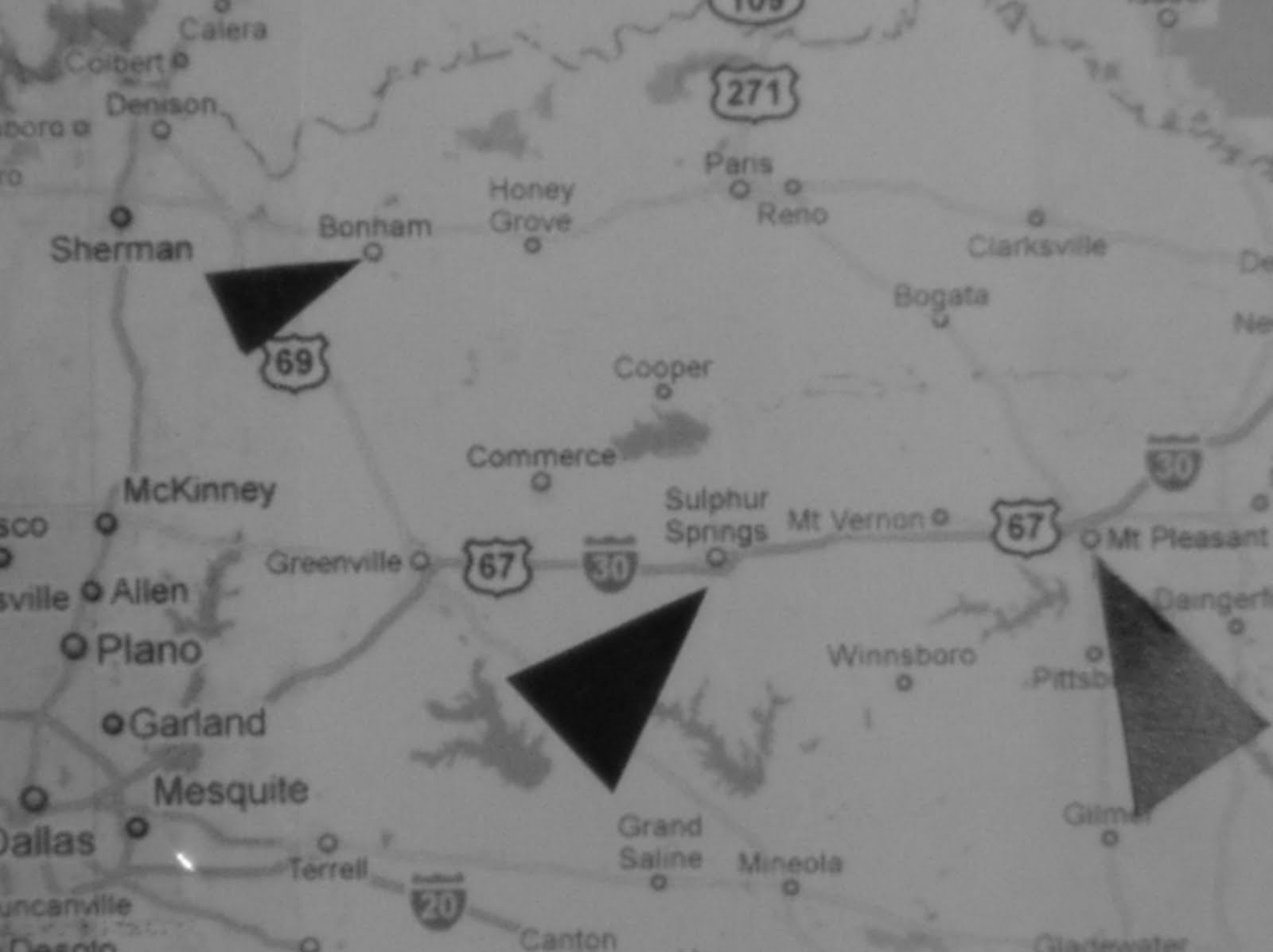
Mount Pleasant is the seat of Titus County, Sulphur Springs of Hopkins County.  About fifty miles northwest of Sulphur Springs is Bonham, seat of Fannin County, the third point in these triangulated memories.  Fannin County was the birthplace of one Great Man (Sam Rayburn, the legendary Speaker of the House); one Bad Man (John Wesley Hardin, the legendary outlaw); and at least one very Good Woman (Cora Louise Nelson Davidson, my maternal grandmother).  Born in 1873, she spent her earliest years on the Red River, the border between Texas and the Indian Territory (now Oklahoma).  She was orphaned early, and sent back east to an Episcopal school in Terre Haute, Indiana, long since defunct, to prepare to be a teacher.  By the age of twenty or twenty-one she was half of the “school system” in Salida, Colorado.


 From Shadow to Reality: Cora Louise looks back over Four Generations

Indeed I had always supposed her to be a native of Colorado.  She revealed to me her Texan origins, which she seemed to regard as slightly shameful, only when I myself moved there.  We have a few things from her, now transferred in trusteeship to her great-great granddaughter Cora Louise Fleming-Benite (born 2004), including her baptismal spoon.   Since little Cora has had all her schooling in France, she probably has not needed another of her ancestor’s relics, an elementary French grammar, which begins with a lesson on how to engage a fiacre (a horse-drawn carriage) at a Paris train station.
What all this Texas stuff is in aid of is the prize book in my package of prize books from Sulphur Springs: Library of American # 168--Katherine Anne Porter’s Collected Stories and Other Writings.  Of course I already owned editions of her most famous story collections—Flowering Judas and Pale Horse, Pale Rider.  There is no better writer of short fiction in the English language, period—an utterance of critical “extremism” I am willing to defend.  But many of the “other writings,” which are not easy to find, are likewise gems, and I am delighting in them. 
Porter was born in the hamlet of Indian Creek, Texas, in 1890; she lived in the Lone Star State until early adulthood; and Texas is a recurrent theme in her writings.  Her attitude toward Texas was not unlike that of my grandmother, who could have been her older sister.   On the other hand she loved Mexico, and lived there as much as she could.  Two short essays of particular poignancy are “Notes on the Texas I Remember” and “Portrait: Old South”.  In the former she tells in her beautiful lapidary prose a horrible anecdote of a group of poor Hispanics ejected from a religious revival in Kyle, Texas, about 1897, on account of being poor and Hispanic.  She died in 1980.  I wish she could have accompanied me in spirit to my amazing fiftieth high school reunion, organized, naturally, around a home football game.   In 1954 the schools in East Texas were still racially segregated.  In 2004 many of the Mount Pleasant Tigers—including the guy who seemed to rule their backfield—were black.  Half of the high-kicking majorettes—a group hardly less important in the aristocracy of a Texas high school than its football stars—were Latinas.  People who think things never change sometimes need to think again.
Katherine Anne Porter knew most of the American literary greats of the 1920s and 1930s.  Like many of them she was a “left-wing intellectual” deeply engaged in our nation’s spectacular injustices and the strange insecurities that gave birth to the Red Scare of 1919, sadly reborn in another form three decades later.  Yet her great political masterpiece, so far as I can tell, was written in 1977, when she was eighty-seven years old!  It is her brilliant memoir—she calls it a “story”--fifty years out, of the agitation surrounding the executions of Sacco and Vanzetti in August, 1927.  Everything about it is perfect, beginning with its title: “The Never-Ending Wrong”.  How can it be that I never came upon this essay while I was writing The Anti-Communist Manifestos?

The never-ending wrong is the larger meaning of the possible judicial murder of two immigrant Italian anarchists; but there are other wrongs, including the shameful arrogance of blind political superstition. “It is hard to explain, [she writes] harder no doubt for a new generation to understand, how the ‘intellectuals’ and ‘artists’ in our country leaped with such abandoned, fanatic credulity into the Russian hell-on-earth of 1920.  They quoted the stale catch-phrases and slogans.  They were lifted to starry patriotism by the fraudulent Communist organization called the Lincoln Brigade.  The holy name was a charm which insured safety and victory.  The bullet struck your Bible instead of your heart.”  I have rarely encountered such wholeness of vision—and I’ve been to the Sulphur Springs Fair, twice.
Her every page bears the stamp of genius

Tuesday, May 3, 2011

Two Weddings and an Assassination

Natalie and Dany on the ballroom floor


The Sahara of my social life is not punctuated by conveniently spaced oases, but it is sometimes, for brief periods, inundated by monsoons of conviviality. Such a happy drenching characterized the last weekend. It began with a dinner party we gave on the eve the British Royal Wedding, not that the two events had the slightest genetic connection. Indeed the Royal Wedding gave me the opportunity to practice my curmudgeonly arts. I didn’t think about it. I certainly didn’t get up in the wee hours to watch it on television. And I was inwardly annoyed that conversation concerning it played a prominent role at our dinner party. This is “nothing personal,” as they say. The young couple are doubtless very nice people, and God knows they are headed for a life one wouldn’t wish on beasts of burden. But I am a patriot and a constitutional conservative. The Constitution says that “No title of nobility shall be granted by the United States” and that no American official can receive “any present, emolument, office, or title, of any kind whatever, from any king, prince, or foreign state”. In one of the Federalist papers Hamilton gives the motive for this clause: "One of the weak sides of republics, among their numerous advantages, is that they afford too easy an inlet to foreign corruption."

Foreign corruption—a great phrase, that. Yet true democracy seems too terrible to bear; as the liberated Hebrews of the Exodus lusted after the fleshpots of of their slave-masters in Egypt, Americans seem to lust after the hereditary aristocracy abolished more than two centuries past. Verily, we have had our reward. Whereas the vices of the Borgias or the Valois had about them a certain admirable awfulness, American aristocratic vice tends to the squalid and the banal. How can the aberrant drowning of a single girlfriend at Chappaquiddick compete with beheading several wives, or even just murdering the young princes in the Tower?

Perhaps my disgruntlement was actually founded in a groundless fear that static from the Royal Wedding might mar the sweet music of the real wedding I was to attend the next day in suburban Philadelphia. On Saturday, in St. John’s Lutheran Church in Melrose Park PA, our friend Natalie Deffenbaugh married Dany Mehry. Natalie is an alumna of the Princeton Class of 2002. Dany is Lebanese, and I don’t actually know about his school or class, except that he showed a great deal of it in marrying Natalie, a beautiful woman of dazzling intellectual ability and luminous ethical character. They are both professional international aid workers who once joyously united almost immediately faced a period of separation, as Dany returned to his assignment in Iraq, and Natalie to hers in the Congo.

The ceremony, which was intrinsically beautiful, was further beautified by the singing of the bridesmaid, Jennifer Borghi, a professional mezzo-soprano already familiar to readers of this blog. The officiant conducted the wedding service and the Communion liturgy with an easy yet impressive dignity, and she preached a brief but memorable sermon carefully crafted for a couple whose youthful vocations have been service among the world’s poor and downtrodden. Wedding couples are sometimes asked to memorize a brief passage of Scripture deemed particularly appropriate for their union. The preacher assigned to Natalie and Dany an unusually long passage—not for memorization (she reassured them) but for contemplation—the whole of Jesus’s Sermon on the Mount, which takes up three entire chapters of the Gospel of Matthew.

 The church had an arresting architectural feature I had never before seen: a single window in the east end, cruciform, filled with a painted glass Crucifixion

The preacher had given us the hard counsel of “getting beyond the beatitudes,” and I discovered her intention for myself when I reviewed the text the next morning. What could be more comforting than “Blessed are the pure in heart”—or the meek, or the merciful, or the peacemakers? And what could be more challenging and disturbing than much of what follows?

“You have heard that it was said, ‘You shall love your neighbor and hate your enemy’. But I say to you, Love your enemies, and pray for those who persecute you.” It is from this same passage that such phrases as “turning the other cheek” and “going the extra mile” have entered the secular vocabulary of the English language, to be used daily by thousands who have no idea of their source. But has there ever been advice more absurd than Love your enemies? I wasn’t thinking about that then--as we feasted in the church hall and danced our geriatric best to strange Levantine beats.

That might have been enough festivity for any mortal, but we capped it the following night at a dinner at the fabulous New York apartment of our friends Michael Goldman and Eleanor Bergstein. Michael, an eminent scholar of drama and a fine poet, was my colleague for forty years. The popular meaning of the word mensch might have been invented for him. Eleanor, for whom "glamorous" is one mot juste, has had a fabulously successful writing career most famously as the creator of Dirty Dancing, one of the most widely viewed films (and now stage shows) of a long generation. Lots of people know that already, but I am in a position to out her as well as an amazing cook. Nobody puts Baby in a corner…but the kitchen? Strongly advised.

 Michael Goldman and Eleanor Bergstein on the set of Dirty Dancing

We had not seen each other in a long time, and the animated conversation of old friends, which often has a priceless quality, was further enriched by the presence of other, brilliant table guests. The long evening would have been memorable even without its dramatic ending. As midnight approached, indeed as we and the other guests were just beginning to make going-away noises, the telephone rang. It was a friend and assistant of Eleanor’s, calling to advise her to turn on the television set, quick. President Obama was just about to announce the death of Osama bin Laden.

We listened to the whole of the President’s announcement. It was of a definitive solemnity, and the evening was over. We took the subway local from Columbia University station down most of the length of Manhattan to Christopher Street. As we walked a few short blocks to our borrowed apartment, the streets were already abuzz. There were occasional shouts of exultation from festive undergraduates along Fourth Street. When we got to the apartment, we immediately turned on the Tube to see scenes of more young people, now massing on Times Square and at Ground Zero. Somebody had a large American flag. There was the usual exhibitionism of playing to the camera. The vibe was of a slightly bibulous athletic event. They were all chanting, as they might chant in support of their team in the semi-finals: U-S-A, U-S-A!

Who could blame them? A mass murderer, and one who added to the enormity of his criminality the blasphemy of claiming divine sanction for his crimes, had received a just retribution, and, given geo-political realities, probably the only one plausible. Why, then, did the gloating seem to me vaguely unseemly? Sometimes, surely, just getting within shouting distance of the beatitudes ought to be enough, without contemplating the impossible task of getting beyond them.

Tuesday, April 26, 2011

What Would Jesus Tweet?


Stanley Spencer, The General Resurrection (Tate Gallery) 


Not many readers, perhaps, will recognize the name of Walter Savage Landor; but your bloguiste is among what must be a happy few who own a fine large paper edition of his complete works—all sixteen volumes of them. Old Landor (1775-1864) was a colorful and rebarbative literary figure, who back in the day won elite critical acclaim (but, alas, only a puny popular audience) as a poet and dramatist. His most enduring works, however, are several volumes of Imaginary Conversations in which historical characters have improbable chats with each other across the centuries. Two of my favorites are a conversation between Fra Lippo Lippi and Pope Eugenius IV, and a three-way debate among Dante, Boccaccio, and Geoffrey Chaucer—on the occasion of the English poet’s well-known visit to Arezzo.


Walter Savage Landor

There are also conversations that one can only wish were imaginary. In the spiritual frenzy attendant upon the celebration of Passover and Easter, the American Broadcasting Corporation had the bright idea to launch an “in depth” investigation of the current state of American religion, in which their exotic news anchor, Christiane Amanpour, would conduct a series of probing conversations with prominent “religious leaders”. The conversation  I stumbled upon was with religious leader Franklin Graham, son of the once-famous evangelist Billy Graham.

My father was a simple believer, yet a man of deep theological insights. One of them was this: Should you have any doubts concerning the divine nature of the Church, you need only consider the miraculous fact of its continuing existence despite the nature of its leadership over the centuries. Enter, right, the Rev. Franklin Graham. He and Ms. Amanpour warily circle a couple of the great spiritual issues of the age before homing in on the most pressing of all: the Second Coming of Jesus Christ! Mr. Graham is sure that we are in the “last times”—though estimates range elastically between a week and a millennium—for all the biblical signs are there. Wars? Check. Rumors of war? Check. Earthquakes? Check.

 The Rev. Franklin Graham in conversation with Christiane Amanpour

The terrible Lisbon earthquake of 1755 caused the greatest thinkers of that age to question whether the world could possibly be governed by a loving God, but from the apocalyptic point of view it’s apparently the more the merrier. One technical problem puzzles Graham. The Second Coming will be known to “all men” (Luke 21:35). But earth’s population is very large and widely distributed across the globe. How will everybody know when the Great Event occurs? Somewhat cautiously Ms. Amanpour suggests a possible solution: will God use Social Media?

To the dramatic forms of communication already predicted by Saint Paul --“For the Lord himself shall descend from heaven with a shout, with the voice of the archangel, and with the trump of God: and the dead in Christ shall rise first” (I Thessalonians 4:16)—Amanpour and Graham add a possibility more awesome yet. Christ will announce his return with a terrible tweet!

It is an idea that had never occurred to me, to be honest, but it seems to have merit. There are actually few ideas sufficiently simple-minded as positively to benefit from the discipline of being limited to Twitter’s 140 keyboard strokes, but I suppose the apocalyptic imperative must be one of them:


Amanpour and Graham are onto something big. Some witty Torah scholar was able to encompass the entire Passover story in a Social Media format. Christian leaders ought to be able to do as well. Jesus was a man who knew his audience. “Suffer the little children to come unto me,” he said. There is every good reason to believe that were he here today, Jesus would tweet.

His followers need to follow his lead in this as in other matters. This may involve thinking outside the box. For example relatively few parts of the Bible, in its present form, are really fit for the Social Media Age. This fact may explain what seems to me to be a creeping biblical illiteracy among our youth. It’s just, like, way too many key-strokes. Take the current Ten Commandments, for example. Among their other conspicuous inconveniences is their utter untweetability. As things now stand, you get on average only fourteen keyboard strokes per commandment. Now it just so happens that, counting its two word spaces, thou shalt not alone takes up all fourteen, exactly. A carefully selected, edited, and compressed Three and a Half Commandments might rescue the social-media situation, while at the same time giving us all a slightly better shot at salvation. (I could handle honoring my parents and avoiding making graven images, and there has to be half another one I could scrape up somewhere.)

Other parts simply require the exercise of a little imagination, as in the Twitter Lord’s Prayer: “Papa God, hurry up, send bread, forgive sins like us, ixnay on the temptation, keep away from bad stuff, you’ve got big three, always. Amen.”

On the other hand, there are a few discrete passages of Scripture that are already such perfect tweets as to defy any possibility of improvement. One of them, as it happens, is strikingly appropriate to the conversation of Ms. Amanpour and Mr. Graham concerning the Second Coming. It is in fact the shortest verse in the Authorized Version of the Bible (John: 11:35): Jesus wept.