Wednesday, March 1, 2023

Seeing and Believing


On Friday, perhaps it was even Saturday, I had a telephone call from my son Luke in Montreal.  In the course of a sometimes whimsical conversation I asked him if he had read my  most recent blog post.  I was pretty sure what the answer would be, having long ago been advised by somebody who ought to know that “A prophet is not without honor, except in his hometown and among his relatives and in his own household.”  I was right.  He had not read the post; but being a modern man and an adept multi-tasker he started reading it even as we spoke.  “Well,” he said, “there’s an egregious error in the first sentence.”  Alarmed, I then did a little multi-tasking of my own.  He was right!  There was a horrible jumble of repeated words in the very first line.  Since the burden of the paragraph was a complaint that Americans don’t pay enough attention to their language, this discovery was a double embarrassment.  Meanwhile a few hundred people had already read it, all of whom had been too polite to point out the blunder.


We say that seeing is believing, but it often works the other way around.  We see what we already believe, that is what we think we see, or in this instance wrote.  When we say, “Try to see this from my point of view,” we perhaps come close to acknowledging this.  How independent is our vision, actually?  Especially when we are seeing unexpected things.


As a poetry lover, I usually read a few poems during the week; and this week one that I reviewed is pretty famous, Keats’s sonnet “On First Looking into Chapman’s Homer.”  You may well know the poem.  Keats, who could not read classical Greek any more than most of us, came upon the English translation of the Odyssey by the learned Renaissance poet George Chapman (1616) in 1816.

Much have I traveled in the realms of gold

    And many goodly states and kingdoms seen;

    Round many western islands have I been

Which bards in fealty to Apollo hold.

Oft of one wide expanse had I been told

    That deep-browed Homer ruled as his demesne;

    Yet never did I breathe its pure serene

Till I heard Chapman speak out loud and bold:

Then felt I like some watcher of the skies

    When a new planet swims into his ken;

Or like stout Cortez when with eagle eyes

    He stared at the Pacific—and all his men

Looked at each other with a wild surmise—

    Silent, upon a peak in Darien.


This is a poem about comparative gob-smacking discoveries: Hernan Cortez‘s New World discoveries and Keats’s literary discovery of Homeric epic.  Keats’s presentation is rather fanciful, but if poetry cannot be fanciful, I am not sure what actually would qualify.  Cortez never stood on a peak in Darien.  He entered what is now Mexico on the Atlantic side, naturally, and almost immediately found himself immersed in the desperate intrigues that would soon enough lead to the Spanish conquest of the indigenous Mexica.  Much later in his life he did make a memorable trip on which he came upon what is today the Gulf of California and the land that is Baja California.  The Gulf of California was long known as the Sea of Cortez, and still is in one of John Steinbeck’s most charming books.


Years ago I did quite a bit of research on Christopher Columbus, a figure mutating at Mach Four speed in our awakened history books.  For the famous Columbian Exhibition of 1892/3 he was a universal hero and a proto-Yankee business entrepreneur.  By the Quincentenary in 1992 he was a ruthless slaver and kidnapper and a kind of monstrous Typhoid Mary.  My objective view as a literary scholar is less portentous: Columbus was an amazing sailor and navigator, but a disappointingly dull travel writer.  Here he was in the Americas, seeing for the first time a world new to European eyes.  Yet the categories to which he assigned what he was seeing were mainly two: just like what we have in Castile and not like what we have in Castile.  He does report seeing some very strange sights, such as retrohumeral (back-to-front) and monocular men .  He of course could not possibly have seen them, but he was expecting to find them because he had read all about them in the ancient geographers (Pliny, Strabo, Ptolemy et al.) and medieval fabulists like Jean de Mandeville.  Remember: believing is seeing.


In 1992, when I was one of the curators of a large exhibition at the Library of Congress, I gathered together a significant library relating to the topic of Columbus’s voyage.  Just by chance, this week I had plucked from my bookshelves the classic work by the eminent historian and diplomat Miguel León-Portilla about The Ancient Mexicans*—meaning the pre-Columbian civilization Cortez encountered, commonly called the Aztec Empire.  Trying to find something in it that probably was in some other book—my memory is now rapidly deserting me—I stumbled on something highly relevant to Keats and Cortez.  If Keats compared his metaphoric literary cruise through Homer’s Aegean Sea to Cortez’s dazzling view from a peak in Darien, how had Cortez himself viewed things?
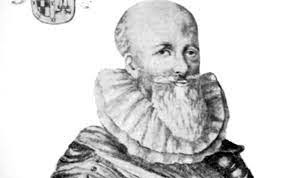
Bernal Diaz del Castillo
 

Keats’ imaginary panorama of the Pacific as viewed from a peak in Darien was perhaps as vivid in his imagination as the actual prospect would have been to stout Cortez’s corporal sight.  As it happens, there was a very good writer accompanying Cortez who recorded some of the things they actually saw.  This literary conquistador was Bernal Diaz del Castillo, who late in his life, and some years after the death of Cortez himself, published his famous True History of the Conquest of New Spain.  The small fleet of Cortez landed at Vera Cruz in February of 1519.  Cortez, who made a speech explicitly comparing himself to Julius Caesar at his point of no return, crossed his Rubicon by intentionally wrecking his ships.  Now retreat was physically impossible.  There was only one possible direction for the Spanish warriors: west along the Aztec-built highway to the Indian capital, Tenochtitlan (Mexico City), an amazing island conurbation of lakeside suburbs fronting a city of magnificent buildings.  In Columbian terms, this would have been very definitely not like what we have in Castile.  How must the first sight of the distant city have affected these Spaniards, plotting conquest while outnumbered a thousand to one, sweating in their iron suits upon their magical steeds?  Bernal Diaz del Castillo tells us.   “It seemed like those magical things that are reported in the Book of Amadís…Some of our soldiers said of what they saw that they must be dreaming….”
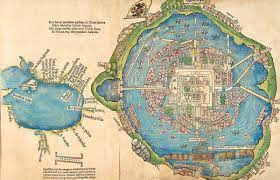
The Aztec Capital in an early map
 

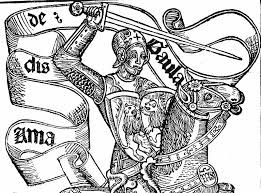
            The work to which Bernal refers is the Amadís de Gaula, an extravagant Iberian prose romance that was the runaway secular best-seller of the early period of printing, though its obscure origins go back at least to the fourteenth century.  Anything that can happen to a hero of romance, and many things that could not happen, occur in this amazing book.  The practically unbounded character of its fabulousness was made famous by Cervantes.  It was Don Quixote’s favorite work, and its inspiration is everywhere to be seen in the novel of which the deluded old hidalgo is the eponymous hero.  In other words, it was for readers in the sixteenth century the apogee of the fantastic and the fictional.  Keats, when he seeks to memorialize a supreme encounter with the literary imagination, invokes as a parallel an imagined historical event in the record  of European discoveries.  Bernal Diaz del Castillo, when he wants to emphasize the transcendental nature of an actual historical event, invokes a popular work of romantic fable.  Such is the power of versatile poetry as it mediates the fascinating terrain between seeing and believing.


*Miguel León Portilla, Los antigos mexicanos a través de sus crónicas y cantares (México: Fondo de cultura económica, 5th ed, 1989).


Wednesday, February 22, 2023

Lots of Words


            Every American is born to a rich endowment which for most of us, sad to say, remains largely undervalued, ignored, and uncultivated through the course of our lives.  I refer to our native inheritance of the English language.  English is the world’s most important language.  This is not a boast or an aesthetic judgment but a simple cultural, political, and economic fact.  Since cultural, political, and economic realities change over time, this linguistic reality may change in time.  But it has held true for much longer than the lifetime of anyone reading this essay and is likely to remain true into the foreseeable future.  It is nearly criminal that so many Americans know so very little about the nature and history of this marvelous gift.  I am tempted to write a few little pieces on this topic off and on over the coming months.


            Language is more than words, but words are a good place to start an appreciation of the genius of evolved English.  To say that we have lots of them is an understatement—or even possibly litotes.  The cultural guardians of the French language have been ferocious in preserving what they regard as its purity and correctness, trying to nip in the bud incipient invasions from the likes of le week-end.  The English language, on the other hand, and especially American English, which now calls the shots, is a magpie tongue.  We have no difficutly at all with fin-de-siècle.  Sounds classy.  We beg, borrow, or steal all the words we can.  That is one reason why the English lexicon (vocabulary, word-hoard) is so much richer than the French.  This statement, too, is merely statistical.  Line up the Oxford English Dictionary and the Grand Robert side to side and you’ll see what I am talking about.


For a language to be a major borrower, it has to have neighbors who force words upon it or who have words based in things it wants or need to borrow.  That is, vocabulary growth is often the product of vigorous cultural exchange brought about by contact, be that military, missionary, or commercial.  The British Isles in the period 500 to 1500 reveal a particularly rich and complex linguistic development.  Its ancient population of Celtic-speakers was overwhelmed by Continental invaders speaking various related Germanic dialects and largely physically expelled from what we now think of as England.  A substantial Celtic-speaking population in Wales and a tiny, vestigial one in northern Scotland, remain to this day.  Cornish, another Celtic tongue, once continuous with the Breton tongue along the French western coast in Brittany, and spoken in the southwest of England, became effectively extinct in the eighteenth century.  In England itself there were in cultural competition significantly different  dialectical versions of English, with that of Wessex (what might be call the Middle Southwest of England) eventually becoming a kind of cultural standard.  


exchanging adjectives


Over several early centuries, especially in the north and in coast regions, there were repeated military migrations (that is, invasions) from bellicose people who in the history books often get lumped together as “Vikings”, who spoke various versions of Scandinavian Germanic.  The English of the north of England is to this very day replete with Scandinavian “loan words”.  From Old Norse alone we get such common words as awkward, bag, club, die, egg, flag…and so on through all the rest of the letters of the alphabet.  But English was barely being consolidated in the British Isles when a much more disastrous invasion overwhelmed the land: the Norman Conquest.  The Normans (Northmen) were yesteryear’s Vikings whose Scandinavian (Germanic) dialects had over time been overwhelmed by the French (Romance) speakers they had conquered.  The French-speaking Norman invaders of England occupied practically all the high offices of church and state, so that a comparatively small French -speaking upper-class lorded it over a much larger English-speaking lower class.  By the time this was settling out in the age of Chaucer (late fourteenth century), English was emerging triumphant, with its old Germanic vocabulary richly expanded with a huge trove of French words.  The animal that gave you wool could be a sheep or a mutton.  The sky might be blue or azure.  Thus English “naturalized” a very large number of French words while retaining their older Germanic equivalents.  There was another large infusion of new vocabulary in the Renaissance, this one engineered by scholars who invented thousands of high-brow and technical terms (much of the language of medicine, for example) on the basis of Greek and Latin models.  Shakespeare and other writers sometimes make fun of the pedantic excesses of some of these “inkhorn terms”.


Almost all cultural exchange leads to linguistic borrowing, as people encounter new foods, new geographical features, new social structures, new and different situations.  Beginning in the sixteenth century British sea power, which went practically everywhere, returned to its little island with a linguistic bonanza as copious and eclectic as the anthropological artefacts in the Pitt-Rivers museum.  British settlers in America, surrounded by a new topography, a new flora, a new fauna, and a large variety of indigenous people speaking a variety of languages that described them, developed English versions of hundreds of Indian words.  Quite similar was the experience of other English-speaking colonials in many other parts of the world.


Very soon, probably even before 1800, the structural distinctions of American English began to appear: flashy, transgressive, careless, democratic.  Americans seemed eager to apply their penchant for superlatives to their language, to press words beyond the obvious.  H. L. Mencken, author of The American Language, still a classic, has many interesting remarks on this subject.  When an Englishman made a drink composed of whisky and soda water, he called it a “Whisky and Soda.”  Really.  The same drink in America had to be at the very least a “high ball”,  with local variations.  Call it a “Cincinnati Sidewinder” if you feel the urge.  Some of our greatest unsung poets were start-up etymologists.  In the days when I taught Old English I used to give my students the following challenge.  Let’s pick a weird word from our reading in the Anglo-Saxon Chronicle.  (One highly successful choice, I remember, was wifcuthu, a dirty word describing the activity of some uncouth chieftan when shacked up with a woman.)  The idea was simply to  start using the chosen word, in appropriate context but without further definition or explanation, in casual conversation.  The goal was to introduce and “jump start” the word into the campus vocabulary.  We often say what we hear other people saying, whether we actually know what it means or not.  When I was quite young, I wrote a Valentine for my teacher.  “Will you be my Valentine?  Can you be my concubine.”  I had no idea what a concubine was, of course; but it sounded like a great word.  Abraham, Solomon, David, and some Levite in the Bible were into concubines, so I knew it had to be all good.

Wednesday, February 15, 2023

Eagle Scouting

Eagles of Mercer County NJ


According to the weather experts in the press, central New Jersey recently endured a significant meteorological event.  Apparently the very low temperatures we experienced—two or three nights when the mercury got only to a few degrees Fahrenheit above zero—were the coldest in recorded history.  And recorded history is now more than a century.  I cannot vouch for the accuracy of that, but it got as cold as I can remember during the sixty years we have lived here.  The chill was very brief, however, and was swiftly followed by what seemed like premonitions of spring.  


Sandhill crane


Monday morning was indeed nearly spring-like.  I got up feeling quite perky, and while still at the breakfast table I resolved that I would do something passing for an adventure to celebrate—take a walk down to the lake along the pleached paths in the backwoods rather than what in the cold has become my humdrum normal route, mostly on macadam and concrete sidewalks of the side of our house facing civilization.  What Joan had been reading aloud over the cream of wheat was a charming op-ed essay by the Nashville columnist Margaret Renkl, wearing her naturalist rather than her political hat, about her visit to an Alabama nature reserve where large flocks of Sandhill cranes were beginning to break up and start North.  This brought to my mind our own local avian celebrities, a mated pair of bald eagles, although I knew that actually searching for them was a fool’s errand.  They are still in the general area, but they moved on from our lakeside tree about two years ago.  I know that I am deceiving myself when I pretend that I might be seeing them in very distant circling turkey vultures; but so much of the best in life rests on self-deception.  So I walked down to the lake, and a fair way along the riparian path, full of manufactured expectation.  It was sunny, and in the occasional open patch where protracted sunlight could do its work,even warm.  There were very few birds of even the commonest species in sight, though a fair amount of (to me) unidentifiable song came to my ears from the distant bare trees beyond my sight-line.  What I discovered , rather to my alarm, was that masses of daffodils, many of them the offspring of my own lakeside plantings,  were trying to show, and some crocuses were already out.  It is too early for this by the old norms.  Late February will almost certainly feature more deep chill.  I doubt that daffodils will be killed, but their eventual appearance could be weakened.


            I have a particular yen for “our eagle”, who for all I know is by now OurEagle 2.0. or higher.  Many years ago this eagle used to make occasional visits to a dying tree at the extreme bottom of our own back yard.  On occasion we would see him perched there near its top , but he was frequently first drawn to our attention by audio-visuals of a thrilling kind.  Sitting in our glass-walled sitting room we would sometimes hear the distinctive whoosing of his huge wings circling the house.  On sunny days the huge shadow of those same wings would flash like an intermittent  visual Morse code across the lawn and even the living room walls.  He seemed to check us out before every visit.  One morning when I went into the yard early I was astonished to see, about ten yards into the lawn, a very large and heavy fish.  Here was piscatorial mystery.  The fish had been decapitated neatly by some sharp blade held by a human hand, but it had not been gutted.  It had to have been the prize catch of some fisherman at the lake docks or canal lock, and snatched from an unattended hamper and transported here by the eagle.  Why the eagle  had to drop it is guess work.  As I say, the fish was quite heavy, but these birds are powerful.  I want think it had been intentionally dropped by eagle, a fisherman’s house gift for an old friend.  Lox!  Imagine that, a Jewish eagle.  For a mad moment I considered making it my breakfast, but unfortunately the fish looked almost as old as the friend.   In one of the passages I remember most vividly from Audubon, he describes his patient but productive espionage session in the clefts of the rock walls encasing the Ohio River trying to spy out a nesting pair of eagles.  Patience paid off.  After a long wait, he spotted a magnificent parent bird, obviously headed for a nest with young out of his peeping sight.  There was a large, whole fish impaled in its talons.


            Yet not seeing much bird life, and certainly no eagles, indirectly expanded my knowledge of the species of the Sandhill crane.  Ms. Renkl’s essay was strong on lyrical interpretation.  She is a fine writer.  But we got a lot more ornithological substance in a phone conversation with our son Richard.  Rich is an amazing bird guy—I mean, seriously.  According to some actual official record kept by some actual recognized official, Rich is the Number Two birder in Brooklyn.  This achievement is quite impressive to his parents.  Yes, I know that the “Second Prize in a Beauty Contest” is an embarrassment in Monopoly, and its ten bucks an insult.  And yes, I know, Julius Caesar said that he would rather be the Number One guy in Aups than the Number Two guy in Rome.  (Aups is an obscure village in Aquitania—today roughly the south of France, and one of the tres partes into which Caesar famously declared that Omnia Gallia divisa est.)   Aups was even more obscure two thousand years ago, when Julius passed through.  But I’m not talking about little places like Aups or ancient Rome.  I am talking about Brooklyn, population two-and-half million!


            Richard told us that the persistent changes in our weather patterns are already beginning to be reflected in our fauna no less than in our flora.  Among the species which are pushing eastward and northward are the Sandhills.  Their natural habitat is the freshwater marsh, and their greatest parade grounds are still on the Platte River in Nebraska, where their great show—around half a million of them—is usually in March.  But Rich tells us that there are now many reports of Sandhill colonies in the mid-Atlantic states, including New Jersey.  We still have quite a bit of wetland that hasn’t been blacktopped, though it’s going fast.  So it is conceivable that Ms. Renkl may someday have to start traveling north rather than south to find the huge flocks.  Who knows?  Now if we could only come up with even one mating pair of Passenger Pigeons…


Wednesday, February 8, 2023

Scholars in Provence

Peiresc 


            I suppose that all scholars are likely to develop at least some interest in the history of scholarship itself.  Most of us, however keen our aspirations to the cutting edge may be, have to acknowledge that we are but the metaphorical dwarves raised upon the shoulders of the actual giants who have preceded us.  Their huge contributions to our cultural growth derive only in part from their individual genius.  There is also the question of the preservation of that genius in transmissible written form.  We owe to the labors of medieval monks the mediation of a vast body learning from classical Antiquity which, for the most part, the mediators themselves were incapable of understanding fully.  The library is the closest thing we have to an immortality machine.


This thought, and the subject of this essay, came to mind last week while reading  a biographical essay about Nicolas-Claude Fabri de Peiresc.  Peiresc (1580 -1637) is hardly a household name, but as I shall explain he played an important role in my own bibliographic education fifty years ago.  He was a French antiquary, astronomer, and polymath scholar whose vast scholarly correspondence is almost a model of the mode of intellectual exchange that would characterize the Enlightenment period of the century and a half after his death.* Peiresc was born in rural Provence, and spent much of his life in and around Aix-en-Provence.  We are all familiar with the country gentleman.  More important for me was the country scholar.


            Joan and I were married in the late spring of 1962 and set off, more or less immediately, for a fabulous year of research and writing, mainly in France.  My manuscript researches on the Roman de la Rose naturally first focused on the collections of two great national libraries: the library of the British Museum in London and the Bibliotheque Nationale in Paris.  Only when I settled down to write in a tiny village in Vaucluse did I come to appreciate the pleasures and resources of many of the provincial French libraries.  Our village was called Beaumes-de-Venise, within fairly easy access to Avignon, where the library of the Musée Calvet (of which I had never heard) proved a gold mine for my needs.  On my first research leave, in the year of semi-Revolution, 1968, I had further opportunity to explore the local scholarly environs when—now delightfully augmented by two small children—we settled down for a time in L’Isle-sur-Sorgue, near Petrarch’s old haunts at the foot of Mont Ventoux.


L'Inguimbertine

and

the Archbishop


       There is every reason that Avignon, once a capital and papal city, might have a significant library, but I was amazed by the mouldering treasures of the town library of the grim little city of Draguignan.  Even more amazing was Carpentras, a place I had never even heard of before I drove by it on my way to buy melons in the “melon capital of the world,” Cavaillon.  Carpentras (Vaucluse), with a population today of perhaps 30,000 was the “big city” for the two Provençal villages in which we have lived.  Like many small towns and small cities in the south of France and northern Italy, it remembers a vanished past with imposing public architecture that today seems outsized: an ambitious town hall, an ancient synagogue, and above all an architecturally dazzling library/museum, the Bibliothèque Inguimbertine.  This was the pet project of the humanist-monk Archbishop of Carpentras from 1735 to 1757, Joseph-Dominique (Malachias) d’Inguimbert.  Many French ecclesiastic institutions did not survive the Revolution, but this jewel, and its large and precious collection of early printed books, miraculously emerged more or less intact.  The day I first visited it there was on display a small collection of learned works by the local scholar who—according to the information posted—had been one of the Archbishop’s chief inspirers: Fabri de Peiresc, who had been born just down the road!

            Had I found the peer of the Morgan or Newbury Libraries in a suburb of Altoona, I could not have been more surprised or delighted.  In the half century since I stumbled upon it, the Commune of Carpentras has continued to maintain, improve, and expand this living monument to the learning of the past.  The idea that a communal library might be a civic necessity and a civic treasure was once universal, and has had a particular impact on the cultural histories of the English-speaking world, including the United States in its formative period.

Free Library of Proctor VT
 

Years ago I often spent part of my summers teaching at the Bread Loaf School of English of Middlebury College in Vermont.  We have many happy family memories of those years, which offered a kind of family vacation in the beautiful mountains in tandem with an intense professional experience for myself offering the opportunity to work with unusually rewarding students and colleagues.  The Vermont countryside is dotted with small towns dotted with public spaces of a certain historical ambition, such as bandstands and extensive town greens.  I was particularly impressed by the number and size of the public libraries, often monuments of substantial private philanthropy of the nineteenth century.  The Free Library of Proctor, a town of a couple of thousand people, once prosperous from its marble quarries, is of an imposing size and architectural grandeur.  And they apparently had lots of spare marble slabs lying about to give their village edifice a whiff of the Parthenon.  In the budgets and tax assessments of how many of our American communities today does the public library make a significant appearance?  Should you happen to think, as I do, that the much touted and very real “threat to our democracy” lies principally in an apathetic and often shockingly underinformed electorate, there might be some food for thought here.


The modern library, while continuous with its ancient and medieval origins, is truly the product of the invention of mechanical printing and its continuous refinement over a period of nearly five hundred years.  Though I greatly admire librarians—those of the present no less than those of the past—I would hate to be one.  For we have arrived at another Copernican moment—in this instance I properly should say Gutenbergian—at which human ingenuity and technological prowess once again challenge our most fundamental concepts of knowledge creation and knowledge preservation.  If it comes to be that the contents of an entire floor of the Widener Library at Harvard can be and actually is securely and accessibly preserved in some easily duplicated electronic device the size of your passport, we are in a new place.  Just what that place is does remain to be seen.


* The huge edition of the Lettres de Peiresc, ed. Philippe Tamizey de Larroque, 7 vols. (Paris, 1888–98) is but a part of his epistolary output.


Wednesday, February 1, 2023

Joseph B. Trahern


One of the sad effects of the Pandemic disruptions, especially as complicated by the distractions and challenges of age, is that it becomes ever harder to remain in frequent communication with old friends.  Thus it was that I did not learn of the death in Knoxville of a very old and dear friend, Professor Joseph B. Trahern, until about two weeks after it had occurred.  The father of one of my excellent daughters-in-law, a prominent retired physician in Murphreesboro, saw the big obituary in the Nashville Tennesseean, and drew it to my attention.  I had known that Joe was seriously ill, but I had not been in touch with him by telephone for about two months.


I must have first met Joe in the Princeton Ph. D. program in the fall of 1961, but without knowing it we already had a good deal in common.  He was from a prominent family in Clarksville TN, an old town about fifty miles northwest of Nashville, near the Kentucky line.  While I had been at Sewanee, he had been at Vanderbilt.  We both graduated in 1958.  Of course we did not know each other then.  I am not sure when he spent a year at Worcester College, Oxford, as a Fulbright Scholar; but it must have been during my last year at Jesus College.  But we would meet only as fellow aspiring medievalists at Princeton.


Joe was married to a southern belle named Marjorie, and both were destined to become our lifelong friends.  Marjorie died in 2009.  Joe had a few more years in a happy second marriage to a fine woman named Peggy, whom I have known but slightly from correspondence and telephone conversations.  The graduate program Joe and I shared was quite intense in our day, and friendships developed in it were deep.  Joe was the unofficial photographer at our wedding in 1962, and was probably among the last living persons to have been in attendance.  Our careers continued in parallel lines.  In 1963 I began teaching at the University of Wisconsin and Joe at the University of Illinois.


Joe’s most important contribution to his graduate alma mater, and to me personally during the years when I was chairman of its English Department, was his long service heading our departmental Advisory Committee.  He did this with flair and, I think, real gusto.  Yet because Joe spent so much of his long and productive career in the higher administrative echelons of two large state-university systems, grappling with large strategic plans and battling budgets, his earlier work as a teacher-scholar has been given too short shrift in the notices I have so far seen.  I want to make a small gesture of reparation.


Joe was deeply learned in a somewhat arcane field of our literature—Old English Studies, that is, the literary cultures of Britain before the Norman Conquest.  His doctoral dissertation was a learned edition of the “Phoenix,” one of the Old English poems in the Exeter Book, a precious anthology of our earliest literature preserved over the centuries in Exeter Cathedral.  Like the great majority of Old English religious texts, the “Phoenix” is the product of the monastic milieu that dominated the surviving literature of pre-Conquest Britain.  It is a learned  English poem one of the Latin sources for which is probably the “De ave phoenice” written by Lactantius, an early Church father (third and fourth centuries), and an advisor to the first Christian Emperor of Rome, Constantine.  The poem assumes, rather than explicates, the Christian interpretation that often became explicit in the later bestiary tradition.  The fabulous Arabian bird, the phoenix, dies in flames only to be reborn from its own ashes.  This ready-made ornithological type of the Resurrection of Christ enjoyed many centuries of popularity as an image of hope in Christian art.  I find it particularly appropriate to this occasion.


Joe worked under the supervision of Prof. J. J. Campbell, an expert in Old English philology.  His learned commentary on the poem’s contents, extended in subsequent scholarly articles, reveals an impressive knowledge of early works of patristic exegesis.  Joe had also done extensive work with my own supervisor, the great Chaucerian D. W. Robertson, Jr.  Joe’s work on the “Phoenix” is of permanent value.


That, I think, covers most of the material that will be remembered in the notices in the journals of the several professional scholarly and academic organizations in which Joe played a role, but of course it tells you little about what made him such an admirable human being and unforgettable friend.  I don’t know if there is a category of virtue in the medieval hagiographies denominated “heroic decency,” but Joe Trahern had it to a remarkable degree.  One’s first impression upon meeting him was not of philological erudition or administrative expertise.  The first impression was of a rather large, deep-voiced but soft-spoken Good Ole Boy from the South.  I cannot rule out the possibility that there is, somewhere, another person equally expert in the compositions of the Venerable Bede and those of Doc Watson; but somehow I doubt it.  His first wife Marjorie, who was a serious viola player, joined with him in taking the lead in fostering the advancement of opera in Tennessee and the South generally.  The musical gene shows up prominently in the next generation.  You can easily find on the Internet the biography of their daughter Sarah, alias “The Business Queen of Country Music:” i.e., CEO of the Country Music Association.


Joe’s helpfulness and kindness to colleagues and students was the stuff of legend.  There are some people who by nature or grace are destined to leave our needy world a better place than they found it, and Joe was of their number.  The personal charity of some of the American super-rich cannot be too lavishly praised, though it is less extraordinary in my view than the modest and often self-effacing community-minded generosity of a significant cohort of our middle class, whose gifts are so much more than a tax deduction.  Only by accident did I discover that Joe and Marjorie were what can only be called life-long philanthropists, with a special focus on local cultural and educational institutions. 


The joys of private friendships are by nature private.  In our retirement years our friendship took on a particularly mellow character.  For many years the Traherns lived in a large and beautiful house right on the Tennessee River in Knoxville.  I used to fly down to Knoxville to spend a day two with them before Joe and I drove, sometimes with another medievalist, a hundred and fifty miles southwest to the Sewanee Medieval Conference.  Often I made the return trip as well.  There is a certain kind of conversation old friends have, and a certain kind of conversation encouraged by the moving isolation of a car interior.  At a moment of inevitable stock-taking in my own life, I find myself remembering my delightful friend and our talks with vivacity, great pleasure, and much laughter.


Joseph Baxter Trahern (1937-2023).  Requiescat in pace


Wednesday, January 25, 2023

The Death of Poetry?


      About three weeks ago, an occasional Times op ed writer, Matthew Walter, published a provocative essay entitled “Poetry Died 100 Years Ago This Month.”  I knew immediately what this essay was going to say, that (with some slight reservations) I was going to agree with it, and that we could soon expect a small avalanche of dissent and denial from poets and poetry lovers writing to the editor.  All three of my premonitions were spot on; but instead of feeling smart, I felt merely wistful and resigned.  Many people protested that they write poetry all the time; others frequently read the daily poem posted on the website of the National Poetry Foundation.  Poetry dead?  Walter’s calendrical allusion was to T. S. Eliot’s publication of “The Wasteland” in late 1922, and he well knew that it did not really mark the “death of poetry”.  But metaphorically, definitely.  To maintain that poetry is a vital part of our national cultural life is wishful thinking.  But that is not T. S. Eliot’s fault.  Eliot’s brilliant modernist poem dazzled a small group of literary “experts,” but he could not claim the popular audience that had made poetry such an important part of English cultural life.  Poetry became obscure, arcane, forbiddingly high-brow.  To attempt to explain the causes of poetry’s serious cultural decline since the nineteenth century would require a book rather than a short essay, but the truth is that there may be as many people in America today who write poetry as there are those who regularly read it.  In hundreds of colleges American poets, many highly talented, eke out a living leading poetry workshops for students who would give an eye tooth to publish something in an on-line magazine you never heard of.

            The word poetry originally meant “something made,” verbal artifice.  And in its classical origins it comes in two main forms, epic (a long story) and lyric (a song).  For centuries Homer and Virgil, tellers of large and noble tales, epics, set the standard.  In England the author of Beowulf, Chaucer, Spenser, Milton—they all told ambitious stories in carefully crafted language.  A special form of poetic narrative was dramatic, as exemplified by Shakespeare.  At least since the late eighteenth century, and certainly today, when most people think “poetry”, they think lyric.  The last epic poem even to approach a popular audience in this country was Benet’s John Brown’s Body (1928).  It is an excellent, and super-woke epic of the American Civil War, and I doubt that there are ten undergraduates in the country who have ever heard of it.

            Articulate speech is a crucial definer of the human species, and I think we all have a natural instinct to use and enjoy language to the full.  The more poetry you read, the more you will marvel at the gift that language is.  We are not going to reinstate poetry to its former glory, but we can all cultivate an interest in some favorite poets and poems.  There is God’s plenty to choose from. Try this: memorize a good short poem; make it a part of your mental furniture.  Poetry  has ceased to be a significant part of the cultural storehouse of literate people.  You will find few major prose writers of the nineteenth century whose works are not laced with poetic quotations and allusions, mainly from memory.  We value what we memorize.  The first piece I was required to memorize had a strange name and forbidding content: “Thanatopsis” (1817) by William Cullen Bryant, probably the most famous poem written in the early American Republic.  In unforgettable language Bryant puts into the framework of Nature’s operations the universality of death, reformulating in elegant romantic diction the inexorable decree of Ecclesiastes: “Dust thou art and to dust thou shalt return.”  Nobody in my public school  seemed to think it inappropriate or “triggering” that a twelve-year old boy should be required inwardly and equably to meditate upon his destiny

To be a brother to the insensible rock   

And to the sluggish clod, which the rude swain   

Turns with his share, and treads upon.

    Perhaps they might have surmised that such lines could give  comfort and resolve to that fellow should he ever become eighty-six and ill, though more immediately he needed to find out what a swain was, and figure out the swain’s share was a plow-blade, and that he was allowed, as he glanced around at his mates, to free-associate over the phrase sluggish clod; because that was how poetry worked.


                Poetry “works” in many ways, of course, and most poetry lovers used to be consciously aware of several of them.  You appreciate anything more if you know even a little bit about its inner workings.  Poetry as “making”, verbal artifice, requires the agile and intelligent use of words in a special fashion, often by discovering things in them that usually go unnoticed.  A fine poet can be “poetic” with the simplest of words.  Virgil does it with the most banal of words, res “things”.  As Æneas stands with his friend Achates before the terrible sculpted history of the Trojan War in Dido’s palace, he shudders before the artistic depiction of the slaughter:  Sunt lachrymae rerum, et mentem mortalia tangent (Aeneid I, 462).  “These are the tears in things, or there are tears of things—and they touch the hearts of other mortals.”  Who would not weep to see Hector’s body dragged about the city walls?—in actual deadly “life” or in life’s imitation in crafted words or sculpted stone?  The tears of things, indeed.  Virgil does that with the word res.  But great poets need not always be so solemn.  In the “Miller’s Tale,” maybe the world’s funniest dirty story, one of several butts of humor is a fancy long-haired, sweet-smelling, skirt-chasing young dandy named Absalon, a clerk of the parish church and the major acolyte in charge of the incense.  He pays special attention to any good-looking females in the congregation.  Exploiting the phonological identity between a censer (meaning the thurifer or guy with the incense, or the hot pot with the incense itself) and a senser (a guy who revels in the sensory experience of checking out the attractive females) Chaucer has these shameless lines:

This Absalon that jolif was and gay

Goeth with a sencer on the haliday

Sensynge the wyves of the parishe faste…


This kind of poetic wit is still to be found in some of our great song-writers like Bob Dylan or the Beatles.  My nomination for the greatest popular song line of the twentieth century has to go to Laurenz Hart (of Rodgers & Hart):

When love congeals
It soon reveals
The faint aroma of performing seals
The double-crossing of a pair of heels
I wish I were in love again.


What a line!  What a genius!  And he has dozens of others.  Not far behind is my Princeton colleague, the poet Paul Muldoon:


She was a systems analyst
For a dot com company
She said, "You think because we've kissed
I'll be yours eternally
I'll sign another pre-nup
And we'll merge our P.L.C.s
That's why most girls go belly-up
In this economy.”


There are tears in things—but also laughs!  But this delightful piece lacks the metrical regularity of perfect performable song.  It gestures toward iambic tetrameter (four feet of duh-dum, …go-bel ly up) though only two lines are actually in that form. But the art of lyric poetry invites attention to both meter (song rhythm) and of lexicon (verbal content).  Here is a “perfect” lyric stanza of iambic tetrameter, the beginning of one of Tennyson’s early Arthurian fantasies, “The Lady of Shallot”:


On either side the river lie
Long fields of barley and of rye,
That clothe the wold and meet the sky.
And thro' the field the road runs by
                To manytowered Camelot.


Does anyone read Tennyson today?  If not, why not?  He was one hell of an artificer.  There is a great line in Ovid, in which the poet characterizes the work of the sculptor Pygmalion, who made an ivory maiden so skillfully that one would not believe she was not living flesh and blood.  “With his art, he concealed his artifice”.  Tennyson doesn’t do all that much concealing.  He wants verbal and metrical perfection, and he is happy to “show his work.”  In the second line he is willing to force a stress upon the humble conjunction and, which in the next two lines reverts to its humdrum unstressed banality.  Wold was already a very old word in Tennyson’s time, mainly preserved in place names (such as the Cotswolds), meaning uncultivated moorland.  It’s probably a little precious here, but the poet wants (and gets) the delicious half rhyme clothe/wold and also the idea of long strip fields defining the edge between nature untamed and  nature tamed by human industry in its variety: of barley
and of rye.  And isn’t it just his good luck that there is a disyllabic English cereal grain (barley), itself a trochee, that can be so positioned as to help create two iambs! 


Now no reader, let alone any poet,  would ever actually scrape over these tender, slightly soupy lines with a heavy harrow of such an analysis as I have just given.  Most students already think poetry is “hard”. To obfuscate if further with fancy technical literary terms adds the insult of pedantry to the injury of difficulty.  But a poem is a thing manufactured, made by the creative “hand” of a poet.  The reason that manufactured goods are more or less pleasing and efficient lies in their maker’s knowledge of its material parts and how they work in interconnection.  In a poem those parts are linguistic.  Pygmalion’s art conceals his art—but it is still there.  A poem should not mean, but be*, says one of our fine poets, but without dropping even a clue about how one comes to be.


*Archibald MacLeish, “Ars Poetica”